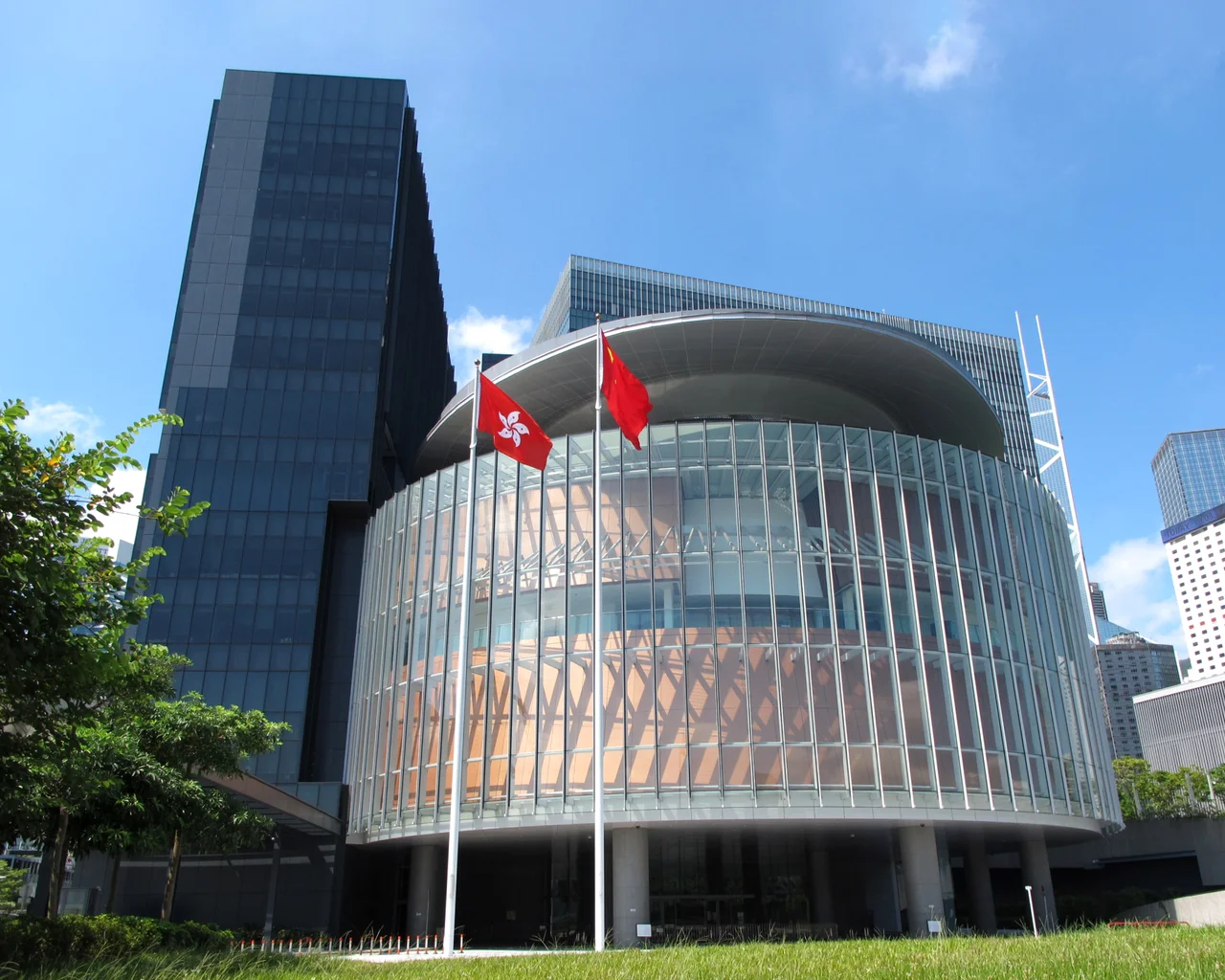

Legislative Council Complex
For most of its existence, the Legislative Council of Hong Kong met wherever it could find space: a French Mission Building in the 1840s, a ballroom at Government House, borrowed rooms in Central Government offices, and finally the old Supreme Court Building from 1985. It took until 2011 — 168 years after the first meeting — for Hong Kong's legislature to have a building designed specifically for it. The Legislative Council Complex opened that year on the Tamar waterfront in Central, facing Victoria Harbour, a glass-and-steel structure built to signal a particular vision of Hong Kong's post-1997 identity. Eight years later, protesters broke through its glass doors.
A Home Built for a Purpose
The complex at 1 Legislative Council Road is part of the larger Central Government Complex, a project that consolidated Hong Kong's administrative headquarters on the Tamar site — prime waterfront land in Central that had previously served various government functions. Construction of the LegCo building began in 2008 after planning that stretched back to the early 2000s. The project faced public debate over its costs and environmental footprint before completion. When it opened in September 2011, it was the first building ever purpose-built for the Hong Kong legislature. Its design — composed of a Council Block and an Office Block, with LegCo Garden and LegCo Square adjoining — features a double-layered ventilated facade intended to reduce energy consumption by regulating temperature naturally.
The Chamber at the Centre
The heart of the complex is the Chamber, an 800-square-metre room where council meetings are held. Public and press galleries sit at the upper level, and every seat there is equipped with headphones for simultaneous interpretation between Cantonese and English. Five conference rooms accommodate committee work. The complex includes a library, an archive, a children's corner, a memory lane exhibition, a viewing gallery, and two education galleries — facilities designed to make the legislature legible and accessible to citizens. Artwork commissioned through the LegCo Art Acquisition Project, launched in 2009, hangs throughout the building: pieces by Cornelia Erdmann, Koo Mei, Simon Heijdens, and others, chosen without a specified theme to allow freedom of expression. Wireless microphones and audio sign systems serve members and visitors with hearing or visual impairments.
1 July 2019
On 1 July 2019, as hundreds of thousands of people marched through Hong Kong against a proposed extradition bill, a smaller group gathered around the Legislative Council Complex. After police withdrew from the perimeter, protesters used improvised battering rams to break through the building's glass exterior. They entered the Chamber. Graffiti appeared on the walls — messages directed at the Hong Kong and mainland Chinese governments, and at the police force. The protesters took care, according to accounts from the time, not to damage historical artefacts or the libraries. Police regained control of the site by midnight. The estimated cost of damage was HK$10 million. That evening — its specificity, its imagery, the care taken to avoid certain targets while defacing others — became one of the defining images of the 2019 protest movement.
Expansion and Its Costs
In 2021, following electoral reforms by Beijing that reduced the number of directly elected LegCo seats and added 40 seats chosen by a small-circle Election Committee, the council expanded from 70 to 90 members. The building needed to grow with it. An expansion plan approved by lawmakers in May 2021 originally estimated costs at HK$1.17 billion. By early 2024, cost overruns had raised the total to approximately HK$1.56 billion — an additional HK$391.2 million. Work on additional floors atop the High Block and Office Block was largely complete as of early 2024, with interior fitting ongoing. A second phase of conversion works was expected to run through early 2026. The expansion is a physical expression of political changes that remain, for many in Hong Kong, deeply contested.
From the Air
The Legislative Council Complex sits at approximately 22.2808°N, 114.1656°E on the Tamar waterfront in Central, Hong Kong. Flying at 2,000–3,000 feet, the complex is visible as part of the Central Government precinct along the harbour's south shore. Victoria Harbour extends northward, with Kowloon across the water. The HSBC Building and Bank of China Tower are visible to the west, with the Peak rising behind them. Hong Kong International Airport (VHHH) lies approximately 28km to the west-northwest. The adjacent Tamar Park provides a visible green buffer between the complex and the harbour edge.
Nearby Stories
- Lok Ma Chau Loop 2.3 km away
- Portas do Cerco 2.3 km away
- Kweilin Incident 17 km away
- Wanshan Archipelago Campaign 34 km away
- Nanxiong Formation 115 km away
- Battle of Nanpeng Island 148 km away
- Heyuan 169 km away
- Cape Maobitou 632 km away