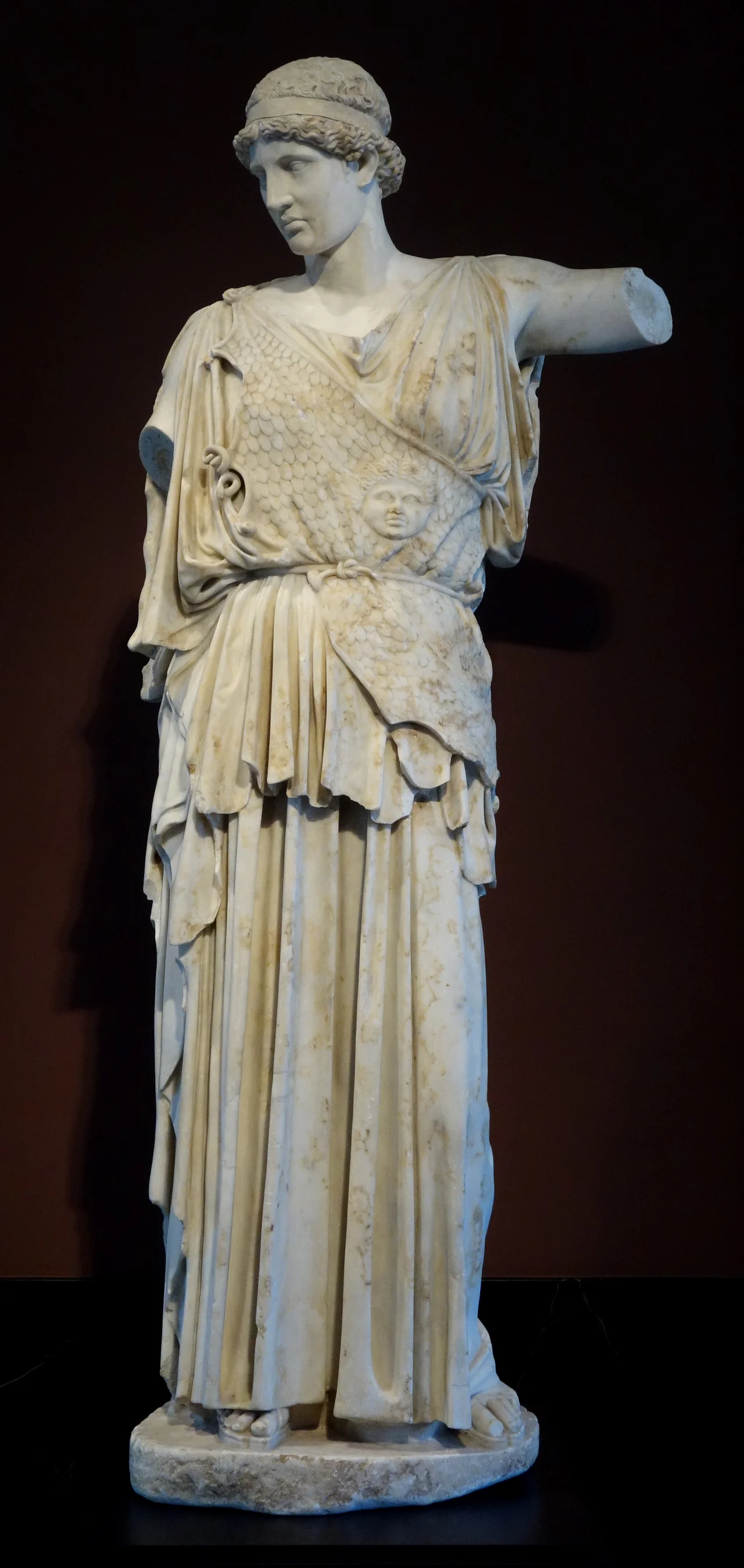
_01_crop.jpg)
Lemnian Athena
Ask a Roman tourist of the second century CE which of Pheidias's works he admired most, and the answer came back without hesitation: not the colossal gold-and-ivory Athena inside the Parthenon, not the towering Zeus at Olympia, but a quieter bronze that once stood in the open air on the Acropolis - the Athena Lemnia. Pausanias, who walked these stones around 150 CE, called it 'the most worth seeing' of everything Pheidias made. Then, somewhere in the long centuries that followed, the statue disappeared. No fragment of the original survives. What we have instead is a detective story stretching across two thousand years.
The Goddess of Lemnos
The statue took its name from the people who paid for it. Athenian settlers bound for the island of Lemnos dedicated this Athena on the Acropolis before they sailed, sometime in the fifth century BCE, and her epithet 'Lemnia' stuck for the rest of antiquity. Pheidias - the master who oversaw the Parthenon's sculptures and shaped the very idea of how the gods should look - cast her in bronze. The ancient praise was extravagant. Lucian, Aelius Aristides, and very likely Pliny the Elder all reached for her as a benchmark of perfection. What made her remarkable, the sources hint, was her restraint: an Athena who set aside the warrior's helmet and stood in serene human beauty, the goddess of wisdom rather than the goddess of battle.
A Masterpiece Reassembled
By the time scholars went looking for her, the bronze was long melted or lost. But Roman collectors had copied the great Greek originals in marble, and the copies scattered across Europe. In 1891 the archaeologist Adolf Furtwängler made the crucial move. He took a headless statue body in Dresden, reunited it with its proper head - removed during an earlier clumsy restoration - and realized that head matched a celebrated marble in Bologna, the so-called Palagi head. From these pieces, plus a tiny image on an engraved gem, he reconstructed a single lost type: a bareheaded Athena wearing the aegis diagonally across her breast, a helmet held out in one hand and a spear rising in the other. That type, he argued, was the Lemnian Athena.
The Argument That Won't Settle
Furtwängler's reconstruction was brilliant - and not everyone believes it. The marbles he assembled are genuinely fifth-century in style; a 1984 technical study of the Dresden statue confirmed that its head and body truly belong together, vindicating his eye. What stays uncertain is the name. The evidence that this particular type is Pheidias's Lemnia, rather than some other lost original, is thin. The classicist J. P. Barron proposed it might descend from a victory monument Pheidias made at Delphi after the Battle of Marathon. Others have floated Alkamenes, Pheidias's younger contemporary, as the real sculptor. The face in Bologna may be a masterpiece. Whether it is the masterpiece the Romans worshipped remains an open question.
Where the Bronze Once Stood
The Acropolis today is crowded with the ghosts of statues that no longer exist - empty plinths, weathered cuttings in the bedrock where bronze feet were once pinned. The Lemnian Athena was one of these vanished presences, standing somewhere on the sacred rock among dozens of dedications, admired for centuries before time and the metal-melters took her. Her surviving heads now sit in glass cases in Bologna and Dresden, in Oxford and the Vatican, scattered like the answer to a riddle no one can fully solve. To stand on the Acropolis is to stand in a gallery of beautiful absences - and hers may be the most beautiful of all.
From the Air
The Lemnian Athena once stood on the Acropolis of Athens, the limestone citadel at roughly 37.971°N, 23.727°E that dominates the center of the city. The Parthenon's colonnade is the unmistakable visual anchor from the air, with the Erechtheion and Propylaea clustered on the same rock. Athens International Airport (LGAV) lies about 30 km east-southeast. The site reads best from low altitude in the clear, dry light of an Attic afternoon, the marble glowing pale against the surrounding sprawl, with the Saronic Gulf and the port of Piraeus visible to the southwest.
Nearby Stories
- Great Sand Beach 5 km away
- Battle of Delium 7.7 km away
- Tower of Aliartos 9 km away
- HMHS Britannic 10 km away
- Saronic Gulf 15 km away
- Sousaki Volcano 17 km away
- Sanctuary of Apollo Maleatas 24 km away
- Skyros 66 km away