.jpg)
Lempertz
In December 1939, three months into the Second World War, the auction house Lempertz held sale number 404. The lots included paintings by Peter Paul Rubens, Camille Pissarro, Arnold Bocklin, Hans Thoma, and an attributed El Greco. The owner of the collection was Walter Westfeld, a Jewish art dealer who had already been arrested by the Nazis. The sale was a Zwangsversteigerung - a forced auction. Westfeld would die in Auschwitz in 1943. Eighty-five years later, his heirs were still suing the German state for the return of paintings the catalogue had so neatly described. Lempertz is Germany's oldest auction house, founded in 1798. It has sold for kings and the Schaumburg-Lippes and Mendelssohn-Bartholdys. It has also sold for the Reich.
From Printer to Auctioneer
Johann Matthias Heberle opened a printing company in Cologne in 1802 and gradually expanded into an antiquarian and auction business. The first Heberle auction took place in 1811. When Heberle died in 1840, his 24-year-old clerk Heinrich Lempertz took over, and the firm became J. M. Heberle (H. Lempertz). Heinrich's brother Mathias Lempertz opened a Bonn branch in late 1844 - with the first auction on 18 November 1844, of the posthumous library of August Wilhelm Schlegel, the Romantic writer and Shakespeare translator - and 1845 is the founding date the modern firm cites. In 1875 a young employee named Peter Hanstein bought the company for 20,000 gold marks. The Hansteins have run it ever since. Henrik Hanstein, born in 1950, took over after his father Rolf died in a car accident in 1970, and remains at the helm of a house with offices in Berlin, Frankfurt, Munich, Zurich, Brussels, Paris, Tokyo, and Shanghai.
Heinrich Boll Behind the Counter
From 1937 to spring 1938, a young man named Heinrich Boll apprenticed as a bookseller in the Lempertz bookstore in Bonn. He hated the work and left after a year. Decades later he would win the 1972 Nobel Prize in Literature for novels that excavated, more relentlessly than almost any other postwar German writer, the everyday complicities of his country under the Nazis. He had been an apprentice in a Cologne firm during the exact years when its parent house was beginning to auction off Jewish collections seized or sold under duress. There is no evidence Boll knew the Cologne auction calendar. But the geographic and temporal proximity is striking. A future moral conscience of the country was sleeving books in the Bonn shop while the Cologne branch was preparing for sale 392.
Auction 392 and Its Long Shadow
Sale 392 took place in 1937. It dispersed 228 artworks belonging to Max Stern, a Jewish art dealer whose Dusseldorf gallery had been ordered closed by the Nazi Reich Chamber of Fine Arts. Stern survived, emigrated to Canada, and died in 1987 leaving an estate that has spent decades tracking down the paintings sold without his consent. The catch for Lempertz is that the 1937 transaction did not stay buried. In 1977 and again in 1996, Lempertz sold paintings it had previously sold in 1937 - without mentioning the forced sale provenance. In 2007 a Dutch painting from the Stern collection passed through Lempertz again, was bought by a London dealer, re-sold in New York, and there spotted by the Holocaust Claims Processing Office. It was returned to the Stern heirs in 2009. New York dealer Richard Feigen, in 2009, restituted to the same heirs an Italian baroque St. Jerome attributed to Ludovico Carracci that he had bought from Lempertz in 2000. "I was surprised that Lempertz had been the auctioneer in the forced sale in 1937 and then resold it to me in 2000," Feigen said.
Speer, Goring, Beltracchi
Other names crowd the Lempertz ledger in ways that make the house's defenders uncomfortable. In May 1981 the firm auctioned twenty to thirty works from Albert Speer's possession for around a million Deutsche Mark, listing them as "From private property" - the anonymous formula that elsewhere conceals what should be disclosed. In 2014 a 1500-period German relief Trauergruppe aus einem Kalvarienberg, formerly from the Hermann Goring collection, sold for 244,000 euros. And in October 2010, Lempertz hammered down a Heinrich Campendonk forgery called Rotes Bild mit Pferden for a record 2.4 million euros. The painting was a fake by Wolfgang Beltracchi, the German forger whose nonexistent Jager collection deceived auction houses across Europe. The Cologne Regional Court ruled in September 2012 that Lempertz had to pay more than two million euros in damages.
Six Hundred and Eighty Open Files
Lempertz was named on the 1946 OSS Art Looting Investigation Unit's Red Flag List of Names. The German Lost Art Foundation today registers more than 680 artworks whose paper trails pass through Lempertz. Some have been returned. Some, like a 1923 Kandinsky called Zwei Schwarze Flecken claimed in 2011 by the heirs of Jewish collector Sophie Lissitzky-Kueppers, were auctioned anyway despite restitution claims. The house turns over fifty million euros a year, holds around fourteen auctions annually, sells Brueghels and Schwitters and Picassos and Gerrit Dous. The building on Neumarkt - the Haus Fastenrath, acquired in 1918 - has been a listed monument since 1993. The cataloguing continues. The sales continue. The 680 open files continue. Lempertz is at once Germany's oldest auction house and one of its longest-running questions about what continuity costs.
From the Air
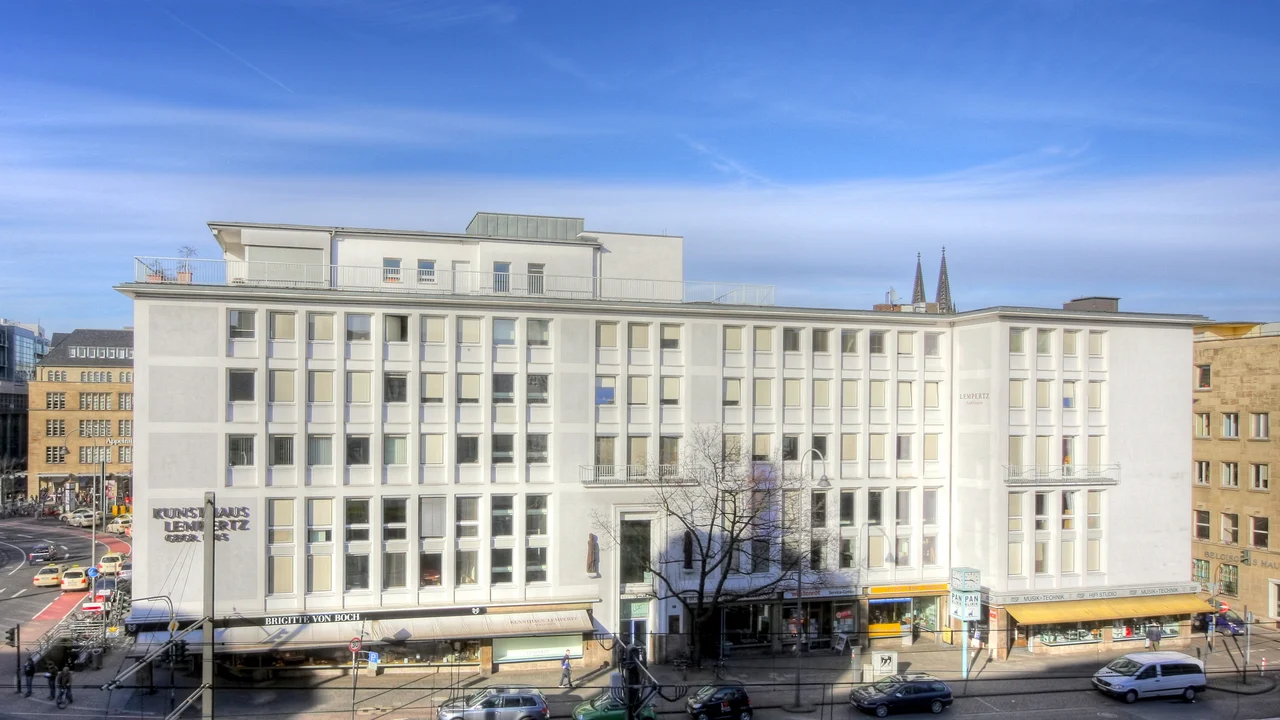
50.94N 6.95E. Lempertz is at Neumarkt 3 in central Cologne, on the corner of Cacilienstrasse. Nearest airport: Cologne/Bonn (EDDK), 15 km southeast. From the air the Neumarkt is a clearly defined open square in the Innenstadt grid, southwest of the cathedral. The Lempertz building - the classicist Haus Fastenrath - faces the square's north side.
Nearby Stories
- Diamond Interchange: How a Simple Idea Reshapes Towns Like Julich 2.8 km away
- Dusseldorf-Unterbach 6.1 km away
- Baumwollspinnerei Ermen & Engels 11 km away
- RAF Bruggen 15 km away
- Hagen Open-air Museum 21 km away
- Belgium 130 km away
- Marcinelle Mining Disaster 173 km away
- Zwingenberg Castle 178 km away