.JPG)
Lennon Wall (Hong Kong)
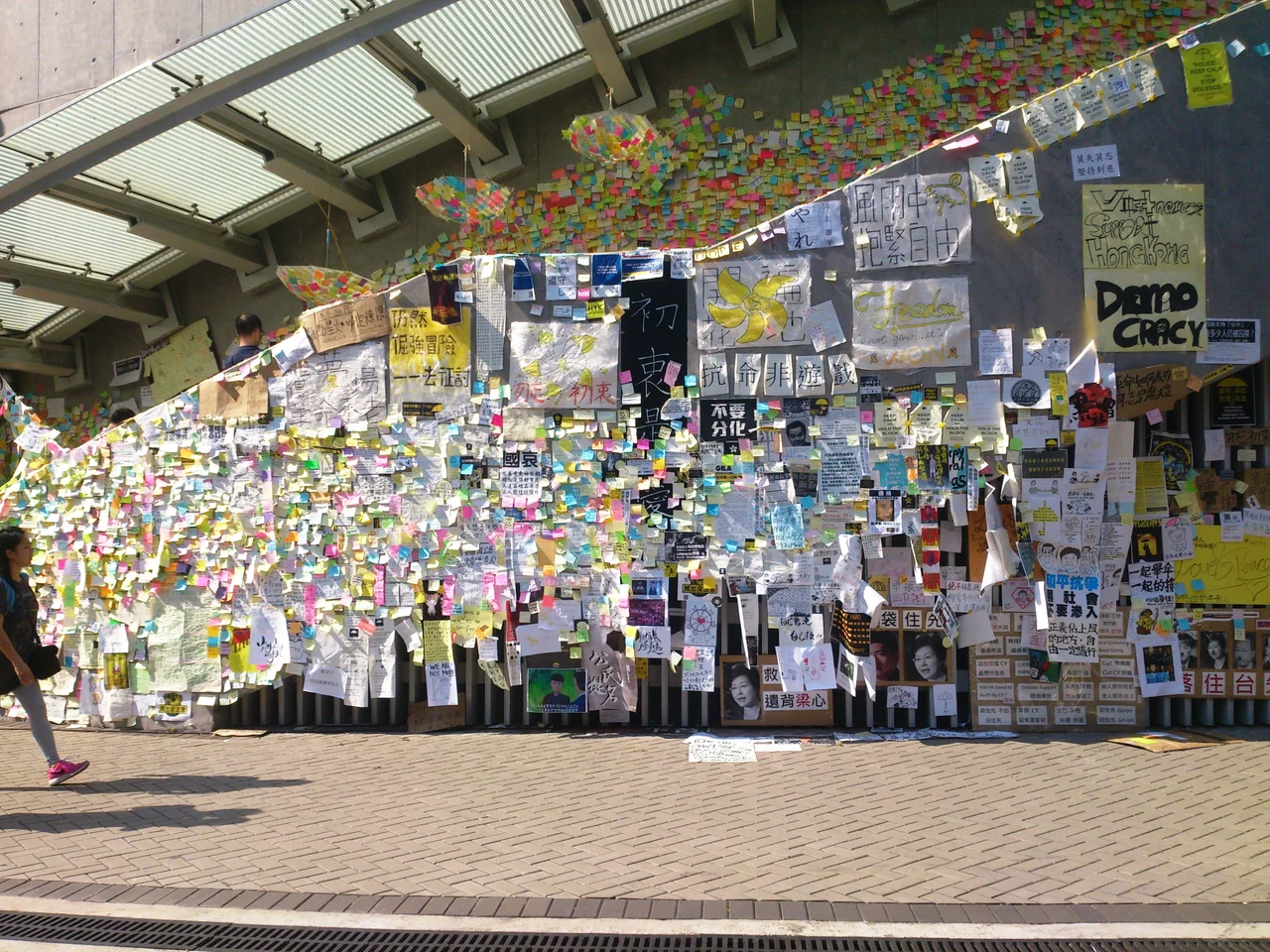
The first post read: "Why Are We Here?" Two social workers, Lee Shuk-ching and Chow Chi, stuck it to the wall beside the staircase leading to Hong Kong's Central Government Offices on 1 October 2014 — three days after police had tried to disperse protesters with tear gas. They left pens and Post-it notes and walked away. What grew in the weeks that followed was not something they had designed. It arrived note by note, in ten thousand small acts of handwriting.
A Wall Made of Wishes
The concept had a precedent. The original Lennon Wall in Prague was created after the murder of John Lennon in 1980, gradually filling with Beatles lyrics and expressions of resistance to the communist regime of Gustáv Husák. By 1988, a year before the Velvet Revolution, that wall had become a symbol of dissent through art. The Hong Kong version took the same idea and adapted it to a different crisis: the demand for universal suffrage in the territory's elections. Over ten thousand Post-it notes accumulated on the staircase wall — epigrams, poems, lyrics, foreign words, and hand-drawn graphics. The scale of it surprised everyone, including the people who started it. When the banner reading 'Lennon Wall Hong Kong' went up on the outside wall, the connection was named and the landmark was made.
The Chalk Girl and What She Showed
Police arrested a fourteen-year-old girl for drawing flowers on the wall with chalk. They threatened her father with the removal of custody and did not release her back to her family until twenty days later. The pictures of her drawing flowers circulated widely on social media, and she became known as "Chalk Girl" — 粉筆少女. Her lawyer, Patricia Ho, stated that the government response was "disproportionate" and that "police are using whatever mechanism they can think of to stop teenagers from participating in any protest." The case concentrated something that the wall itself had expressed diffusely: the gap between what authorities said was permissible and what people felt they had the right to do. A child drew flowers. The state responded as if it mattered enormously. Perhaps it did.
Clearance and Return
When police cleared the occupied areas in December 2014, most of the artworks were removed before the operations began. Citizens tried to rebuild immediately: on 20 December, they stuck posters reading "It is just the beginning," "We will be back," and "Umbrella Movement" on the staircase wall outside the Central Government Offices. Staff from the Leisure and Cultural Services Department tried to stop them. The police noticed but did not intervene. Sensing the loss that was coming, one organizer had already created an online version of the wall, digitizing approximately ten thousand Post-it notes into an archive. The physical wall could be cleared. The record of it was harder to erase.
Blossoming Everywhere: 2019
The phrase the 2019 protesters used was 遍地開花 — "blossoming everywhere." Beginning in June, as protests against a proposed extradition bill spread across Hong Kong, Lennon Walls appeared throughout the territory: Sheung Shui, Sha Tin, Fanling, Causeway Bay, Kwun Tong, and more than 100 other locations according to a crowd-sourced map. Some appeared inside government buildings, including RTHK. They spread internationally too — Toronto, Vancouver, Tokyo, Berlin, London, Melbourne, Sydney, and Taipei all saw installations in solidarity. When Marco Leung Ling-kit, a democracy activist, died in June 2019, artists in Prague painted a memorial on the original Lennon Wall: his yellow raincoat, and the words "Hong Kong, Add oil."
What a Wall Means
Walls are usually built to stop things. This one was built to say them. The Hong Kong Lennon Wall worked because it asked for almost nothing from the people who contributed — just the willingness to write something down and leave it in a public place. That smallness was its power. Each note was easy to dismiss individually; tens of thousands of them in one place were not. The walls were vandalised, torn down, defended, and rebuilt. At the Yau Tong MTR station, on 10 July 2019, hundreds of people gathered after word spread that local residents — some suspected of being off-duty police officers — were threatening pro-democracy youth maintaining the wall. The conflict lasted several hours. Two retired police officers were among those arrested for assaulting democracy activists that night. A Post-it note had become something worth fighting over.
From the Air
The original Lennon Wall was located at the Central Government Complex on Harcourt Road in Admiralty, at approximately 22.2808°N, 114.1656°E — the administrative heart of Hong Kong, identifiable from altitude by the dense cluster of government and institutional buildings between Central and Wan Chai. Hong Kong International Airport (VHHH) is approximately 35 km to the west on Lantau Island. At 2,000–4,000 feet, the Admiralty area is recognizable as the transition point between the high-rise commercial core of Central and the residential towers of Wan Chai further east. Victoria Harbour lies immediately to the north.
Nearby Stories
- Lok Ma Chau Loop 2.3 km away
- Portas do Cerco 2.3 km away
- Kweilin Incident 17 km away
- Wanshan Archipelago Campaign 34 km away
- Nanxiong Formation 115 km away
- Battle of Nanpeng Island 148 km away
- Heyuan 169 km away
- Cape Maobitou 632 km away