
Lesbos
Eleven million olive trees. That is the figure that catches you about Lesbos: silver-green groves blanketing two-fifths of an entire island, the source of its wealth, its cooking, its very smell. The third-largest of the Greek islands and the eighth-largest in the Mediterranean, Lesbos sits in the far northeastern corner of the Aegean, so close to the Turkish coast that at the narrowest point only five and a half kilometers of water separate them. It is a verdant, volcanic, mountainous place, sometimes called the Emerald Island, and it has been many things across three thousand years: the home of poets, the seat of philosophers, a Genoese lordship, an Ottoman port, and, most recently, the first European ground beneath the feet of people fleeing war.
The Island of the Poets
Lesbos earned a nickname that still clings to it: the Island of the Poets. Two of the nine lyric poets of the ancient Greek canon were born here, and one of them changed literature forever. Sappho, writing in the local Aeolic dialect in the 7th and 6th centuries BC, composed verse of such intimate force that the ancients ranked her among the greatest of all poets. Her birthplace, Eresos, still draws visitors who trace their literature back to her. Alongside her stood Alcaeus, poet and political brawler. But the island's creative roll runs longer than that. Terpander is credited with the seven-note scale of the lyre; Arion shaped the dithyramb that fed the birth of tragedy; and the philosopher Theophrastus, the father of botany, was a native son. Aristotle himself lived here for a time, beginning his pioneering zoological studies by the Gulf of Kalloni. In 1979, the modern poet Odysseas Elytis, descended from an old Lesbos family, won the Nobel Prize in Literature, extending the line into our own age.
Castles, Lords, and Empires
Stand anywhere on the coast and history presses close. Three great medieval castles guard the island, and the most consequential of them belonged to the Gattilusi. In 1355 the Genoese adventurer Francesco I Gattilusio was granted Lesbos by the Byzantine emperor John V Palaiologos, his reward for helping the emperor retake Constantinople and sealed by marriage to the emperor's sister. For just over a century his family ruled the island as Genoese lords, rebuilding the great fortress above Mytilene and the castle at Molyvos in the north. The Ottomans took the island in 1462, and under their long rule Mytilene grew into what was reckoned the busiest port in the Aegean, exporting olives and oil, wine and figs, soap and leather. Greek troops landed at Mytilene in 1912 and Lesbos joined the Greek kingdom. German forces occupied it during the Second World War until liberation came on 10 September 1944.
Stone Trees and Hot Springs
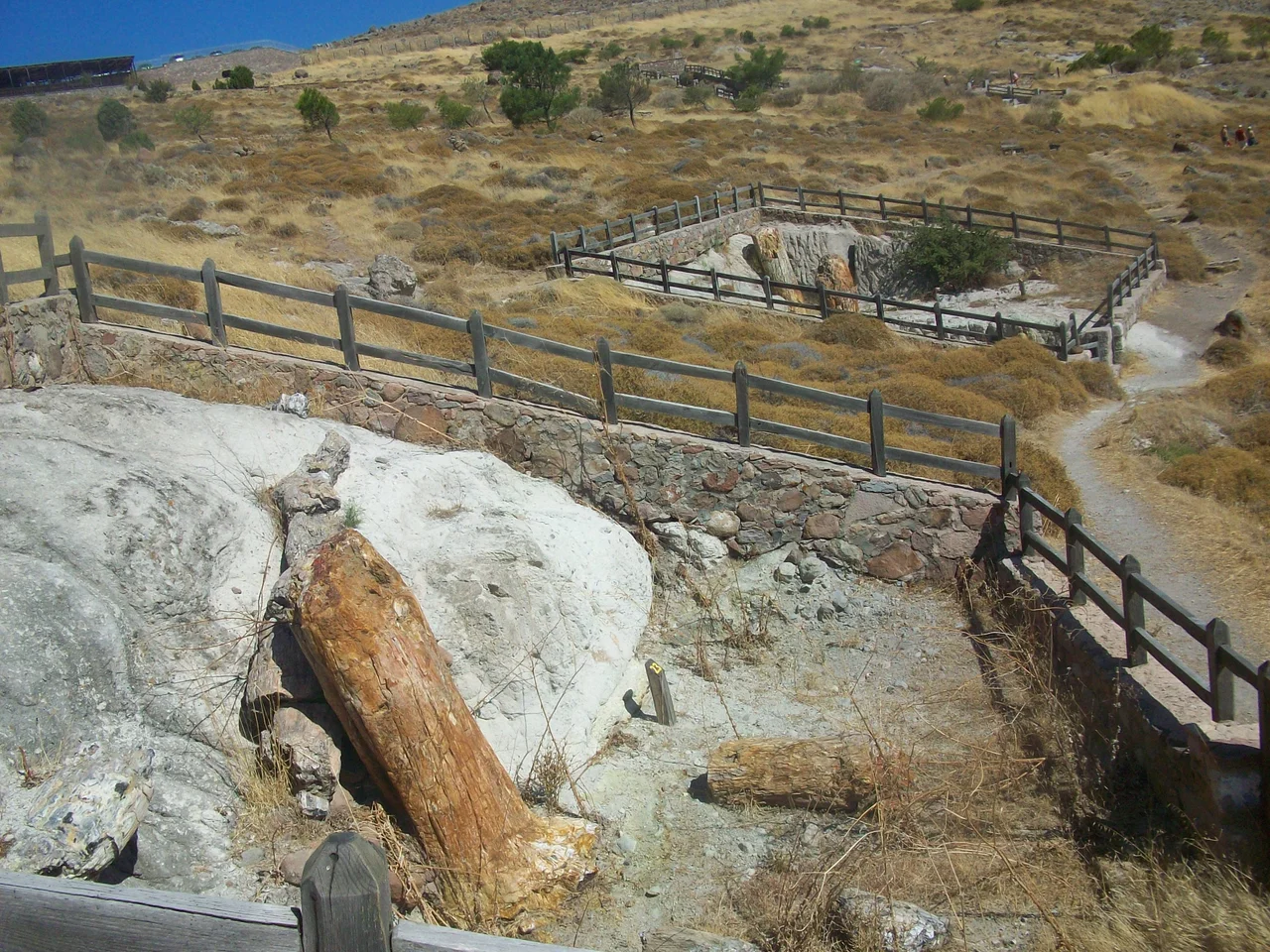
The whole of Lesbos is a UNESCO Global Geopark, and the reason lies in its deep past. Around 15 to 20 million years ago, in the Miocene, violent volcanic eruptions buried a subtropical forest under ash and pyroclastic flows. Mudflows preserved entire trees where they stood. The result is the Petrified Forest of Lesbos near Sigri, one of the few such forests on Earth, where fossilized trunks, some up to twenty meters long with roots reaching seven meters down, lie turned to colored stone. It is a Protected Natural Monument and the heart of the geopark. The island's volcanic origins surface elsewhere too, in hot springs and in the two great gulfs, Kalloni and Gera, that intrude deep into its triangular shape. Two peaks dominate the interior, Mount Lepetymnos at 968 meters and Mount Olympus at 967, the latter not to be confused with its famous mainland namesake. Among birdwatchers, Lesbos is one of the finest islands in the world.
Olive Oil and Ouzo
The economy here grows from the ground and the sea. Olive oil is the main source of income, pressed from those eleven million trees, and old stone olive mills survive as museums to the trade. The other great product is ouzo, the anise spirit that is Greece's national liqueur and a particular pride of the southern town of Plomari, where distilling families have made it for generations and now run museums to its history. Add to that fishing, soap-making, and the famous Kalloni sardines, and you have the working island. Tourism layers on top, drawn by the coastal towns of Petra, Molyvos, Plomari, and Eresos, supported by the international airport at Mytilene. The local table is distinctive: meats stewed with quince or chickpeas or celery, the protected cheese Ladotyri Mytilinis cured in olive oil, and almond sweets to finish, all of it best washed down, of course, with ouzo.
The Frontline of a Crisis
Because only a few kilometers of sea separate Lesbos from Turkey, the island became one of the first places in Europe that people fleeing the Syrian Civil War and other conflicts could reach. From 2015, refugees arrived by boat almost daily, families crossing the strait in overloaded vessels in search of safety. When a 2016 agreement between the European Union and Turkey closed the route onward, thousands were left stranded. The Moria camp, built for a fraction of the number, swelled past 17,000 people by May 2020, the conditions deteriorating as months stretched into years. In September 2020 fire destroyed Moria, and a new facility rose at Kara Tepe. These were not statistics. They were doctors and teachers and children, people who had crossed a continent and a sea carrying what they could, and who found on this island a hard, uncertain refuge. Lesbos, the Island of the Poets, became for a time a place where the world's displaced waited to learn what would become of them.
From the Air
Lesbos is centered near 39.21 degrees N, 26.28 degrees E in the northeastern Aegean, a roughly triangular island of 1,633 square kilometers deeply cut by the gulfs of Kalloni (south) and Gera (southeast). From the air the two near-enclosed gulfs make it unmistakable, with the Turkish coast just 5.5 km away at the Mytilini Strait. Mytilene International Airport (ICAO: LGMT) lies on the southeastern coast beside the capital. Mounts Lepetymnos (968 m) and Olympus (967 m) anchor the north and center. A viewing altitude of 6,000 to 9,000 feet captures the whole island; the central Aegean's famous sunshine usually offers excellent visibility, with the Petrified Forest's pale volcanic terrain visible in the west near Sigri.
Nearby Stories
- Antandrus 6.8 km away
- Agios Isidoros, Lesbos 19 km away
- Adramyttium 30 km away
- Troy 45 km away
- Destruction of Psara 51 km away
- St. Helena Church 72 km away
- Psara 82 km away
- Battle of Athos 85 km away