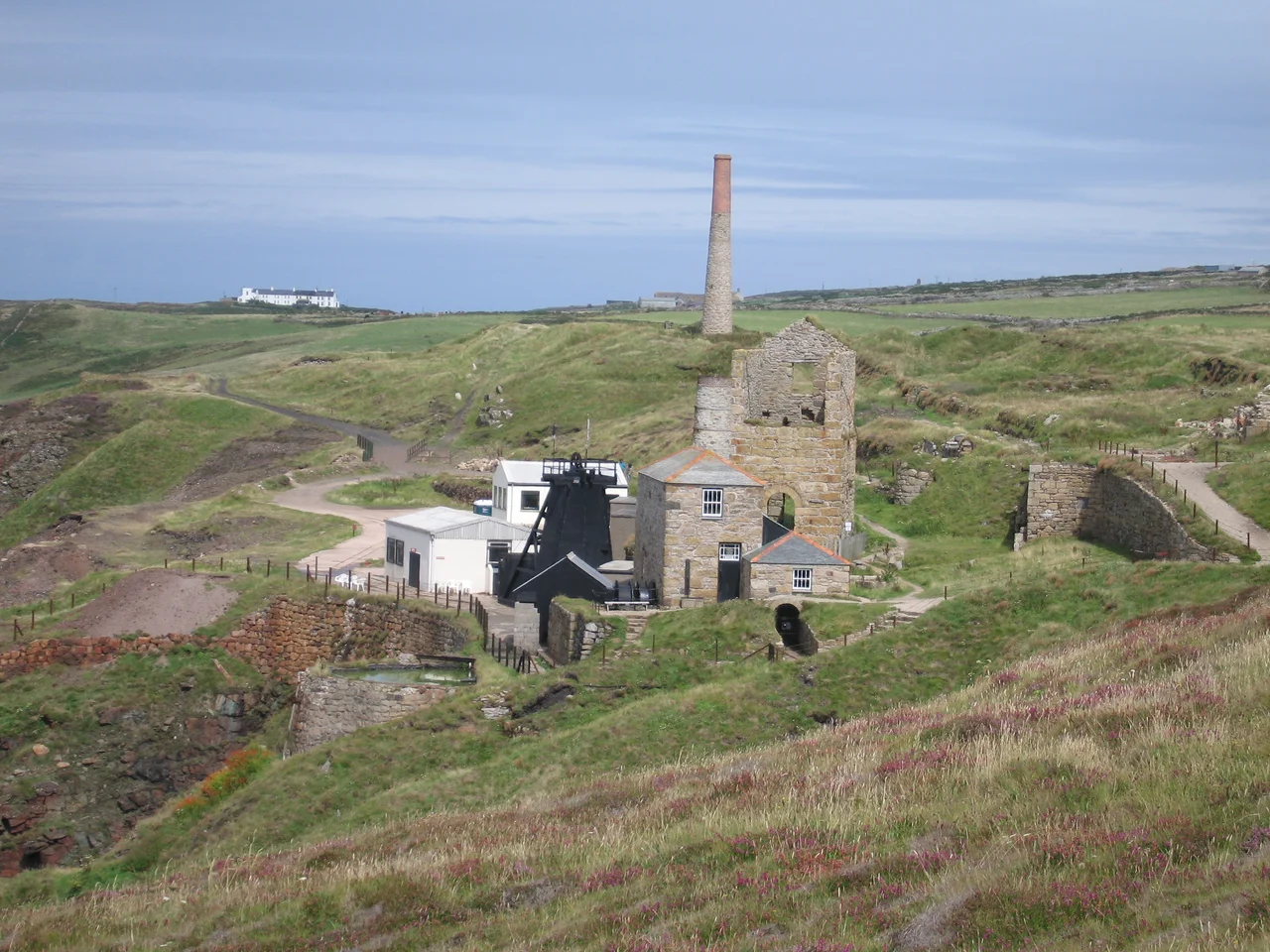

Levant Mine and Beam Engine
It was just before half past two on a Monday afternoon, 20 October 1919. The day shift was riding home. At Levant Mine, that meant clinging to the timbers of the man engine - a rocking shaft of wood that lifted and lowered men through six hundred metres of darkness, twelve feet at a stroke. Roughly a hundred and fifty men were on the rod that afternoon, spread up its full length. The bolt securing the cap to the engine arm sheared without warning. The whole timber column lurched and then plunged into the shaft. Thirty-one men died. Their names are read aloud in Trewellard every October. Their mine has become a museum. Their engine, the world's last Cornish beam engine still in steam on its original site, still works.
The Mine Under the Sea
Levant opened in 1820 with twenty shares of twenty pounds each. By the time the first big profits were tallied, the mine had returned £171,000 against £1.3 million worth of ore raised from the rock. What made the place extraordinary was the direction it ran. From the cliffs at Trewellard, the workings extended up to 2.5 kilometres beneath the Atlantic itself, following lodes of tin and copper out under the waves. The miners called it the mine under the sea. They worked in heat of around 92 degrees Fahrenheit, mostly naked, drinking spring water from huge canteens. The levels were seven feet high and seven feet wide; the lode itself rarely more than three feet thick. Hand-drilled holes were charged with gunpowder; premature ignition routinely killed and maimed. Few men were able to work underground after the age of thirty-five.
Six Engines on the Cliff
By 1883 The Cornishman could list six engines at work above the shafts: a 45-inch pumping engine to keep the sea out, a 30-inch stamps to break the ore, a 26-inch whim to wind it up, an 18-inch crusher, a small 14-inch winding engine, and a 24-inch man engine to carry the workforce up and down. The surviving beam engine was built by Harvey's of Hayle, the great Cornish foundry whose castings powered mines from California to Mexico. Around 366 men, boys, and girls worked the place that year, down from 600 a few seasons before. Three shifts of eight hours each rotated through the levels every day except Sunday. It is a vision of industrial labour that reads now like something out of Dante - but to the men of St Just and Pendeen and Trewellard it was simply Monday.
Thirty-one Names
The man engine was a Cornish invention, an attempt to spare miners the brutal climb up wooden ladders at the end of a shift. A great vertical rod, fitted with platforms, oscillated in the shaft; a man stepped on, rose twelve feet, stepped off onto a fixed platform, waited for the next stroke, and stepped back on. It worked beautifully for most of a century. On 20 October 1919, the engineering finally betrayed the men who trusted it. When the cap bolt sheared, those riding the rod fell with it. Among the dead were boys and grandfathers, named in newspapers afterwards as ordinary men of the parish: hewers, timberers, fathers. Households in Trewellard lost more than one. The mine continued working for another eleven years - it had little choice; this was its community's only livelihood - but the man engine was never replaced. Cornish mining never really recovered its old confidence, either. The tin crisis of 1930 finally closed Levant for good.
The Engine That Survived
After the mine shut, salvage crews stripped most of the surface works. The Harvey's beam engine of 1840 might have gone for scrap had a small band of enthusiasts not started saving it in 1984 - the Greasy Gang, as they cheerfully called themselves, who spent years cleaning out decades of cliff weather. They got the engine working again in 1993. It is the only Cornish steam winding engine still working in its original location, and the last in Cornwall in steam at all. On open days you can stand in the engine house and watch the great timber beam tip slowly through its arc, hear the hiss of the cylinder, smell the warm oil. It is a sound the dead men of 1919 would recognise instantly.
What Remains
Today Levant is a National Trust property. A visitor centre tells the story honestly. There is a short underground tour, and the South West Coast Path links Levant to Botallack Mine along the cliff. Since 2006 it has been part of the Cornwall and West Devon Mining Landscape UNESCO World Heritage Site. The disaster is commemorated each year on its anniversary, when the names of the thirty-one are read in St Just parish. The mine that killed them keeps its memory in steam. There is something fitting in that. The beam engine was built to lift men out of the dark; now it lifts a story out of the past, one stroke at a time, on a Cornish cliff edge where the Atlantic is always within earshot.
From the Air
Located at 50.1521°N, 5.6855°W, on the cliffs at Trewellard between Pendeen and St Just. The engine house, chimney stack, and adjacent ruins are unmistakable from the air - a low cluster of grey stone right at the cliff edge above the Atlantic. Geevor Tin Mine lies 0.5 nm to the northeast, Botallack Mine 1 nm to the southwest. Land's End Airport (EGHC) is 3 nm south-southeast. Recommended viewing altitude 1,500-2,500 ft. Best light in early morning or late afternoon when the chimney casts a long shadow across the workings.
Nearby Stories
- Bartholomew Ledges Wreck 1.8 km away
- Carn Brea Castle 4.6 km away
- Battle off Lizard Point 12 km away
- Carnewas and Bedruthan Steps 18 km away
- King Charles's Castle 25 km away
- MV Cita 34 km away
- 1979 Fastnet Race 47 km away
- Trevose Head Lighthouse 55 km away