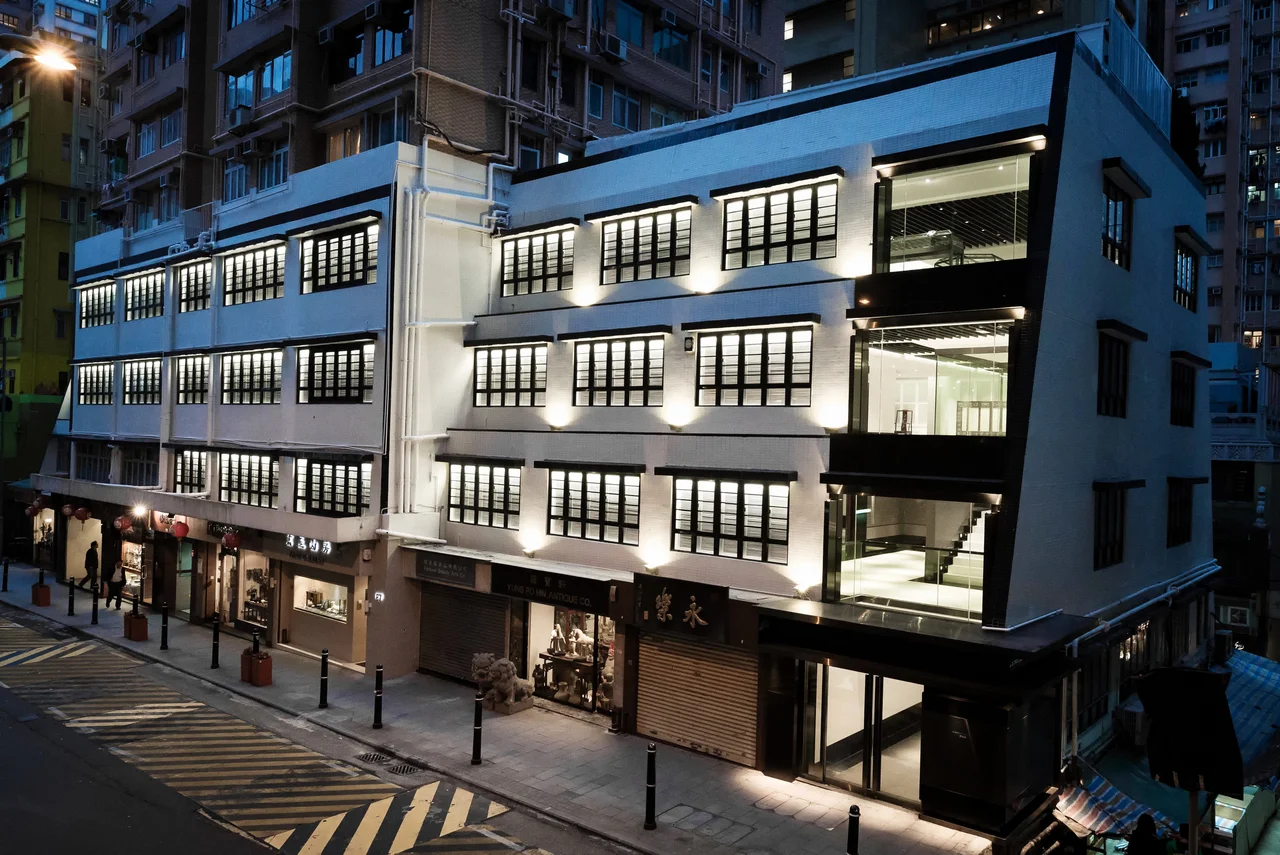

Liang Yi Museum
Two collections sit inside the Liang Yi Museum in Sheung Wan that have no obvious reason to be together. One traces the highest traditions of Chinese furniture-making across the Ming and Qing dynasties, built from materials so rare and dense that a single chair can weigh as much as a small person. The other is European: a gathering of over 800 jewelled clutches, compacts, and powder boxes made by houses like Cartier, Boucheron, and Van Cleef & Arpels between the late 1880s and the 1960s. The collection was started in the 1980s. That it took three decades to assemble, and that it ended up in Hong Kong, says something about what this city became: a place where objects from opposite ends of the world found a common address.
Huanghuali and Zitan: Wood as Treasure
The Chinese furniture collection at Liang Yi is built around two materials that Chinese craftsmen of the Ming and Qing dynasties valued above nearly everything else. Huanghuali — a fragrant rosewood — was prized for its warm honey-gold color and the organic, flowing grain patterns that ran through each piece. Zitan, a dense tropical hardwood, was darker and more austere, almost purple-black in fine examples, heavy enough to sink in water. Both were used for scholar's furniture and court pieces, shaped without nails using joinery of extraordinary precision. The collection has grown to over 400 pieces. Selected works have been exhibited at the National Museum of History in Taiwan and at the Palace Museum in Beijing — institutions that hold the imperial furniture against which all other Chinese antique pieces are measured. Being exhibited alongside that standard is its own form of validation.
The Evening Bag as Art Object
The second collection occupies a different register entirely. Between the late 1880s and the 1960s, European jewelry houses made small evening accessories — nécessaires and minaudières — that functioned as cosmetic cases, card holders, and cigarette boxes, but were designed as objects of display. Cartier, Boucheron, and Van Cleef & Arpels produced pieces set with diamonds, rubies, sapphires, and enamel, small enough to hold in one hand but dense with craftsmanship. The Liang Yi collection holds over 800 examples spanning roughly eighty years of production, covering the transition from Art Nouveau organic forms through Art Deco geometry to the postwar modernism of the late 1950s. These objects were made to be carried into rooms full of people who would recognize what they were looking at. The museum has lent pieces to the Palace Museum in Beijing and to Goldsmiths' Hall in London — two institutions that rarely find themselves in the same exhibition circuit.
Sheung Wan as Setting
Sheung Wan sits just west of Central on Hong Kong Island, a neighborhood that trades in the old and the specialist: dried seafood shops, antique dealers, temple goods suppliers, and the cat-and-dog streets of the Western District. It is a different texture from the financial district a few blocks east, and the Liang Yi Museum fits its neighborhood more than it might first appear. This is a part of Hong Kong where the material culture of South China has always had a commercial presence — where the things people make and trade and keep have been moved around and valued for a long time. A museum devoted to objects of the highest quality, assembled over decades by a collector with specific expertise, belongs here in a way that makes sense only once you have walked the surrounding streets.
Private Vision, Public Value
The Liang Yi Museum opened its permanent galleries in 2014 and remains privately held. It is not the largest museum in Hong Kong, and it does not attempt to cover the breadth of any single field. What it does is show depth: the Chinese furniture collection and the European vanities collection are each serious enough to have been exhibited by major public institutions on multiple continents. The juxtaposition of the two is itself a form of argument — that craftsmanship, wherever it appears and whatever materials it uses, belongs to a common tradition of making things as well as they can possibly be made. That argument is made in rooms rather than in text, which is the correct way to make it.
From the Air
The Liang Yi Museum is located in Sheung Wan, Hong Kong Island, at approximately 22.2847°N, 114.1497°E, just west of the Central business district. From altitude, Sheung Wan is identifiable as the area where the dense tower grid of Central gives way to the older, lower-rise urban fabric of the Western District. Hong Kong International Airport (VHHH) lies approximately 37 km to the west on Lantau Island. Victoria Harbour runs immediately to the north; the hills of the Mid-Levels rise steeply to the south. At 2,000–3,000 feet, the contrast between Sheung Wan's older street grid and Central's tower clusters to the east is visible.
Nearby Stories
- Lok Ma Chau Loop 2.3 km away
- Portas do Cerco 2.3 km away
- Kweilin Incident 17 km away
- Wanshan Archipelago Campaign 34 km away
- Nanxiong Formation 115 km away
- Battle of Nanpeng Island 148 km away
- Heyuan 169 km away
- Cape Maobitou 632 km away