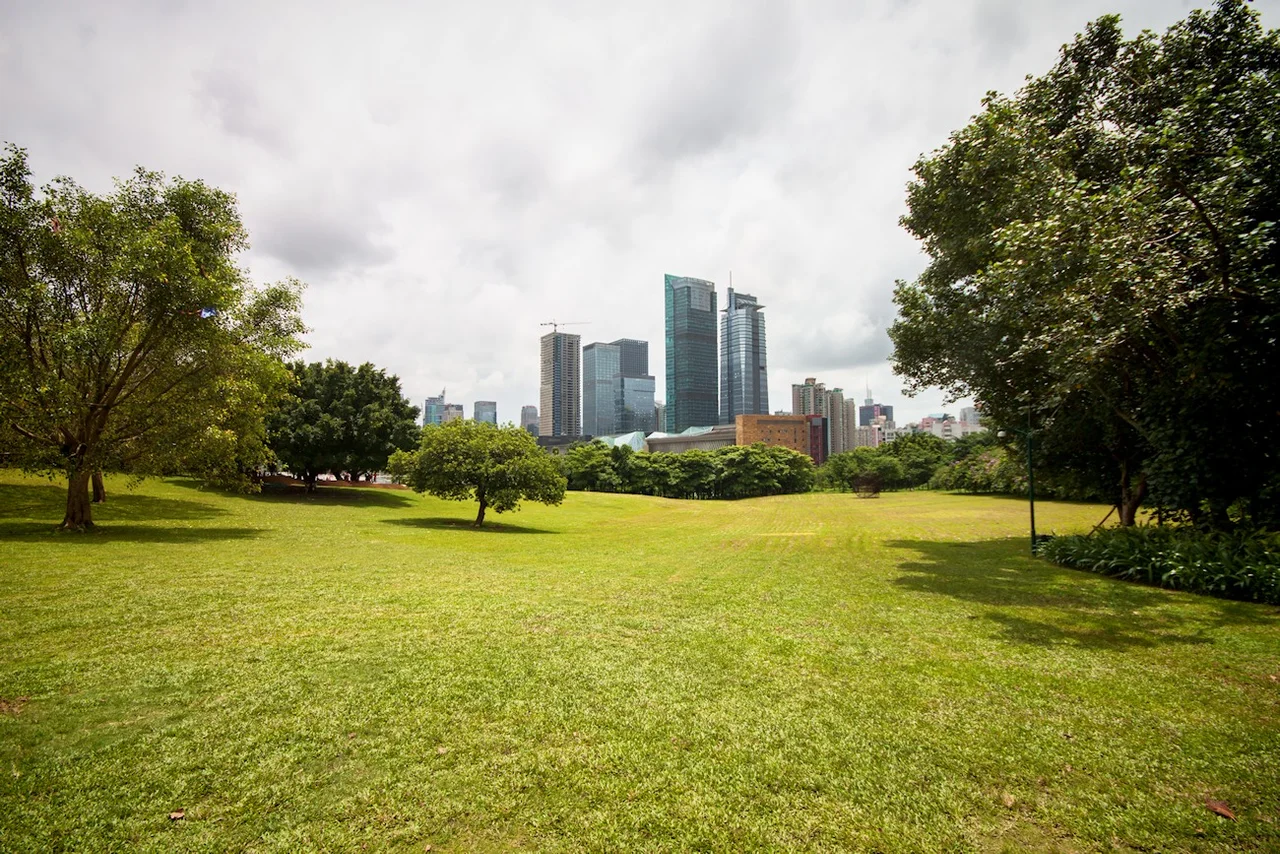

Lianhuashan Park
The statue almost never happened. A 1995 decision to honor Deng Xiaoping with a monument in Shenzhen's new Lianhuashan Park immediately ran into controversy — enough that the finished bronze sat in a warehouse for years while officials debated its fate. When it was finally unveiled in November 2000, with Communist Party General Secretary Jiang Zemin in attendance, the six-meter figure had been waiting long enough to accumulate its own small history. That backstory fits the place. Lianhuashan Park, inaugurated in 1997 in Shenzhen's Futian Central Business District, is a green hill dropped into one of China's most deliberately constructed cities — a breathing space above the skyline that Deng's policies built from rice paddies in a single generation.
A Hill Above the Blueprint City
Shenzhen did not exist as a city before 1980. What the government designated as China's first Special Economic Zone was, at the time, a collection of fishing villages and farmland just north of Hong Kong. The decision to transform it — attributed in large part to Deng Xiaoping's vision for economic reform and opening-up — produced one of the fastest urban expansions in modern history. By the time Lianhuashan Park opened in 1997, Shenzhen had a population of several million and a skyline dense enough to require a park as a counterweight. The 150-hectare site at the northern end of the Futian Central Business District was designed to do exactly that: provide open space in a city whose planners had been too busy building everything else. From the hilltop, the geometry of the Futian district unfolds below in a way that makes the urban design logic visible — a planned axial composition that the Deng statue now anchors from above, echoing the spatial grammar of imperial Chinese city planning.
The Statue and Its Complicated Journey
Sculptor Teng Wenjing created the statue following the Shenzhen Municipal Committee's 1995 decision to mark the 20th anniversary of the Shekou Special Economic Zone with a monument to Deng. The choice of subject was straightforward. The controversy was not. Objections — about timing, about form, about the politics of public commemoration for a living leader — kept the completed work in storage while its fate was argued. It was eventually unveiled on November 14, 2000, in the presence of Jiang Zemin, Deng's successor as CCP General Secretary. The statue shows Deng mid-stride, walking briskly — a visual translation of his own words that the pace of reform and opening-up should be bigger. The pedestal carries a calligraphy inscription by Jiang Zemin. The statue weighs six tons and stands six meters tall, positioned at the hill's crest so that it commands the long ceremonial axis of the Futian district. Xi Jinping visited in 2020 to lay flowers, reinforcing the site's function as a place of political pilgrimage within a city that itself serves as an argument for a particular theory of development.
Green Space in the Fastest-Built City on Earth
Whatever political weight the hilltop statue carries, the park beneath it functions primarily as a place where people go to breathe. Shenzhen's density makes Lianhuashan's 150 hectares feel improbable — a green interruption in a city where every other surface has been accounted for. Families fly kites on the slopes. Retirees do morning exercises along the paths. The metro stop at Children's Palace Station puts the park within easy reach of central Futian, and on weekends the hill fills with people doing what people in dense cities everywhere do when given access to open ground: they occupy it completely. The lotus-shaped hill the park takes its name from — Lianhuashan, or Lotus Mountain — gives the site a Chinese classical resonance that the surrounding glass towers do not undercut so much as reframe. The park opened the same year Hong Kong was handed back to China. The statue was unveiled three years later. Both the timing and the location were chosen deliberately, but the green hill has outlasted the ceremony to become something simpler: the place where Shenzhen goes to catch its breath.
From the Air
Lianhuashan Park sits at approximately 22.555°N, 114.05°E in the Futian district of Shenzhen, China. From the air, the park appears as a distinct green hill rising above the dense urban fabric of the Futian Central Business District, with the ordered geometry of the CBD's boulevards visible below. The Deng Xiaoping statue on the hilltop is not visible from cruising altitude but the park's irregular oval footprint — green against grey — is easy to identify. Nearest airport is Shenzhen Bao'an International (ZGSZ), approximately 25 km to the west-northwest. Hong Kong International (VHHH) lies roughly 55 km to the south. Best viewed at 3,000–5,000 feet on a clear day when the contrast between the park and surrounding development is sharpest. Winter and spring offer the clearest visibility over the Pearl River Delta plain.
Nearby Stories
- Hong Kong Disneyland 4.1 km away
- Mount Guanyin (Dongguan) 7 km away
- 2024 Lixinsha Bridge Collapse 7.4 km away
- Portas do Cerco 12 km away
- Lotus Hill 15 km away
- Nanxiong Formation 78 km away
- Heyuan 130 km away
- Checheng Fu'an Temple 629 km away