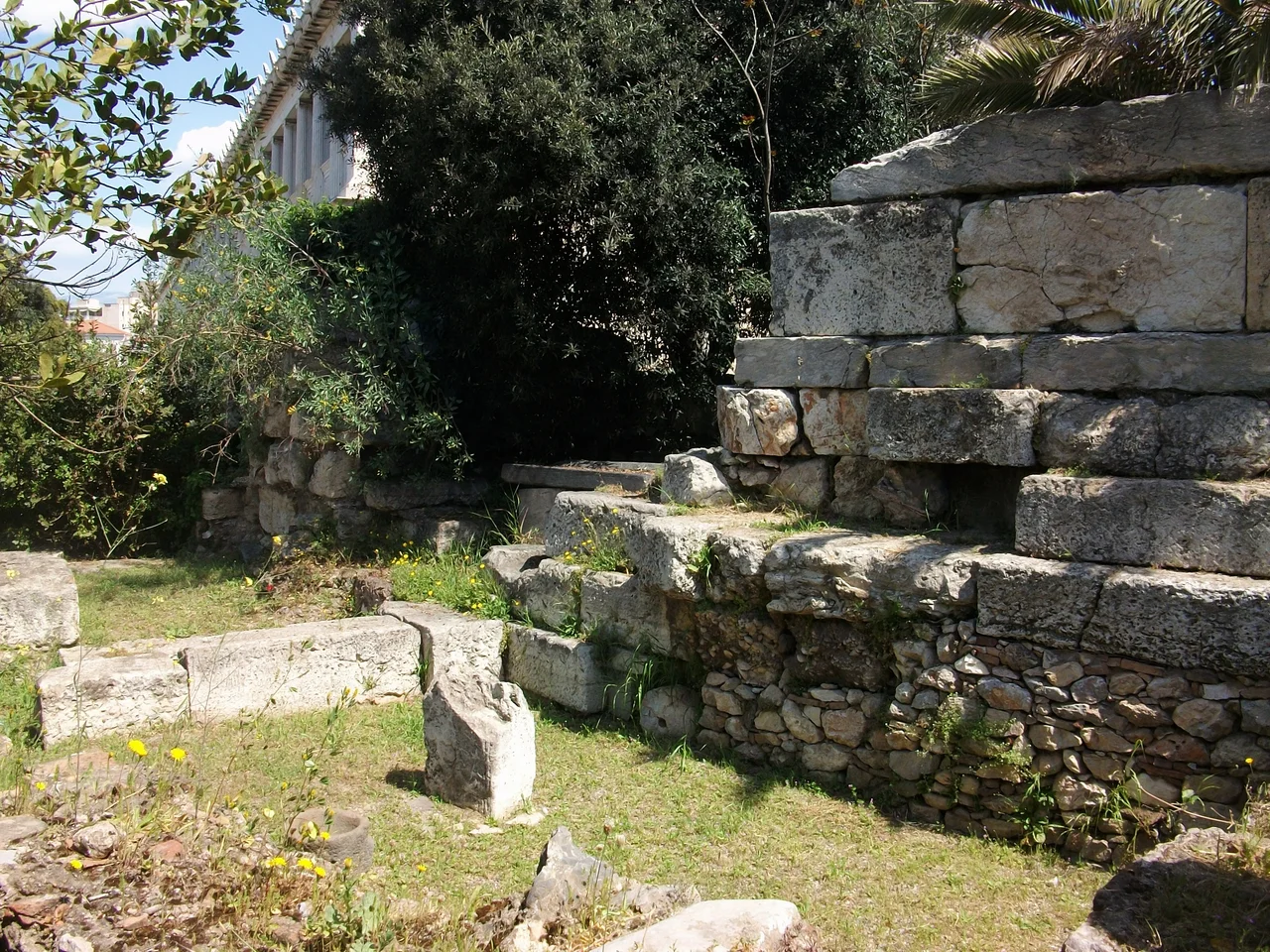

Library of Pantainos
No book shall be taken out, since we have sworn it. It will be open from the first hour until the sixth. Those words were carved into marble in Athens around 100 AD, and they are still legible today. They form the oldest set of library rules to survive from the ancient world - a borrower's notice, essentially, scolding readers across nineteen centuries. The library they governed has crumbled to a fragment in the southeast corner of the Agora, but the rules outlasted the building.
A Gift With a Name on It
The library was the gift of one man who wanted Athens to remember him. Titus Flavius Pantainos was a philosopher and the son of a philosopher, and around 100 AD he paid out of his own pocket for the whole complex: the outer galleries, the colonnaded courtyard, the library itself, and every book and ornament inside it. The dedication, carved on the lintel of the main entrance, names not only Pantainos but the emperor Trajan and the people of Athens, and it credits his two children, Flavius Menander and Flavia Secundilla, alongside him. This was a family act of civic generosity, and it was meant to be read. Centuries later, when builders raised a defensive wall through the ruined Agora, they reused that lintel as ordinary stone - and so the inscription survives, embedded in the late Roman wall to this day.
The Rules in Stone
The second inscription is the one that astonishes. On a white marble plaque, found in the Agora and now preserved in the Epigraphic Museum of Athens, three short lines lay out how the library worked. Books could not leave the building - the librarians had sworn an oath to that effect. The doors opened at the first hour and closed at the sixth. In the Roman system that divided daylight into twelve hours, that meant from sunrise to midday: a half-day of reading, no lending, no exceptions. Look closely and you notice the carver spelled book as byblion, with a u, rather than the familiar biblion. The word traces back to byblos, the Egyptian papyrus that reached Greece through the Phoenician port of Byblos in present-day Lebanon. The very word for book carried, in its spelling, the memory of where books came from.
Fire and Forgetting
Athens was a city of learning, and the Library of Pantainos belonged to a quarter where philosophy and the cult of the Muses were nurtured side by side. That world ended abruptly. In 267 AD a Germanic people called the Heruli swept down on Athens and burned much of the lower city, the library among the casualties. What rose afterward was not a library but a defense: in the fifth century the surviving stones were folded into a great peristyle and a heavy tower, the masonry of a city now thinking about survival rather than scholarship. The books were gone. The walls that had held them became walls meant to keep enemies out.
Uncovered Again
The library slept under Athens until American archaeologists began excavating the Agora. Work on the Pantainos building started in 1933, and the first findings were published two years later, in 1935; the eastern part of the structure was not fully cleared until 1970. What emerged is fragmentary - foundations, a buried lintel, the marble plaque - and most of it still lies partly hidden beneath that late Roman wall and its tower. But fragments can speak loudly. From a few courses of stone and two inscriptions, we know who paid for this place, who he honored, when the doors opened, and the single rule that mattered most. Stand at the southeast edge of the Agora today, below the Acropolis, and you are standing where Athenians once came to read between sunrise and noon - and were told, firmly, to leave the books where they found them.
From the Air
The Library of Pantainos sits in the southeast corner of the Ancient Agora of Athens at 37.974 degrees N, 23.725 degrees E, directly below the Acropolis and just south of the reconstructed Stoa of Attalos. From the air the Agora reads as a green archaeological clearing wedged between the Acropolis rock to the south and the dense Monastiraki and Plaka districts to the north and east. A recommended sightseeing altitude is 1,500 to 2,500 feet, weather permitting; the white marble of the Acropolis is the unmistakable navigation landmark. The nearest airport is Athens International (Eleftherios Venizelos), ICAO LGAV, roughly 20 nautical miles east-southeast. Athens enjoys clear, dry visibility for much of the year, with summer haze most likely in July and August.
Nearby Stories
- Great Sand Beach 5 km away
- Battle of Delium 7.7 km away
- Tower of Aliartos 9 km away
- HMHS Britannic 10 km away
- Saronic Gulf 15 km away
- Sousaki Volcano 17 km away
- Sanctuary of Apollo Maleatas 24 km away
- Skyros 66 km away