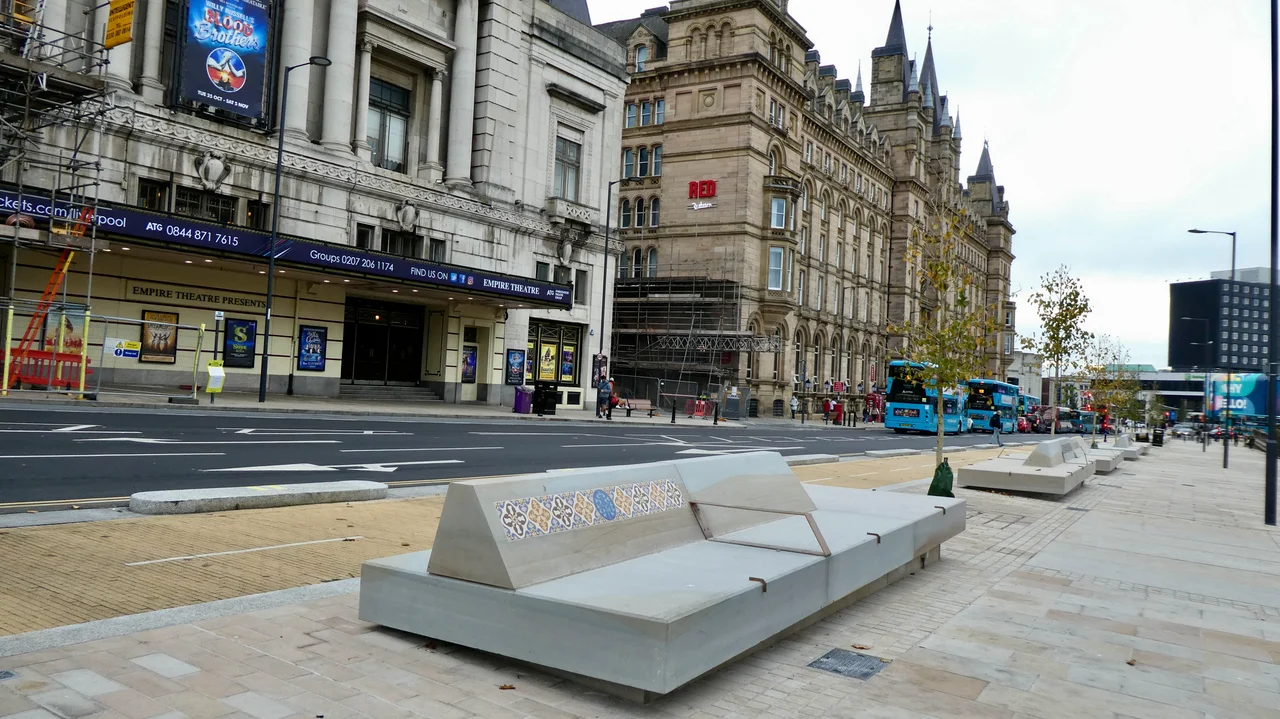

Lime Street, Liverpool
The street smelled, at first, of burning lime. In 1790, when Liverpool laid out a new road on the eastern edge of the town, the most prominent feature was the kilns of William Harvey, a local businessman whose limeworks gave the street its name. The land had been windmills in the 1770s. The kilns moved on by 1804 -- the doctors at the new infirmary, where St George's Hall stands today, complained the smoke was poisoning their patients -- but the name stuck. Maggie May still drank there in the folk song. The Beatles recorded her ballad on Let It Be. Today Lime Street is what it became after the railway arrived in 1836: Liverpool's civic spine, lined with the kind of monumental Victorian buildings cities raise when they are sure they will matter forever.
Limekiln Lane to Lime Street
Before there was a street, there was a smell. Four windmills stood on the open ground east of Liverpool in the 1770s, and beside them William Harvey burned chalk and limestone in tall kilns to make quicklime for builders. When the road was laid out in 1790, the locals called it Limekiln Lane. It was outside the city limits then, on the edge of where the town gave way to fields. By 1804, the kilns had become a nuisance — the doctors of the new infirmary objected to the smoke drifting into their wards — and Harvey was made to move his operation. The kilns went. The name remained, shortened to Lime Street. Through the early 1800s the street was lined with roperies, where workmen twisted hemp into miles of cordage for the ships in the docks below. It was a working street, not yet a grand one.
The Railway Changes Everything
In 1836 the trains arrived. Lime Street Station opened as the Liverpool terminus of the Liverpool and Manchester Railway, the first inter-city railway in the world. Suddenly the street was no longer the edge of Liverpool — it was the gateway. Every visitor to the city stepped out of a carriage onto Lime Street and looked across at what the corporation built to greet them: St George's Hall, completed in 1854, one of the finest neoclassical buildings in Europe, all columns and pediment and proportion. The North Western Hotel followed in 1871, a Renaissance pile commissioned to house railway travellers in the manner they expected. By the time Victoria died, Lime Street had become Liverpool's stage set, the place where the city showed itself to the world. The Empire Theatre opened in 1925, replacing an earlier playhouse from 1866. The Futurist Cinema flickered on from 1912 until 1982. The flyovers came in 1970 and were demolished in 2019 when they turned out to be unsafe.
Maggie May, Forever
Every street worth knowing has a song. Lime Street has "Maggie May," a Liverpool folk ballad about a thief and a prostitute whose favourite ground was this very pavement. The song dates from the mid-nineteenth century, when Lime Street's red-light history was a fact of life rather than a footnote. Sailors with their wages in their pockets came up from the docks and looked for company, and Maggie May -- or some Maggie May, since the name floated through dozens of versions -- robbed them of their oilskins and their pay. The song outlived its world. Stan Kelly, Lonnie Donegan, and finally the Beatles all recorded versions. On Let It Be, Lennon and McCartney sang the chorus in their broadest Scouse, a wink to the city that made them. The novelist Helen Forrester used the street in the title of her memoir Lime Street at Two. Alun Owen wrote a play called No Trams to Lime Street. In 2012, the Royal Court staged A Nightmare on Lime Street, with David Gest -- yes, that David Gest -- playing Frankenstein's monster recreated in the bowels of the railway station.
Standing on Lime Street Today
Stand at the south end of Lime Street and you can see the whole story at once. The Adelphi Hotel anchors the crossroads where the street ends and Renshaw Street rises uphill toward St Luke's Church, the bombed-out shell left as a memorial to the May Blitz of 1941. Behind you, the Empire Theatre's Portland stone façade still has the largest two-tier auditorium in the United Kingdom — 2,348 seats arranged so steeply that even the cheap ones can see Kate Bush in 1979 or whichever musical is touring this week. Across the road, St George's Hall houses the city's law courts and concert hall in the same Greek-temple shell. The Walker Art Gallery and World Museum sit on William Brown Street running off to the north. Wellington's column rises at the far end of the street, the duke himself on a fluted pillar of granite, gazing across a quarter mile of Victorian ambition. It is one of the great civic compositions in Britain, and it began with the smell of burning lime.
From the Air
Located at 53.408N, 2.979W in central Liverpool, running roughly north-south past Lime Street Station and St George's Hall. From the air the wide street axis between the railway station glass roof and St George's Hall colonnade is easy to identify. Nearest airport: Liverpool John Lennon Airport (EGGP), approximately 7nm southeast. Best viewed from 2,000-4,000ft.
Nearby Stories
- RAF Wrexham 3.3 km away
- Birkdale Palace Hotel 3.7 km away
- Turton Tower 4.1 km away
- Tatton Park 5.6 km away
- Abergele Rail Disaster 9.6 km away
- Diglake Colliery Disaster 13 km away
- Ysbyty Ifan 16 km away
- Celtic Array 62 km away