.jpg)
Lin Fa Temple
The boulder came first. Before the temple, before the street that takes its name from the temple, before the Causeway Bay that grew up around it, there was a large rock in the Tai Hang area of Hong Kong Island that the local community called the Lotus Rock. According to tradition, Kwun Yam — Guanyin, the goddess of mercy — once appeared on this rock to help people avert disasters and bring good luck. In 1863, during the Qing dynasty, the community built a temple on the rock in her honor, shaped to resemble the flower she stood on. The rock is still there, partially hidden by the exterior wall, partially exposed — the foundation that everything else rests on.
Built on Stone
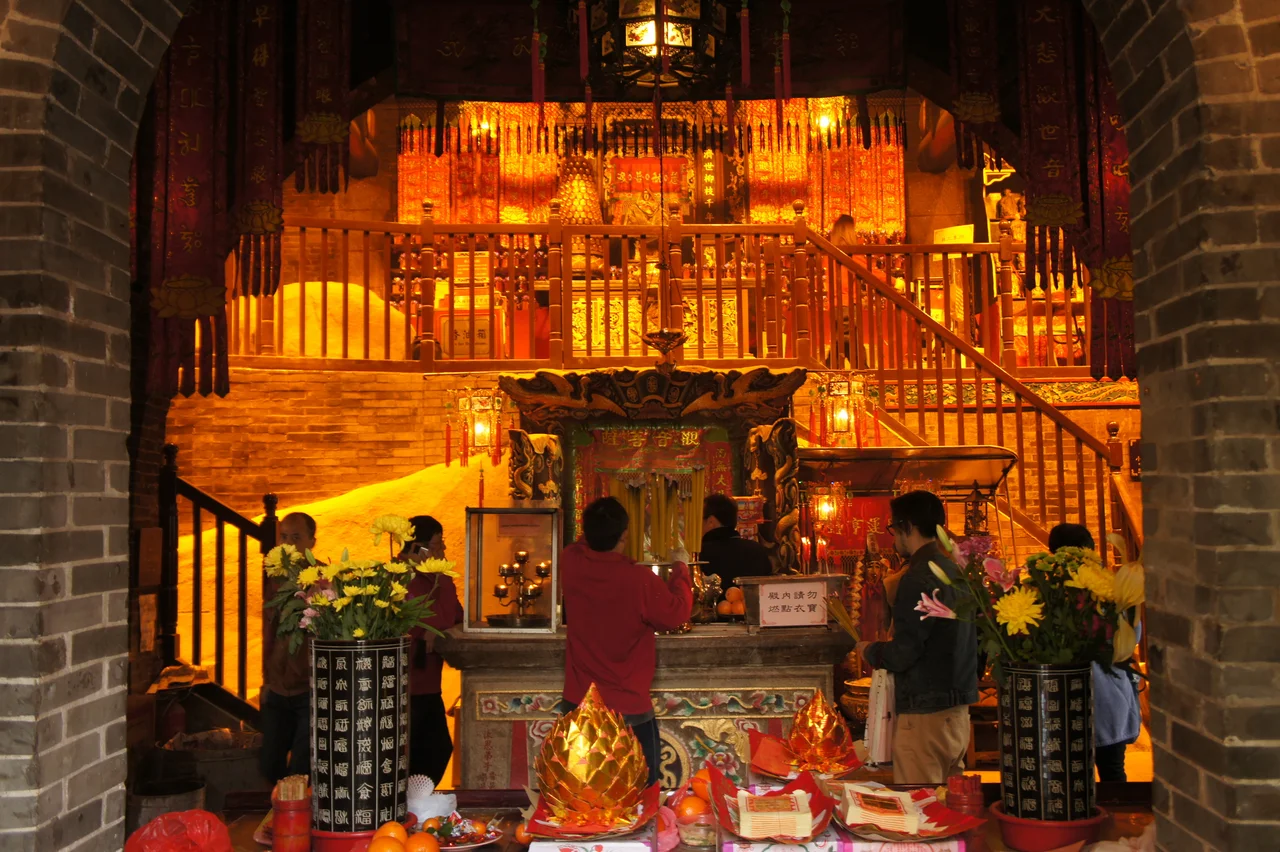
Lin Fa Temple's architecture is an accommodation with its site rather than an imposition on it. The front section of the terrace stands on pillars ten to twelve feet high; the back section sits directly on the Lotus Rock itself. This is not the grand symmetry of a large public temple — Lin Fa is compact, tucked into the Tai Hang neighborhood at the end of Lin Fa Kung Street, which was named after the temple. The name means Lotus Palace: Lin Fa being the lotus flower, Kung being the honorific. Inside, the main hall houses Kwun Yam alongside several other deities: Tai Sui — the Sixty Gods of Time — Skanda (known in Cantonese as Wai Tor), and the god of wealth, Choi Sun. The roof carries murals of flying dragons, phoenixes, and arrangements of lotus flowers, painted there, it is said, because of the fire dragon dance that the temple anchors every year.
Four Festivals, One Goddess
Worshippers come to Lin Fa Temple three times a year on the 19th day of the 2nd, 6th, and 9th lunar months — marking Kwun Yam's birthday, the day she attained Buddhahood, and the day she renounced the world. These visits are not tourist events. They are the regular rhythm of devotion that has continued at this address since 1863, through the colonial period, through the Japanese occupation of Hong Kong, through the complete reconstruction of the temple in 1986 and again in 1999. The Chinese Temples Committee took stewardship of Lin Fa in 1975 and carried out the 1986 renovation. The site has been upgraded from a Grade I historic building to a declared monument under Hong Kong law — a legal status that affords the highest level of protection.
Fire Dragon in the Streets
The Mid-Autumn Festival transforms Tai Hang every year. The Tai Hang Fire Dragon Dance — a tradition connected to Lin Fa Temple — sends a dragon made of straw and incense sticks through the neighborhood's narrow streets after dark. The dragon is enormous: built in sections, carried by dozens of people, studded with thousands of burning incense sticks that glow in the darkness and drift smoke across the lane. The tradition is said to have begun in the late nineteenth century, when plague struck the community and residents performed the dance to drive away the epidemic. Whether or not that origin is precise, the ritual has outlasted the epidemic, the colonial administration, and the urban transformation of Causeway Bay from a fishing bay into one of Hong Kong's most expensive shopping districts. The dragon still runs the same streets.
Tai Hang, Then and Now
Tai Hang sits on the edge of Causeway Bay, separated from the shopping centers and the tram lines by a few turns of narrow streets. The neighborhood retains a village quality that most of Hong Kong Island has lost — low shophouses, local restaurants, the kind of residential texture that belongs to people who have lived somewhere for generations rather than moved in during a development cycle. Lin Fa Temple is both the spiritual center of that community and one of the physical reasons it has retained its character: a declared monument cannot be demolished, and a neighborhood with a functioning active temple at its heart is not easily reduced to a generic block of towers. The goddess of mercy, from her position on the Lotus Rock, has offered the place a measure of protection that the planning system alone might not have provided.
From the Air
Lin Fa Temple is located in Tai Hang, southeastern Causeway Bay, at approximately 22.2794°N, 114.193°E on Hong Kong Island. From altitude, Causeway Bay is identifiable as the dense urban cluster east of the Central business district, just north of Happy Valley Racecourse — one of the most distinctive landmarks on Hong Kong Island, recognizable even at cruising altitude by its oval track surrounded by residential towers. Hong Kong International Airport (VHHH) lies approximately 34 km to the west on Lantau Island. At 2,000–3,000 feet in clear conditions, the Causeway Bay Typhoon Shelter and the broad arc of Victoria Harbour provide clear orientation.
Nearby Stories
- Lok Ma Chau Loop 2.3 km away
- Portas do Cerco 2.3 km away
- Kweilin Incident 17 km away
- Wanshan Archipelago Campaign 34 km away
- Nanxiong Formation 115 km away
- Battle of Nanpeng Island 148 km away
- Heyuan 169 km away
- Cape Maobitou 632 km away