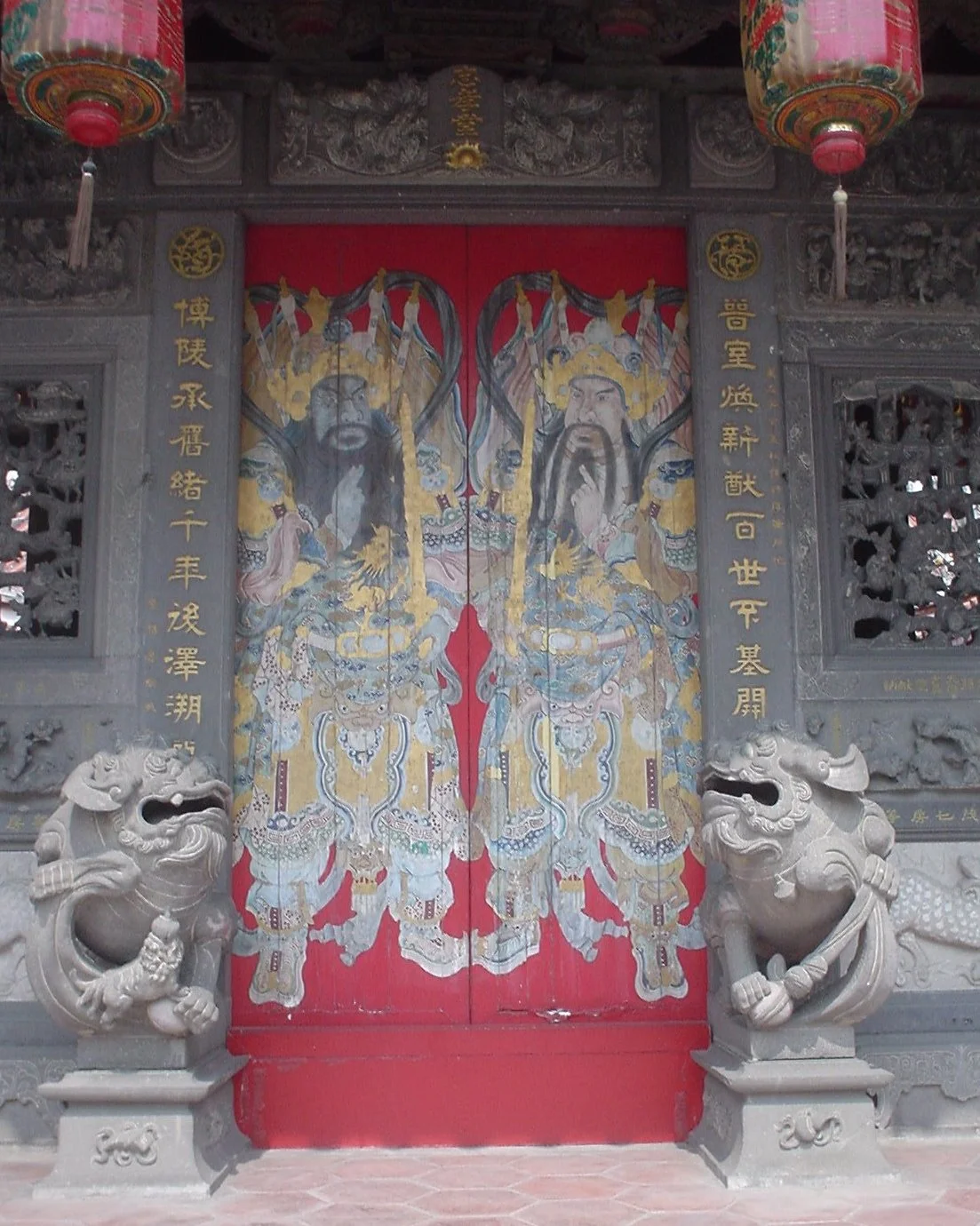

Lin Family Ancestral Shrine
When does a shrine become a monument? For the Lin Family Ancestral Shrine in Taichung, the answer arrived on November 27, 1985, when the city government formally designated it a protected site. But the building's importance to the Lin family — one of the most influential clans in central Taiwan's history — stretches back much further, to origins so old they are still debated. A stone engraving inside the shrine, dated 1952, claims the family first built here during the reign of the Jiaqing Emperor, who ruled from 1796 to 1820. A Japanese-era newspaper from 1934 puts the founding date even earlier, at 1775. Nobody agrees on the beginning. What's certain is the current shrine: built between 1918 and 1930, it stands as one of the most carefully crafted ancestral halls in the region.
A Clan Across Central Taiwan
The Lins are not a single family but a constellation of related lineages spread across Taichung and the surrounding areas, most notably including the Wufeng Lin family, known for their grand estate. Ancestral shrines in Chinese and Taiwanese tradition serve as physical anchors for clan identity — places where generations gather to honor the dead, maintain family bonds, and assert continuity across time. The original Lin shrine stood in what is now Dali District, and it moved multiple times beginning in 1895, the year Japan took control of Taiwan following the First Sino-Japanese War. The turbulence of that transition reshaped much of Taiwanese society, and the Lin family's shrine moved with it before settling into its current form.
Seven Courtyards, Three Traditions
The architect Chen Yingshan designed the shrine in the traditional Hokkien style — the southern Chinese architectural tradition brought to Taiwan by Fujianese settlers — but the building that resulted tells a more complicated story. Its halls are arranged in a siheyuan layout, the courtyard-centered configuration of classical Chinese architecture, dividing the interior into seven courtyards of varying sizes. Brick walls reinforced internally by wooden supports form the structure. But look more carefully and the Japanese colonial period makes itself visible: Japanese materials and construction techniques appear throughout, alongside European elements that reflect the early twentieth century's global cross-pollination of styles. The result is a building that wears its era honestly, the result of craftspeople working in multiple traditions at once.
Surface as Statement
Wealth in a family shrine like this is communicated through ornament, and the Lin family did not hold back. Sculptures and paintings cover the shrine's surfaces — dragons on the ridgepoles, painted deities on doorways, intricate wood carvings on the beams and columns overhead. In the exterior courtyards, a small tower for burning joss paper stands as a functional reminder of the shrine's purpose: these are not decorative spaces but working places of ritual, where the living maintain their obligations to the dead. The painted doors, the carved stone, the layered ornamentation — all of it was meant to signal that the Lin family had resources and that it honored its ancestors well.
Preservation and What It Protects
City monument status has shielded the shrine from the redevelopment pressures that have reshaped so much of Taichung since the 1980s. The East District neighborhood around it has changed considerably; the shrine itself has not. That protection matters, because what the shrine preserves is not just architecture but a way of understanding family and time. Taiwanese ancestral veneration holds that the dead remain part of the community, that honoring them is an ongoing responsibility rather than a historical gesture. The Lin Family Ancestral Shrine is protected as heritage, but for the Lin family and the communities connected to it, it has never stopped being a living place.
From the Air
The Lin Family Ancestral Shrine is located at approximately 24.132°N, 120.677°E in Taichung's East District. Taichung International Airport (RCMQ) lies roughly 16 kilometers to the west. On approach from the west, the flat Taichung basin spreads out below, with the older street grids of the East and Central Districts visible before the newer high-rise zones further west. The shrine itself is not visible from altitude, but the surrounding neighborhood's older low-rise character distinguishes it from the newer developments nearby.
Nearby Stories
- Taroko National Park 4.5 km away
- Jiji, Nantou 9 km away
- Miaoli Ceramics Museum 9.2 km away
- Smangus 17 km away
- Taixi, Yunlin 23 km away
- Lintianshan Forestry Culture Park 24 km away
- Taiwan Strait 52 km away
- China Airlines Flight 611 60 km away