
Lin Heung Tea House
A Hanlin Academy scholar walked into a tea house in early 20th-century Hong Kong, tasted the lotus paste buns, and liked them so much he gave the place half its name. That small act of appreciation is baked into Lin Heung Tea House's identity — *lin heung* means "fragrant lotus" in Cantonese — and it captures exactly what this Wellington Street institution has always traded in: the pleasure of a meal worth remembering. Founded in Guangzhou in 1889, it opened its Hong Kong branches in 1926 and settled into its Central location in 1980, spending the decades between becoming one of the city's most stubbornly traditional dining rooms.
The Art of the Trolley
No menus. No pre-orders. No host waiting at the door to show you to your seat. At Lin Heung, you find your own table — or, more likely, share one with strangers — and then you wait. The dim sum arrives on traditional bamboo-handled trolleys pushed by staff who move fast, and if you want something, you need to intercept the trolley before it passes you by. A tally card on the table gets stamped for each item. It sounds chaotic, and it is, but that is precisely the point. The experience strips away the softened hospitality of modern restaurants and puts you directly inside a working Cantonese tea house. Regulars know which trolley carries the har gow and which comes around with the steamed chicken buns. Visitors follow instinct and luck. Both strategies have merit.
What Only Lin Heung Makes
Over 30 varieties of dim sum rotate through the kitchen, but a handful belong exclusively to Lin Heung. The Steamed Chicken Bun (雞球大包) is one — a larger, denser cousin of the standard barbecued pork bao. The Shumai Made with Liver (豬膶燒賣) surprises first-timers accustomed to the pork-and-shrimp standard. The Whole Winter Melon Soup (冬瓜盅) arrives in the hollowed gourd itself. The Pa Wong Duck and the eight treasures duck (八寶鴨) round out a list of dishes that exist nowhere else in Hong Kong in quite the same form. The lotus paste that started everything is still there too — in the steamed buns, in the mooncakes, sourced from brown-red Xiang-lian lotus imported from Hunan province for their characteristic smooth flavour.
Inside the Tenement
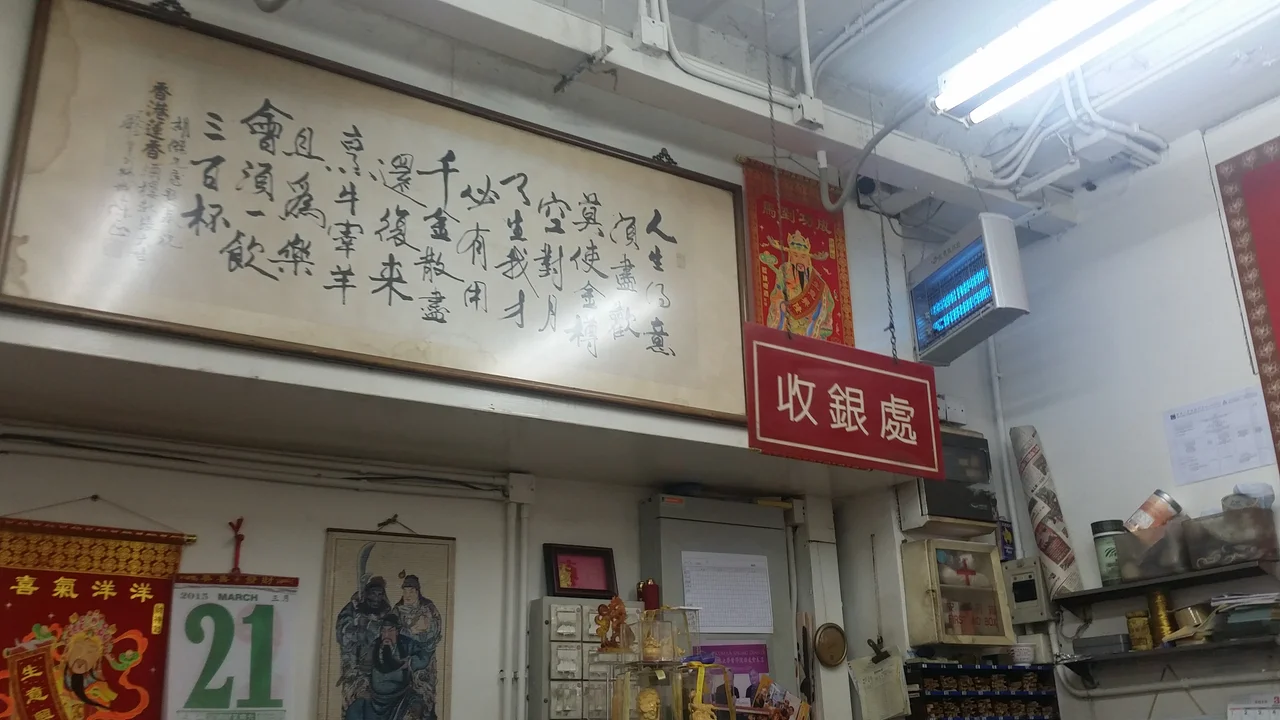
The building itself is a tong lau, a Hong Kong tenement type that once lined the older commercial streets of the city. Lin Heung occupies two floors: the ground level held the bakery (converted in 2024 to a tea shop under new ownership), while the first floor is the restaurant proper. Traditional Chinese calligraphy scrolls and ink landscape paintings line the walls, framed and aged in the manner of a family dining room rather than a decorated restaurant. The two-teacup system for serving tea — a larger cup for steeping, a smaller one for drinking — is practiced here because that is how it was always done, not because anyone decided it was charming. Water is refilled when you lift the lid of your larger cup. The staff notice.
Filmed and Famous
Wong Kar-wai chose Lin Heung as a location for *In the Mood for Love* (2000), the film's dreamy, compressed portrait of mid-century Hong Kong nostalgia finding a fitting backdrop in a room that had changed little since the 1960s. Fruit Chan's *The Longest Summer* (1998) also passed through. CNN and TIME magazine have written about the place. None of that attention altered the operation. When the restaurant announced its closure on Facebook in August 2022 — citing, among other troubles, wages owed to staff — the sense of loss was genuine and specific. Hong Kong was losing something that had not been replicated elsewhere. In April 2024, Lin Heung reopened at the same Wellington Street address, same floors, under new ownership. The trolleys came back out. In early 2026, the Central location closed again and the restaurant relocated to Sheung Wan — carrying its traditions to a new address rather than letting them expire on the old one.
A City's Palate
What Lin Heung represents is not simply old-fashioned service or nostalgic decor. It is a set of habits — how to pour tea, how to flag a trolley, how to share a table with people you've never met — that form a specific Cantonese grammar of eating together. The tea house as an institution originated in Guangdong during a period of tea house proliferation at the turn of the 20th century; Lin Heung's 1889 Guangzhou founding places it inside that tradition at its height. The 300-seat dining room, with its 50 tables and standing crowds on busy mornings, is not an experience designed for comfort. It is an experience designed for the kind of pleasure that comes from doing something the right way, in the right room, with the right food, just as it has always been done.
From the Air
Lin Heung Tea House sits at 22.2843°N, 114.1534°E in Central, Hong Kong Island, at the corner of Wellington Street and Aberdeen Street — roughly 2 km northwest of Hong Kong International Airport's former Kai Tak site. The nearest active airport is Hong Kong International (VHHH), located 30 km to the west on Lantau Island. From the air at 1,500 ft, the dense Central business district grid is visible directly north of Victoria Peak; Wellington Street runs through the lower Mid-Levels, a few blocks uphill from the waterfront. The Star Ferry pier and IFC tower serve as useful visual landmarks for orientation.
Nearby Stories
- Lok Ma Chau Loop 2.3 km away
- Portas do Cerco 2.3 km away
- Kweilin Incident 17 km away
- Wanshan Archipelago Campaign 34 km away
- Nanxiong Formation 115 km away
- Battle of Nanpeng Island 148 km away
- Heyuan 169 km away
- Cape Maobitou 632 km away