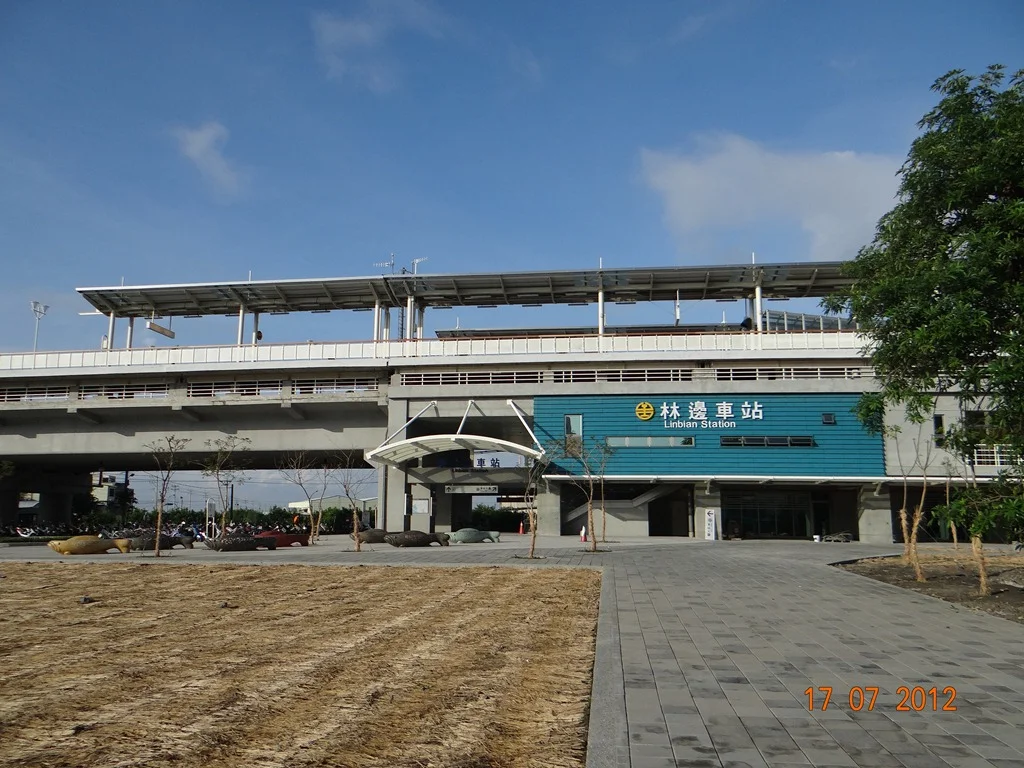

Linbian
January in Linbian looks nothing like winter. The afternoons push past 29°C, the air sits still over the flat Pingtung plains, and the wax apple orchards — row after dense row of them — are already heavy with fruit. While the rest of Taiwan bundles up, this small township at the mouth of the Linbian River simply carries on with its warmth, as it always has. The locals have a name for what the climate produces: 蓮霧之鄉, "the wax apple township," and it is not a boast so much as a statement of geography.
Where the River Meets the Strait
Linbian sits at the southwestern corner of Pingtung County, pressed between the Linbian River and the open water of the Taiwan Strait. The township covers 15.62 square kilometers — compact by any measure — and about 16,382 people call it home. To the south lies the Hengchun Peninsula, whose sea currents cool the air enough to give it a temperate edge. Linbian sits just north of that boundary, which is why January here feels like spring almost everywhere else. The latitude is low, the plains flat, and the moderating effect of the peninsula is absent. The result is Taiwan's smallest gap between its warmest and coldest months, a climate distinction the township shares with a handful of neighboring Pingtung communities.
A Name with Dutch Roots
The name Linbian — written 林仔邊 in Chinese, and Lìm-piên-hiông in Hakka — describes a place beside a forest edge. But the settlement is older than those Chinese characters. During the Dutch colonial era of the seventeenth century, this stretch of coast was known as Pangsoya or Pangsoia, a name that appears in VOC records of the period. By the time the Dutch were gone, the place had contracted to Pang-soh. Later still, as Hakka settlers moved down from the north and merchants established footholds near the river mouth, the present name settled in. In 1951, the administration carved out Nanzhou Township from Linbian's territory, setting the boundaries that hold today. The ten villages that remain — among them Guanglin, Renhe, and Zhonglin — spread out across the lowland plain between river and sea.
The Fruit That Defines the Place
Wax apples — called lembu in the local dialect, jambú in Malay, and Syzygium samarangense in botanical Latin — are bell-shaped, faintly pink or deep crimson, and almost entirely water. They crunch like an apple but taste like a gentle, floral nothing, refreshing precisely because they do not insist. Linbian grows them better than almost anywhere in Taiwan, and the reason is the same warmth that makes January mild. The harvest season here stretches longer than in cooler growing regions, which means the market gets Linbian wax apples when supplies from elsewhere have tightened. Roadside stands and seafood restaurants cluster around the township's main street, and during harvest months the scent of the fruit — faint, sweet, green — carries into the lanes between orchards.
On the Railway and in the Record
Two Taiwan Railway stations serve Linbian Township: Linbian Station and Zhen'an Station, both on the coastal line that runs south toward the Hengchun Peninsula. The railway makes the township legible on the national map in a way that its modest size might not otherwise allow. Among its notable natives, Tsao Chi-hung served as magistrate of Pingtung County from 2005 to 2014. Tsai Sen-lang went further afield, founding and overseeing the Da-Dung Hospital in Kaohsiung — a career in medicine that began in a township where the pace is slow and the seasons barely change.
Slow Time, Tropical Light
There is no single monument in Linbian, no dramatic vista or world-famous site. What the township offers instead is a quality of light and tempo that belongs specifically to the extreme south of Taiwan: flat horizon, broad sky, the Linbian River bending toward the sea, orchards lit by a sun that has not decided it is winter yet. The Strait side of Pingtung is not dramatic in the way the mountains are dramatic, but it has its own logic — subtropical, agricultural, patient. Linbian is a place that knows its particular excellence and has built a life around it, one wax apple season at a time.
From the Air
Linbian Township lies at approximately 22.43°N, 120.52°E on the southwestern Pingtung plain, just north of the Hengchun Peninsula. Flying south along the Taiwan Strait coast from Kaohsiung, the flat agricultural lowland gives way to orchard rows and the Linbian River delta. Nearest major airport: RCKH (Kaohsiung International), approximately 30 km to the north. Recommended viewing altitude: 3,000–5,000 feet for the full river-mouth and coastal plain perspective. The strait is visible to the west; on clear days the Hengchun Peninsula ridgeline appears to the south.
Nearby Stories
- Zhiben Hot Spring 8.7 km away
- Fo Guang Shan 8.8 km away
- Duoliang Station 11 km away
- Checheng Fu'an Temple 32 km away
- Orchid Island 62 km away
- Dongji Island 68 km away
- South Penghu Marine National Park 96 km away
- Hong Kong 12 548 km away