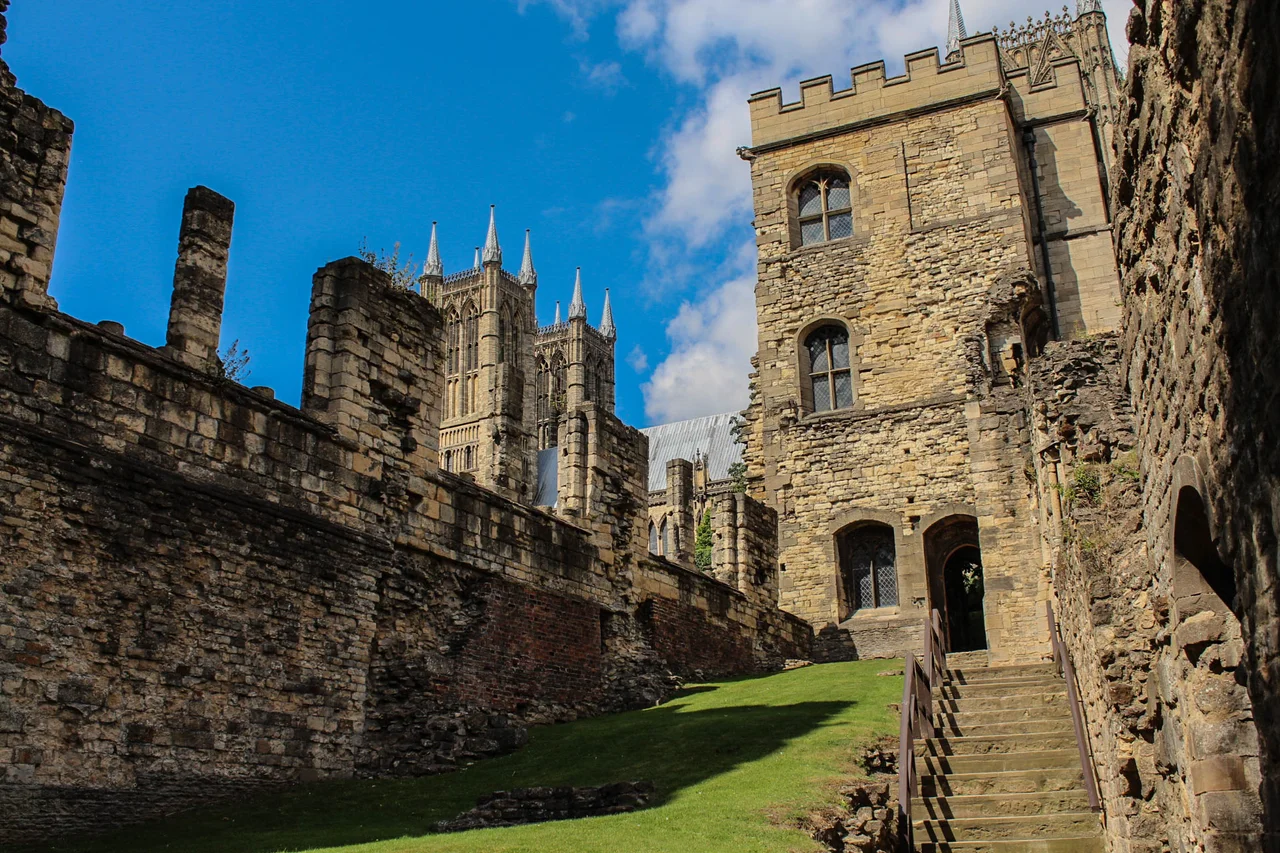

Lincoln Medieval Bishop's Palace
When the bishop's diocese stretched from the Humber to the Thames, you needed a palace to match. The medieval Diocese of Lincoln was the largest in England — by some measures the largest in western Europe — and the man who ran it lived on a terraced hillside immediately below Lincoln Cathedral, in a complex of halls, chapels, kitchens, undercrofts, and a vineyard. Most of it is roofless now. The walls were slighted in the Civil War, the bishops moved elsewhere, and what survives is a quiet English Heritage ruin tucked behind the cathedral, with a view across the city that has not changed much since 1230. The vines, replanted in 2012, are the surprise.
A bishop with a small kingdom
The Diocese of Lincoln, founded in 1072, reached from the Humber estuary to the Thames at its medieval height. Lincoln itself sat near its northern edge, but the cathedral and its bishop's palace presided over an ecclesiastical territory that included most of the east Midlands. The palace was begun in the late twelfth century and grew across the following two centuries into one of the most impressive buildings in medieval England. The hillside site mattered: from his hall, the bishop looked south across the River Witham, across his cathedral city, and into the diocese itself. The Roman wall of Lindum ran along the upper edge of the site, doubling as the bishop's northern boundary. To enter the precinct was to pass from city to a kind of private state.
Saint Hugh's hall
The palace's most notable surviving feature is the East Hall, completed before 1200 for Hugh of Lincoln, the Burgundian-born bishop who arrived at Lincoln in 1186 and earned canonisation within a generation of his death. The hall was built over a vaulted undercroft cut into the hillside, with the great chamber raised above and the working spaces tucked beneath. Two hundred years later, Bishop William Alnwick (1436-1450) added a tower gatehouse and expanded the chapel. The fenestration in the Alnwick tower included an elaborate oriel window — drawn in the 1780s by the Swiss artist Hieronymus Grimm, working for Dean Richard Kaye, when the whole complex was already a romantic ruin without turrets or crenellation. The bishops who lived here employed scribes, librarians, lawyers, falconers, gardeners, a private chapel staff. The household ran like a small court. The kitchen, whose roofless stone shell still stands, fed a hundred people on a feast day.
Slighted, abandoned, half-remembered
The Civil War broke the palace. Parliamentary soldiers occupied Lincoln in 1644 after the siege, and the bishop's residence — symbol of episcopal authority and royalist sympathy — was a natural target. A detailed survey by Parliamentary Commissioners in 1647 recorded what was left, and Samuel Buck's engraving of 1726 shows the building already deep in decay. After the war, successive bishops chose to live elsewhere: at Buckden Palace in Huntingdonshire, then at Riseholme just north of Lincoln after the diocese was reduced in 1841. In 1886 a smaller residence on the western edge of the old precinct was rebuilt in Tudor revival style by the architect Ewan Christian. Two years later, the south end of the medieval Great Hall was converted into a private chapel by Bodley and Garner. In 1948 the bishops moved out for good, judging the place too large, and the Victorian house became a retreat centre and, since 2009, the Old Palace Hotel.
The vineyard returns
The ruined sections passed to the Ministry of Works in 1954 and are now managed by English Heritage. The undercroft, the gatehouse tower, the kitchen, the chapel walls, the alignment of the Great Hall — all are visible and walkable. In 2001 Mark Anthony Walker laid out a modern garden plan that respects the surviving footings. In 2012 the vineyard was re-established on the south-facing terraces, picking up a thread the bishops had let go centuries earlier. England's climate is now warm enough to make commercial wine on a hillside in Lincolnshire — something that would have surprised the medieval bishops, who grew vines here in a colder period because they had to make their own communion wine and could not always rely on imports from France. The vines are back, the cathedral still looks down from the ridge above, and a bishop's palace that once governed half of England now grows quietly in the lee of the wall it was built against.
From the Air
Located at 53.233°N, 0.536°W, terraced into the south face of the cathedral hill, immediately below Lincoln Cathedral. The site is hard to spot from the air because it nestles against the hillside; look for the cathedral's three towers as the navigation reference, with the palace ruins on the steep slope just to the south. The vineyard is on the lower terraces. Nearest active airfield is RAF Waddington (EGXW), 5 miles south. English Heritage site, open seasonally.
Nearby Stories
- Louth Navigation 2.9 km away
- Major Oak 3.6 km away
- Grantham Rail Accident 8 km away
- South Yorkshire Aircraft Museum 9.3 km away
- Gotham, Nottinghamshire 11 km away
- Alford Windmill 16 km away
- RAF Binbrook 21 km away
- Wisbech 29 km away