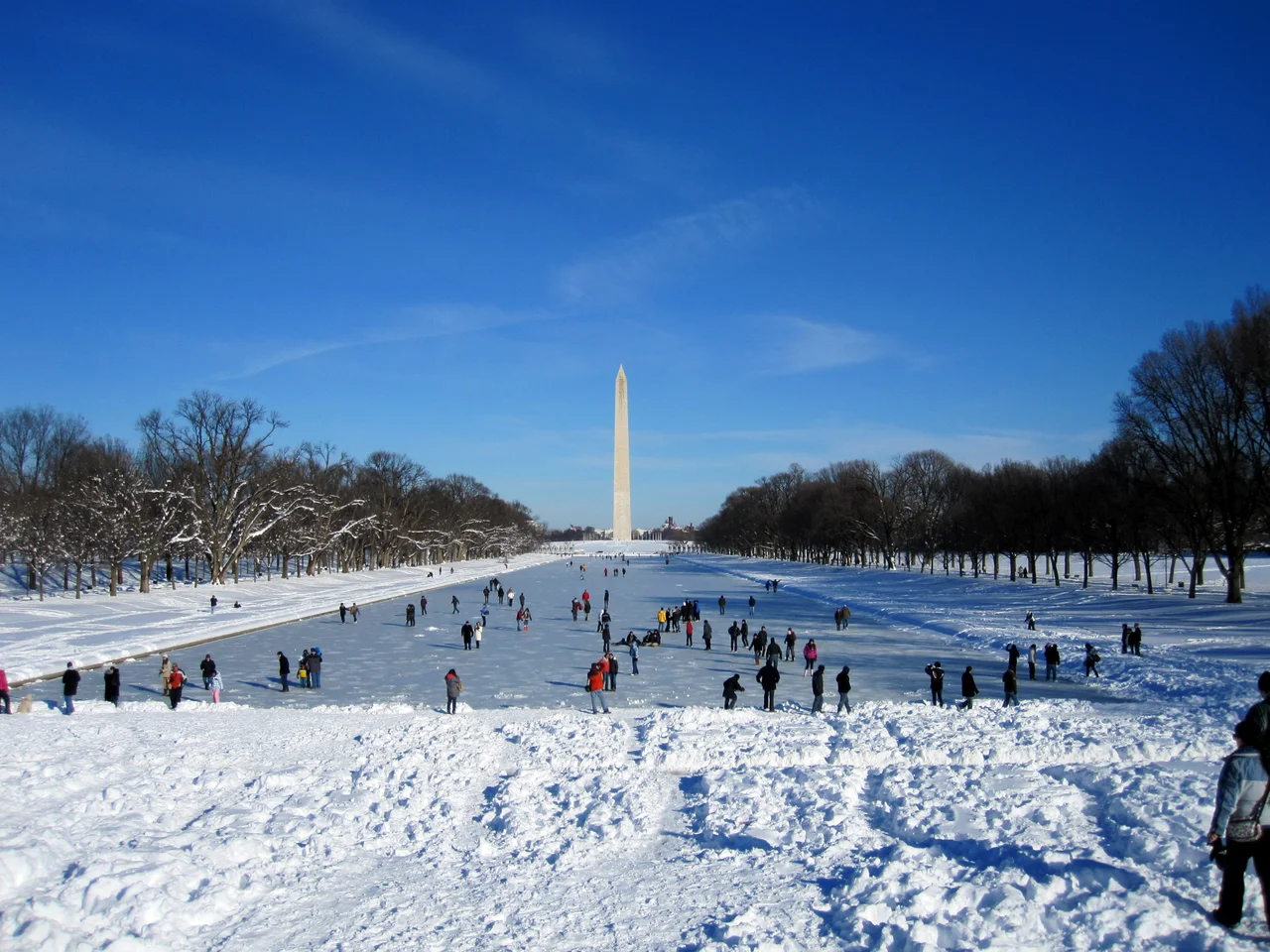

Lincoln Memorial Reflecting Pool
On Easter Sunday, April 9, 1939, contralto Marian Anderson stood on the steps of the Lincoln Memorial and sang to a crowd of 75,000 people who stretched along the water in front of her. The Daughters of the American Revolution had refused her use of Constitution Hall because she was Black. Eleanor Roosevelt resigned from the DAR in protest. Anderson opened with My Country, 'Tis of Thee. The mile-long rectangle of water that ran east toward the Washington Monument acted as a vast amplifier, doubling the crowd in reflection, doubling Lincoln's columns, doubling the sky. The Lincoln Memorial Reflecting Pool was only sixteen years old that day. It has hosted some of the largest gatherings in American history ever since.
Bacon's Long Rectangle
Architect Henry Bacon designed the Lincoln Memorial, and when the memorial was dedicated in 1922, he set about designing its eastern foreground: a reflecting pool 2,030 feet long and 167 feet wide, the largest such pool in Washington. Construction ran through 1922 and 1923. The water sits a few inches deep near the rim, deepening to 30 inches at the center - shallow enough to walk through, deep enough to throw a perfect mirror. The pool holds approximately 6.75 million gallons of water. Bacon's instinct was Beaux-Arts: the long axis from the Capitol to the river required a horizontal element to match Lincoln's columns, and the pool's still surface multiplied the Washington Monument's obelisk into a vertical column of light. Trees and walking paths line both edges. Twenty-four million people visit the National Mall annually, and most pass the pool's edge.
Two Hundred Fifty Thousand
On August 28, 1963, the March on Washington for Jobs and Freedom drew approximately 250,000 people to the foot of Lincoln Memorial. They stood along the reflecting pool stretching east to the Washington Monument - a crowd so vast that aerial photographs needed long lenses to capture it. Martin Luther King Jr. delivered I Have a Dream from the marble steps. By then the pool had already become the national stage for moral argument. Four years later, on October 21, 1967, 100,000 anti-Vietnam War protesters gathered at the pool before marching on the Pentagon. In 2009, 400,000 people filled the same edges for Barack Obama's pre-inaugural celebration. On January 19, 2021, then President-elect Biden and Vice President-elect Harris stood at the pool's edge as 400 lights - each representing 1,000 of the 400,000 Americans then dead of COVID-19 - illuminated the water in vigil. The pool itself has become the silent partner of every speech and silence.
A Pool on Marsh
By the late 2000s, the pool was failing. Decades of settling in the soft river clay that once formed the Potomac's tidal flats had cracked the basin. Water was being filled from the city's potable supply and turning stagnant. Algae bloomed. Walking paths along the edges had eroded to mud. In November 2010, using $30.74 million from the American Recovery and Reinvestment Act, the National Park Service began an 18-month reconstruction. Crews drove 2,133 wood pilings into a 40-foot layer of marshy river clay and dredged material until they hit bedrock. The new pool would draw water from the Tidal Basin and circulate it continuously, eliminating the stagnation problem. The Louis Berger Group managed the project. On August 31, 2012, the pool reopened. Within weeks, an algae bloom covered the surface so completely that the National Park Service had to drain it again at a cost of $100,000 - and then double the ozone disinfectant dose. The marsh that built Washington was still working on the engineering.
The Snail Problem
In June 2017, the pool was drained again. This time the cause was parasitic flatworms that infect aquatic snails and cause swimmer's itch in humans - and lethal infections in ducks. More than eighty ducks and ducklings had died at the pool since May 20 of that year. Park Service workers drained the basin, cleaned it, and refilled it over the following ten days. The pool that mirrors monuments also generates ecology. Tens of millions of gallons of slow-circulating Tidal Basin water bring snails and algae and ducks who lay eggs along the edges. The same shallow geometry that produces a perfect mirror also produces wildlife. Every few years the engineers and the swamp negotiate.
Two Thousand Candles
On December 31, 2012, National Park Rangers - using their own money and their own time - lit more than 2,000 candles along the edges of the rebuilt pool. They had gathered to mark the 150th anniversary of the Emancipation Proclamation, which Lincoln had signed on January 1, 1863. They sang My Country, 'Tis of Thee, the same song Marian Anderson had opened with seventy-three years earlier. The rangers called it the Night Watch and Freedom Vigil. The candles ringed the long rectangle of water. The Washington Monument reflected in the surface. The Lincoln Memorial reflected behind. Lincoln had freed the people that the Republic he saved had enslaved. He sat in marble at one end of the water, looking east. The rangers stood among the candles and waited for midnight.
From the Air
The Lincoln Memorial Reflecting Pool sits at 38.8893 N, 77.0448 W, on the National Mall between the Lincoln Memorial (west) and the Washington Monument (east). Best viewed from 1,500 to 2,500 feet AGL. The 2,030-foot rectangular pool produces a distinct visual axis from the air, particularly when sun angles allow the mirror effect to be photographed. Reagan National (KDCA) lies two nautical miles south. The pool sits inside the Washington Flight Restricted Zone; GA overflight prohibited. Aerial views require approved operations. Best photographed within an hour of sunrise or sunset, when the angle of light produces strong reflections of the Washington Monument.
Nearby Stories
- Gunston Hall 1.1 km away
- 2023 Baltimore Shooting 4.9 km away
- Battle of Middleburg 6.6 km away
- Crownsville Hospital Center 10 km away
- Battle of Loudoun Heights 13 km away
- First Battle of Rappahannock Station 20 km away
- Howard County, Maryland 21 km away
- Harriet Tubman Underground Railroad 50 km away