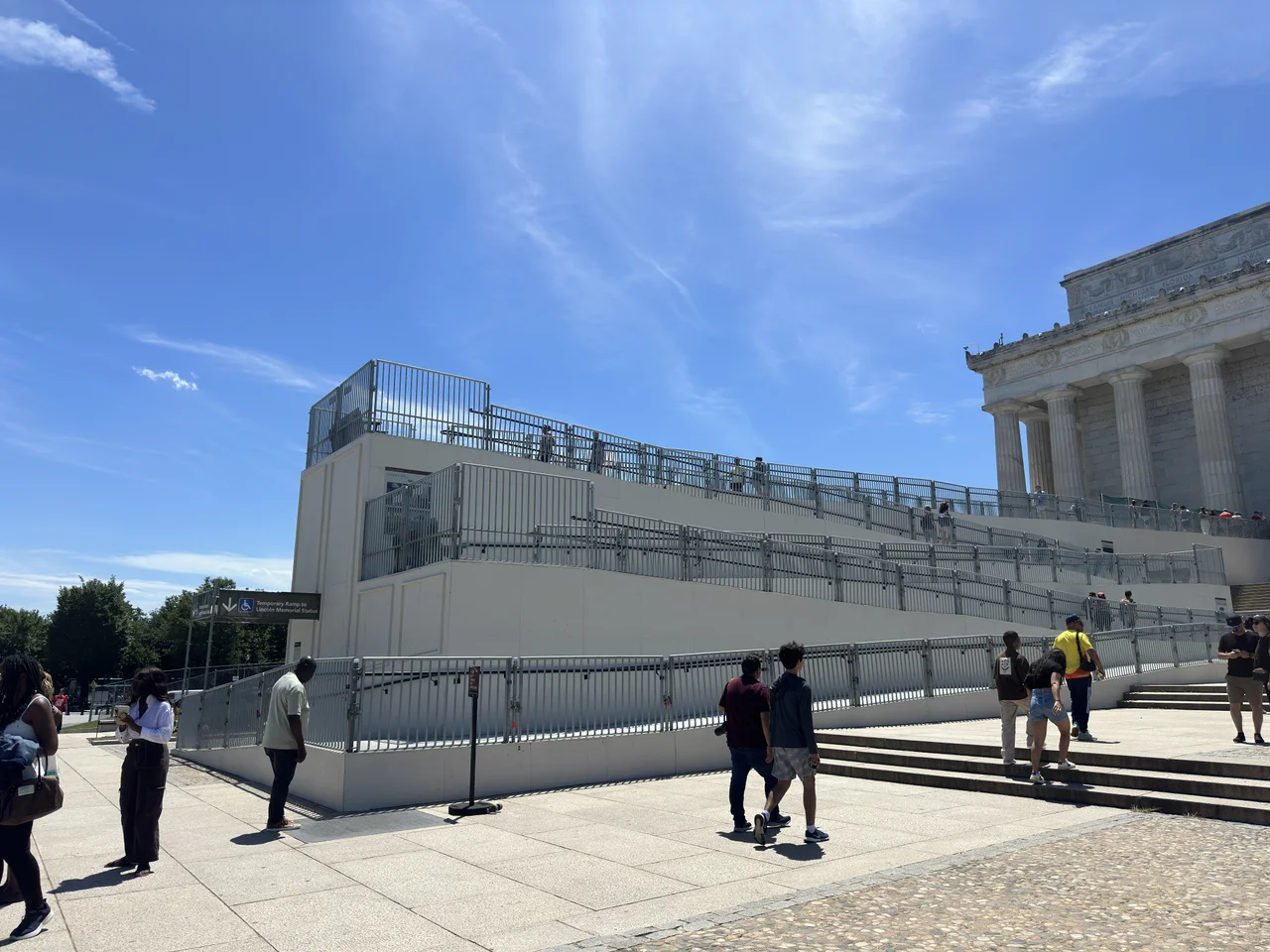

Lincoln Memorial
Daniel Chester French had originally planned the seated figure of Abraham Lincoln to stand 10 feet tall. By the time the marble was being shaped, French had increased the dimensions until the figure measured 19 feet from head to foot. If Lincoln were depicted standing, he would be 28 feet tall. The reason was acoustical and architectural and emotional all at once - inside Henry Bacon's vast Greek temple, where the interior chamber alone stretches 60 feet wide, 74 feet deep, and 60 feet high, anything smaller would have been swallowed. The Piccirilli brothers, six immigrant Italian carvers based in the Bronx, did the marble work. They cut Lincoln from 28 blocks of Georgia white marble assembled so precisely the seams are barely visible. The figure looks down at visitors with the heavy patience of a man whose face had been etched by a war and a re-election and a Thursday night at Ford's Theatre.
Six Bills and a Speaker's Veto
Plans for a Lincoln memorial began before the dirt over the assassinated president had settled. Lot Flannery's statue went up in front of the D.C. City Hall in 1868. Congress passed bills for a national monument in 1867, but funding never materialized. The proposed designs were grandiose - sculptor Clark Mills imagined a 70-foot structure adorned with six equestrian statues, 31 pedestrian figures, and a 12-foot Lincoln on top. Subscriptions came in too short. The project lay dormant for decades. Beginning in 1901, Senator Shelby Cullom of Illinois introduced bill after bill, only to have them blocked by Speaker Joe Cannon, who opposed both the cost and the proposed location in the West Potomac Park reclaimed marshland. Cannon called the site a swamp. The sixth Cullom bill - Senate Bill 9449, introduced December 13, 1910 - finally passed. The commission first met in 1911 with President William H. Taft as chair. Construction began on February 12, 1914, Lincoln's 105th birthday.
Yule Marble from Colorado
Bacon's exterior is a Doric temple in plan: 36 fluted columns - one for each state in the Union when Lincoln died - surround the building. Two more stand in the entry portico. The columns rise 44 feet, each assembled from 12 marble drums including the capital. The exterior cladding is Yule marble, quarried in Colorado, prized for its pure white grain. The walls and columns are slightly inclined inward to compensate for an optical illusion that would otherwise make the building appear to bulge - the same correction the Parthenon used 2,400 years earlier. Above the colonnade, the frieze carries the names of the 36 states at Lincoln's death; an attic frieze higher up adds the names of the 48 states that existed when the memorial was dedicated. Ernest C. Bairstow carved the ornamental scrollwork, lion heads, and palmettes. 58 steps lead from the chamber to the plaza, then 29 more from the plaza down to the Reflecting Pool - 87 in total.
Two Speeches on the Walls
Inside, the chamber is divided into three sections by two rows of Ionic columns. Lincoln sits in the central section. The north chamber bears the carved text of his second inaugural address - With malice toward none, with charity for all. The south chamber holds the Gettysburg Address. Sculptor Evelyn Beatrice Longman carved the inscriptions and the bordering pilasters. Jules Guérin painted the murals above the inscriptions, allegorical scenes of emancipation and reunion. Royal Cortissoz wrote the epitaph above Lincoln's head: In this temple, as in the hearts of the people for whom he saved the Union, the memory of Abraham Lincoln is enshrined forever. The ceiling holds panels of Alabama marble saturated with paraffin to make them translucent - sunlight filters through them like a stained glass made of stone. Bacon and French eventually added concealed floodlights in 1929 to give the seated Lincoln the cathedral lighting they had wanted.
The Memorial That Became a Stage
The dedication took place on May 30, 1922. President Warren G. Harding accepted the memorial. Robert Todd Lincoln, then 78 and Lincoln's only surviving son, attended. So did prominent Black Americans, who discovered upon arrival that the U.S. Marines had assigned them a segregated viewing area - a policy set by the office of public buildings director Lieutenant Colonel Clarence O. Sherrill. Seventeen years later, on Easter Sunday 1939, Marian Anderson sang to 75,000 people on these steps after the Daughters of the American Revolution barred her from Constitution Hall. In 1947, Harry Truman became the first president to address the NAACP, speaking from these steps to a national radio audience. On August 28, 1963, Martin Luther King Jr. delivered I Have a Dream to 250,000 people gathered for the March on Washington. The labor organizer Walter Reuther had persuaded the march leaders to use the Memorial rather than the Capitol - less politically threatening, more symbolically resonant under Lincoln's gaze. The spot where King stood, eighteen steps below Lincoln's feet, was engraved in 2003 to mark the 40th anniversary.
The Hands and the Undercroft
Historian Gerald Prokopowicz has noted what some viewers have long suspected: French's Lincoln may hold his hands in shapes that approximate the American Sign Language letters A and L. French had a deaf son and was familiar with sign language. Lincoln, as president, had signed the legislation giving Gallaudet University - then the only college for the deaf in the country - the authority to grant degrees. No documents confirm French's intent, but the theory has not been refuted either. Below the memorial sits an undercroft, a vast lower chamber where workers scrawled graffiti during construction. Over decades, water seeping through the marble's calcium carbonate formed actual stalactites and stalagmites - a small cave growing beneath the temple. Tours of the space stopped in 1989 after asbestos was found. For the memorial's centennial in 2022, philanthropist David Rubenstein funded a $69 million project to rehabilitate roughly 15,000 square feet of the 43,800 square-foot undercroft - opening it as a museum, theater, and exhibit space by 2026, with glass walls revealing the cathedral-like cavern below.
From the Air
The Lincoln Memorial sits at 38.8893 N, 77.0502 W, at the western end of the National Mall, immediately west of the Reflecting Pool. Best viewed from 1,500 to 2,500 feet AGL. The white Yule marble temple is unmistakable from above; the long axis of the Reflecting Pool extends due east toward the Washington Monument. Reagan National (KDCA) lies two nautical miles south. The Memorial sits within the Washington Flight Restricted Zone; GA overflight prohibited. Aerial views require approved operations or vantage from beyond the FRZ. The memorial appears most dramatic at sunrise or in the hour before sunset, when low light angles strike the eastern columns. More than seven million people visit annually.
Nearby Stories
- Gunston Hall 1.1 km away
- 2023 Baltimore Shooting 4.9 km away
- Battle of Middleburg 6.6 km away
- Crownsville Hospital Center 10 km away
- Battle of Loudoun Heights 13 km away
- First Battle of Rappahannock Station 20 km away
- Howard County, Maryland 21 km away
- Harriet Tubman Underground Railroad 50 km away