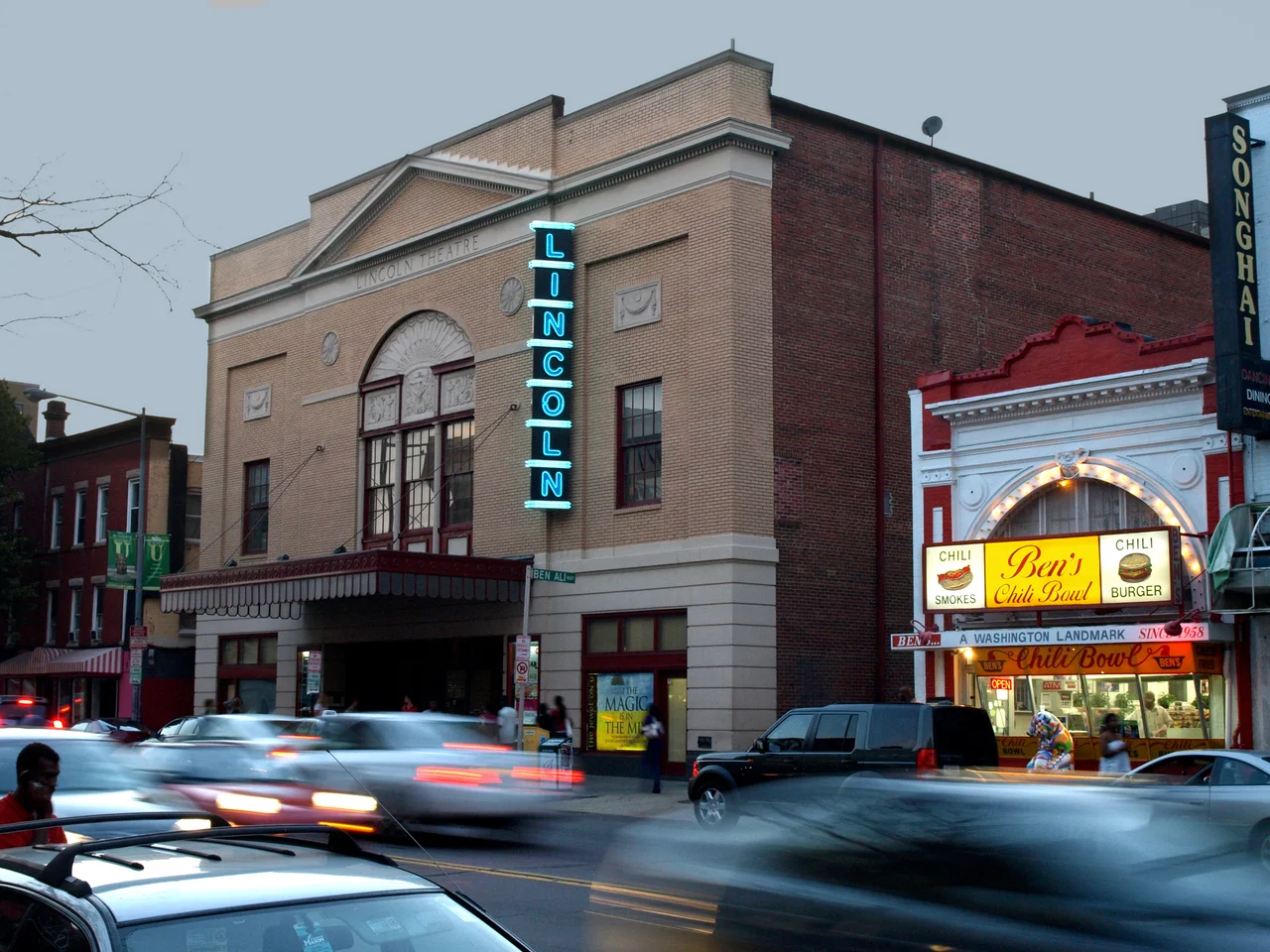

Lincoln Theatre (Washington, D.C.)
Before Duke Ellington was Duke Ellington, he was a teenage piano player named Edward Kennedy Ellington from Washington, D.C., learning his craft within walking distance of the Lincoln Theatre. The Lincoln opened in 1922, two years after Ellington left for Harlem. He came back to play it. So did most of the major jazz figures of the next four decades - because for most of that time, the Lincoln Theatre was one of the few major venues in Washington where Black Americans could perform, watch, or simply be seated. U Street, in the years before integration, was called Black Broadway. The Lincoln was its largest house. Next door, then as now, was Ben's Chili Bowl.
Crandall and Geare
Construction began in summer 1921. Architect Reginald Geare designed the building in collaboration with Harry Crandall, a local theater operator whose chain of D.C. movie houses had become one of the most successful in the country. The Lincoln opened in 1922 as a venue for silent film and vaudeville aimed specifically at Washington's Black community - which segregation barred from most of the city's other major theaters. The exterior was brick, the interior trimmed in Victorian ornament. Behind the proscenium were full backstage facilities for live performance. In 1927, the theater was sold to A.E. Lichtman, who set out to turn it into something even more ambitious: a luxury movie palace with a ballroom attached, the Colonnade, where the city's Black social life could find space the segregated downtown denied it. By 1928, the projector booth was wired for sound, and the Lincoln became one of the first Black-serving theaters in Washington equipped for the talkies.
Black Broadway
Through the 1930s and 40s and into the 50s, U Street ran on a current the rest of segregated Washington could not generate. Howard University, two blocks north, fed the neighborhood with students and intellectuals. The U Street Corridor housed Black-owned businesses, Black-owned banks, Black-owned newspapers, Black-owned churches. The Lincoln Theatre and its Colonnade ballroom anchored the entertainment district. Duke Ellington played the Colonnade. So did Cab Calloway, Louis Armstrong, Ella Fitzgerald, Pearl Bailey, and most of the touring jazz and big-band names. In 1952, the Lincoln installed a television projection system - large-screen TV broadcasts shown to ticketed audiences, a peculiar transitional technology of the early television era. The Colonnade was demolished in the late 1950s as the audience habits that had supported it began to fragment.
1968 and the Long Closure
On April 4, 1968, Martin Luther King Jr. was killed in Memphis. Within hours, U Street was on fire. The riots that followed gutted the corridor - shops burned, businesses fled, residents left. The Lincoln Theatre survived the flames but lost its audience. The neighborhood entered a long decline. In 1978 the building was crudely subdivided into two smaller theaters and renamed the Lincoln Twins. All-night movie programs in the late 1970s drew weekend crowds of a few hundred at a time, but the grand Lincoln of the Ellington years was gone. In 1983, developer Jeffrey Cohen bought the property as part of a $250 million plan for the corridor he called Jackson Plaza. He filed for bankruptcy in 1991. The D.C. government and a local foundation took over the restoration, hired the firm Leo A. Daly to manage it, and reopened the theater on February 4, 1994 - with a performance of Barry Scott's Ain't Got Long to Stay Here, a one-man show about the life of Martin Luther King Jr.
Twenty Years of Struggle
The reopened Lincoln did not have an easy path back. Throughout the 1990s and 2000s the theater required regular financial aid from the D.C. government to stay afloat. Programming was eclectic - the annual LGBT film festival Reel Affirmations ran here from 1998 to 2008. The Black Ensemble Theatre's Jackie Wilson Story played a multi-week run in 2002. The Duke Ellington Jazz Festival launched at the Lincoln in 2005. From 2008 to 2010, Arena Stage used the venue for productions including Carrie Fisher's Wishful Drinking, while Arena's Southwest Waterfront complex was being renovated. Dave Chappelle filmed Killin' Them Softly here for HBO in 2000. By 2011, with city funding cut, the Lincoln faced closure again. The D.C. Commission on the Arts and Humanities took over management and began searching for an operator willing to run the venue commercially.
I.M.P. and the Second Life
In June 2013, Mayor Vincent Gray's office announced the new operator: I.M.P., the company behind the 9:30 Club, Washington's most successful independent music venue. I.M.P. began booking the Lincoln that fall, and the room has run nearly continuously since. Janelle Monáe opened with a show on October 14, 2013. Lauryn Hill played February 9, 2014. Sharon Jones and the Dap-Kings ran two nights in February 2014. Experience Hendrix - Bootsy Collins, Eric Johnson, Dweezil Zappa, Buddy Guy - filled the room March 30, 2014. Spoon ran three nights. Nas performed the 20th-anniversary set of Illmatic on October 4, 2014. Kendrick Lamar played November 1, 2015. Patti Smith sat down for a conversation with co-owner Seth Hurwitz on October 12, 2016. Brian Wilson performed Pet Sounds in full for its 50th anniversary on consecutive May 2017 nights. Trevor Noah, Demetri Martin, Hannibal Buress, Louis C.K., and Deon Cole have all filmed comedy specials in the room. The U Street Metro station opened across the street in 1991, completing the corridor's resurrection. Ben's Chili Bowl, next door, has never closed.
From the Air
The Lincoln Theatre stands at 38.9169 N, 77.0294 W, on U Street NW between 12th and 13th Streets, in the heart of the historic U Street Corridor. Best viewed from 1,500 to 2,500 feet AGL. The brick facade sits within a continuous row of historic theaters and storefronts, with the Howard Theatre about a half mile northeast and Howard University two blocks north. Reagan National (KDCA) lies four nautical miles south. The site sits within the Washington Flight Restricted Zone; GA overflight prohibited. The corridor is most distinct in aerial photography after dusk, when the marquee lights illuminate the U Street strip.
Nearby Stories
- Gunston Hall 1.1 km away
- 2023 Baltimore Shooting 4.9 km away
- Battle of Middleburg 6.6 km away
- Crownsville Hospital Center 10 km away
- Battle of Loudoun Heights 13 km away
- First Battle of Rappahannock Station 20 km away
- Howard County, Maryland 21 km away
- Harriet Tubman Underground Railroad 50 km away