,_August_2012.jpg)
Line 3 (Athens Metro)
Boring into the rock beneath Athens in the 1990s was always going to be complicated. The city is, famously, built on top of itself — Byzantine over Roman over Hellenistic over Classical over Archaic — and every shovel of soil in the historic centre risks encountering something significant. Line 3 of the Athens Metro encountered thousands of significant things. The construction crews found pottery, coins, skeletons, mosaic floors, entire sections of ancient road. Rather than relocating the finds and pressing on, the project incorporated them. The metro became, in its central stations, an archaeology museum running at full speed.
The Line That Runs the Length of Athens
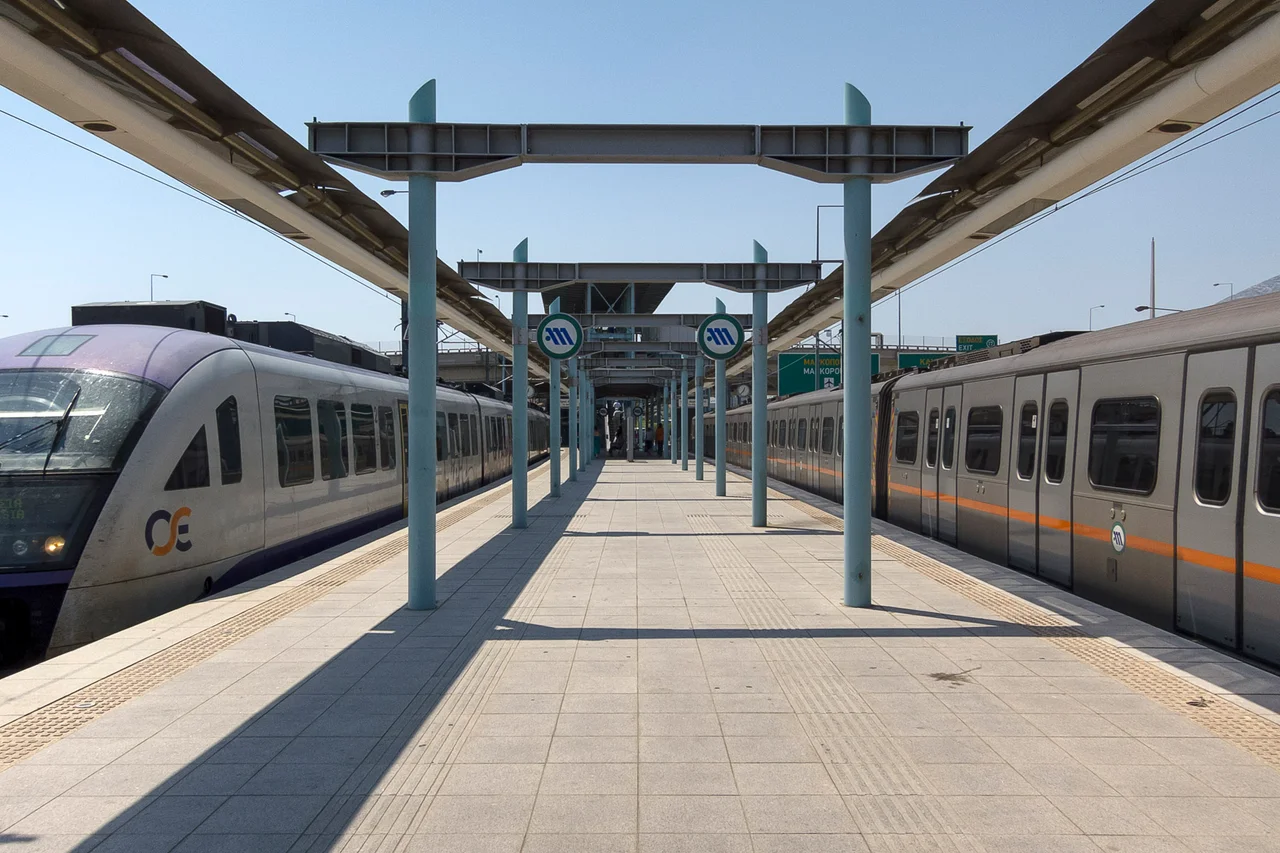
At 47.3 kilometres, Line 3 is the longest in the Athens Metro system. It runs from Dimotiko Theatro — the Municipal Theatre station in central Piraeus, opened in October 2022 — through the heart of Athens and out to the northeastern suburbs, where it joins the Athens Suburban Railway for the final surface-level stretch along the A6 motorway to Athens International Airport. The full journey from Piraeus to the airport takes up to 59 minutes. Most trains on the line begin or terminate at Doukissis Plakentias station; only one direct service every 36 minutes continues all the way to the airport. The line opened its first section between Syntagma and Ethniki Amyna on 28 January 2000, the same day as Line 2, marking Athens' transformation into a city with a genuinely modern urban transit network. The Monastiraki extension, completing the link to the city's historic bazaar district, followed in April 2003.
Digging Through History
Construction of Line 3 yielded more than 50,000 artifacts in the central Athens sections alone. The stations at Syntagma and Monastiraki were particularly rich: beneath Syntagma, workers encountered the bed of the ancient Eridanos River, a Roman bath complex, Byzantine ruins, and human burials spanning multiple periods. Rather than simply catalogue and remove these finds, the designers made them part of the experience. Display cases were built into the station concourses. Syntagma station, opened in 2000, shows cross-sections of the excavation layers behind glass alongside artifacts. Passengers changing trains can stop and look at a city that existed seventeen centuries before the train they are about to board.
Extension to Piraeus
The westward push to Piraeus was a long time coming. Construction on the Piraeus extension began with a signed contract on 1 March 2012 between Attiko Metro S.A. and a joint construction venture. The extension to Nikaia in 2020 brought the municipalities of Korydallos and Nikaia into the metro's catchment area, serving approximately 132,000 additional passengers daily. The final three stations — Maniatika, Piraeus, and Dimotiko Theatro — all opened together on 10 October 2022. The completed line now links the Port of Piraeus, one of Europe's largest passenger ports, directly to Athens International Airport. One transfer-free ride connects the ship terminal to the departure hall. The dual-voltage rolling stock, supplied by ROTEM, switches automatically from 750 V DC third-rail inside the tunnels to 25 kV AC overhead catenary on the surface section to the airport.
The Airport Train That Almost Disappeared
Not everything about Line 3 has run smoothly. On 1 November 2018, the transit operator STASY introduced a new timetable that cancelled direct metro services from central Athens to the airport. The reason was pragmatic if embarrassing: a shortage of spare parts for the dual-voltage fleet meant there were not enough trains to run the full service. Passengers who needed the airport had to change trains at an intermediate station. The reaction was immediate and vocal — including a formal complaint from the Transport Ministry's General Secretary, who argued that STASY required ministerial approval before making such a change. Eight days later, on 9 November 2018, STASY reversed course and reinstated the direct service from 10 November. The episode was brief, but it illustrated how deeply the airport connection had embedded itself in the expectations of both travellers and the city's political establishment.
A Network Still Growing
Line 3 continues to shape Athens. Its arrival in Nikaia in 2020 extended urban transit into working-class western suburbs that had relied on buses for decades. The planned Line 4 — a U-shaped route that will cross the city on a different axis — absorbed a branch-line proposal that was originally part of Line 3's early designs. The network the first tunnellers envisioned in the 1990s has become something larger and more interconnected than the original plans suggested. Beneath the ancient city, the trains run through rock that remembers everything — and carry passengers who mostly don't think about that at all, which is also, in its own way, a kind of continuity.
From the Air
The central alignment of Line 3 runs roughly east-west through Athens at approximately 37.97°N, with the metro's midpoint around 23.73°E. From the air at 3,000–5,000 feet, the underground route is not directly visible, but the Syntagma Square terminus and the Monastiraki area are navigational anchors in the city centre. The surface section from Doukissis Plakentias to the airport follows the A6 motorway corridor clearly visible from altitude. Athens International Airport (LGAV / Eleftherios Venizelos) is the eastern terminus of the extended Line 3 service, at 37.94°N, 23.95°E.
Nearby Stories
- Parnitha 3.4 km away
- Kea (island) 7.3 km away
- Sanctuary of Apollo Maleatas 11 km away
- Sousaki Volcano 12 km away
- Battle of Leuctra 14 km away
- Great Sand Beach 18 km away
- Agios Georgios (island) 23 km away
- Skyros 84 km away