
Linneper Hof
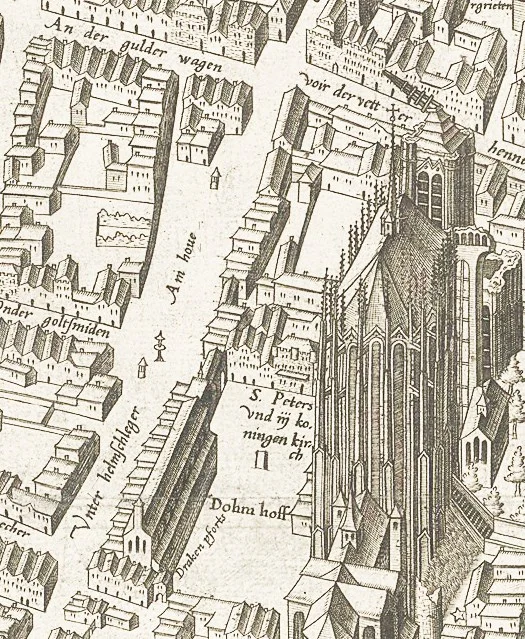
Walk the open plaza south of Cologne Cathedral today and you will see tourists posing for photos, the sleek glass face of the Romano-Germanic Museum, and the cathedral's massive choir blocking out half the sky. What you will not see is a house. But for more than 600 years there was one — the Reifferscheider Hof, later called the Linneper Hof — pressed so tightly against the cathedral choir that the famous Mercator city map of 1571 shows it almost completely hidden. Generations of clerics, bankers, and a single condemned heretic lived inside its walls. By 1864 the last of them was gone and the building came down. The cathedral has outlived almost everything around it. This house is one of the things it outlived.
A Gift Beside the Cathedral
Archbishop Heinrich I von Müllenark gave the property to the cathedral chapter sometime before his death in 1238, designating it a canon's residence — the kind of house only a senior cleric of the diocese could occupy. The first known resident was the canon Herimann von Heppendorf, who died in 1257, and through his mother Agnes von Linnep the house's eventual name began its slow approach. For decades the building passed between members of the Reifferscheid family, all of them named some variation of Heinrich, all of them serving as canons of Cologne, all of them living in the cathedral's literal shadow. The Hof was an emphyteusis — a kind of perpetual hereditary lease — which meant the cathedral chapter never really gave it away, only loaned it across centuries.
Diplomats, Princes, and a 1477 Betrothal
The Hof's residents tilted increasingly grand. In 1397 Wilhelm von Sombreffe handed it to Gottfried, lord of Heinsberg and Count of Chiny; a year later Gottfried sold it to the sub-dean Johannes II of Linnep, prior of St. Gereon, and from then on the building carried his family's name. In July 1477 it found itself momentarily at the centre of European dynastic politics. The Trier Archbishop Johann II of Baden, who was acting as envoy to the future Emperor Maximilian I, was staying in the house in Cologne at the same time Maximilian himself was arriving for his betrothal to Mary of Burgundy. Four days after taking up residence in the Linneper Hof, Archbishop Johann signed a coinage agreement with the electors of Mainz, the Palatinate, and Jülich. A few hundred square metres of cathedral-quarter real estate had briefly become a chamber of the Holy Roman Empire.
The Burgher Who Wouldn't Baptise His Child
Not every story inside these walls was about princes. In 1534 the cathedral chapter rented the house — misspelled in the lease as the Lenneper — to a Cologne burgher named Mathias Vorsbach, who moved in with his wife Jutta von Lachem and his children. Vorsbach was a quiet kind of dissident in a city where dissent could be lethal. From 1551 onward he was prosecuted for refusing to baptise his child as an infant, a defining demand of Anabaptist conscience. He died in prison in Brühl, just south of Cologne, six years later. His widow lived on for another half-century. The cathedral, meanwhile, continued to draw its rent from a house whose tenant had been killed by the cathedral's own theology.
The Seminary, the Demolition, and the Soil Below
In 1747 and 1748 the Roman Catholic Archdiocese bought the Linneper Hof from the cathedral chapter, paying to clear ground for the architect Michael Leveilly's new Cologne Seminary, finished by 1748. The seminary itself was relocated in 1827, and the building lingered until 1864, when demolition crews finally erased the last walls. For nearly a century afterward there was just open space here at the edge of the Domhof. Then archaeologists found a Roman mosaic floor only a metre or two beneath the surface, and in 1974 the Romano-Germanic Museum opened above it. The site that once held a 700-year-old aristocratic residence now displays a Dionysian floor laid down by Cologne's first occupiers, the Romans. Layer over layer over layer — Cologne, telling its own story in stratigraphy.
From the Air
The vanished Linneper Hof stood at roughly 50.941°N, 6.958°E, immediately south of Cologne Cathedral's choir and now beneath the Romano-Germanic Museum on Roncalliplatz. From the air the cathedral's twin spires are the unmistakable landmark, with the Rhine sweeping past 200 metres to the east. Nearest airport is Cologne Bonn (EDDK / CGN), 14 km southeast.
Nearby Stories
- Diamond Interchange: How a Simple Idea Reshapes Towns Like Julich 2.8 km away
- Dusseldorf-Unterbach 6.1 km away
- Baumwollspinnerei Ermen & Engels 11 km away
- RAF Bruggen 15 km away
- Hagen Open-air Museum 21 km away
- Belgium 130 km away
- Marcinelle Mining Disaster 173 km away
- Zwingenberg Castle 178 km away