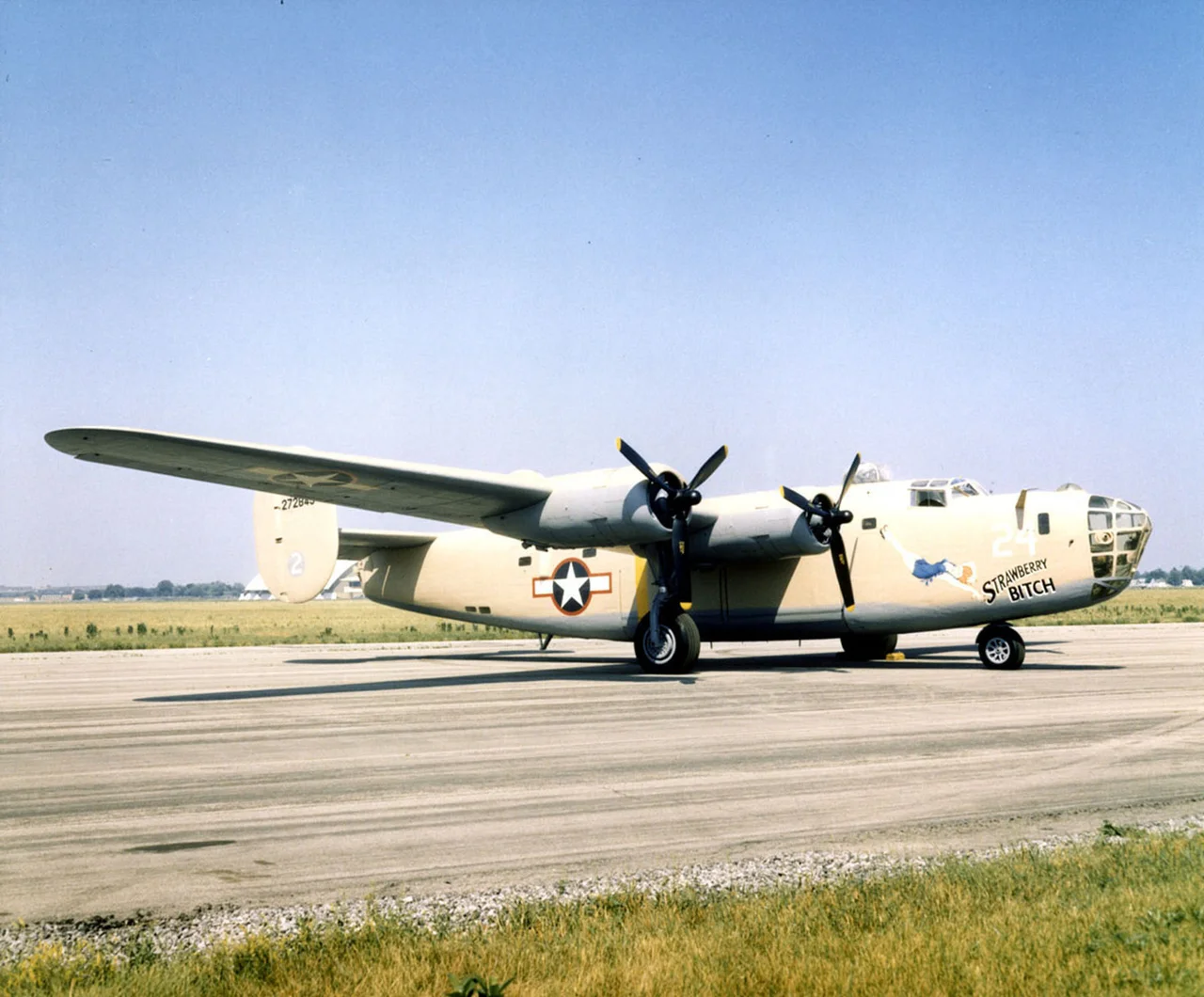

Little Eva
At about 2:45 on the morning of 2 December 1942, a four-engined bomber fell out of a thunderstorm and burned into the scrub near a waterhole north-west of Burketown. The men who had jumped from it a few minutes earlier drifted down into one of the emptiest corners of Australia, believing they were somewhere near Cairns and the east coast. They were wrong by the width of a continent's top edge. What killed most of them was not the crash. It was the country, and the heat, and the slow arithmetic of thirst over the weeks that followed.
The Storm That Took the Radio
"Little Eva" was a Consolidated B-24 Liberator of the 321st Squadron, 90th Bombardment Group, flying from the airfield at Iron Range on Cape York. On 1 December she joined four other Liberators in a high-altitude raid on a Japanese troop convoy north of Buna, in New Guinea. On the way home she lost contact with the others and turned for base alone. Then a severe tropical thunderstorm closed over her, knocked out the radio, and pushed the crew off course in the dark. By the time the navigator understood how lost they were, the fuel was nearly gone. Lieutenant Norman Crosson, the pilot, gave the order every airman dreads: bail out. The crew went into the night over country none of them could see.
Two Who Walked East
Not everyone made it to the silk. Several men died in those minutes — one when his parachute fouled on the aircraft, others who rode it down to the crash. Crosson and Sergeant Loy Wilson found each other on the ground and, by sheer luck, chose to walk east. They had almost no food and almost no water, and their feet blistered raw inside their flying boots. The route they guessed at happened to carry them, after thirteen days, straight onto Escott Station, about fifteen kilometres west of Burketown. On 14 December the station manager drove two starved, sunburned Americans to Burketown's four-bed hospital. Their survival was the first anyone knew of the crash. It set off a search across the Gulf that would last nearly five months.
The Long Walk West
The other survivors had gone the opposite way, toward what they thought was the coast near Cairns. Four men stayed together: Staff Sergeant Grady Gaston, the ball-turret gunner; co-pilot Lieutenant Arthur Speltz; bombardier Lieutenant Dale Grimes; and Lieutenant John Dyer. Between them they had a jungle knife, a fish hook and line, a few bars of chocolate, some matches in a waterproof tin, and two pistols they soon threw away as useless. They reached the Gulf of Carpentaria and turned to follow the shoreline, swimming the river mouths where saltwater crocodiles live. On Christmas Eve they sheltered in an abandoned paperbark hut. Speltz, whose feet had given out, stayed behind. The walking grew slower. Crossing the flooded Robinson River, Grimes was swept out to sea, too weak to fight the current.
Five Months Alone
Dyer and Gaston turned back to the hut where Speltz waited. Through February 1943 the two officers died there of starvation, days apart — Dyer first, then Speltz on the night of the 24th. That left Grady Gaston, twenty-two years old, alone in a paperbark shelter in the Gulf wet season, living on fish he could catch and whatever berries he could find. He held on. On 23 April 1943, Aboriginal stockmen out looking for stray cattle came upon him — nearly five months after "Little Eva" went down. He was carried out, recovered, and lived another fifty-five years. The bomber's wreckage still lies near Moonlight Creek, and the story has since drawn books, a survival documentary, and a planned feature film. But it is really the story of five men who came home from a raid and could not find their way back from the silence beneath it.
From the Air
Crash site near Moonlight Creek, roughly 17.33°S, 139.00°E, in flat Gulf savanna north-west of Burketown. Burketown Airport (YBKT) lies to the south-east with 24-hour AVGAS and JET A1; Mornington Island/Gununa (YMTI) sits offshore to the north, and Normanton (YNTN) is to the east. The terrain is deceptively featureless — low scrub, tidal river mouths, and saltpan reaching to the Gulf shore — which is exactly why a lost crew misjudged where they were. Best appreciated from 3,000-5,000 ft in the dry-season clarity of June to October; in the wet, the same plains flood and isolate for months.
Nearby Stories
- Nicholson River 22 km away
- Leichhardt River 24 km away
- Old Westmoreland Homestead 28 km away
- Bountiful Islands 53 km away
- Burketown Post Office 56 km away
- Boodjamulla National Park 125 km away
- Vanderlin Island 216 km away
- Delta Downs Station 242 km away