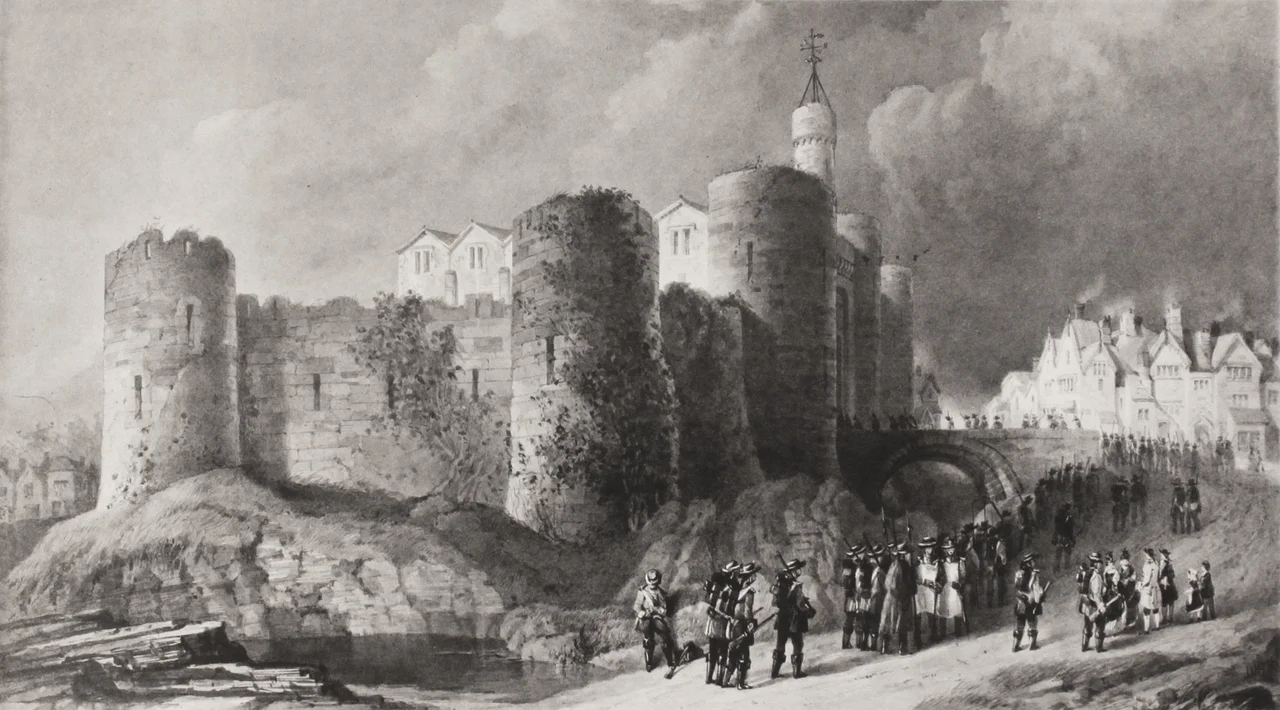

Liverpool Castle
Stand in Derby Square in central Liverpool and look up at the bronze figure of Queen Victoria, sceptre in hand, on her granite pedestal. Beneath her -- buried under paving stones, traffic islands, and a Crown Court built to look like a castle -- lies the actual castle. King John founded Liverpool by Letters Patent in 1207 and someone built him a stronghold here to guard the new port. By 1235 the garrison from nearby West Derby had been transferred in to hold it. It would stand for nearly five hundred years, survive a single rebellion put down in under an hour, fall to Prince Rupert's cavaliers in a week of brutal fighting during the English Civil War, and be demolished by an Act of Parliament in 1715 so that a church could be raised on its site. Prince Rupert called it "a crow's nest that any party of schoolboys could take." The 1,500 men he lost trying to take it suggest otherwise.
The Pool and the Castle
Liverpool began as a tidal inlet called The Pool — a natural harbour cut into the Mersey's eastern bank, drying at low tide, deep enough for shipping at high. King John gave the place its borough charter in 1207, hoping for a port from which to launch expeditions to Ireland, and somebody set about fortifying it. There are no surviving records of when the castle was actually built. The first hard reference comes in 1235, when William de Ferrers, 4th Earl of Derby, was issued a licence to crenellate — royal permission to strengthen his existing castle. That same year, the garrison of 140 soldiers from West Derby Castle, the old motte-and-bailey two miles inland, was transferred to Liverpool. The new fortress stood at the junction of Castle Street and Lord Street, on the highest ground overlooking the Pool. By 1297 West Derby was abandoned entirely. By 1326 it lay in ruins. Liverpool Castle had absorbed its purpose, its men, and its name.
Four Towers and a Moat
It was a small castle by the standards of the great northern strongholds, but it was a serious one. The builders cut a moat twenty yards wide out of solid bedrock and raised the castle on a constructed plateau above it. The plan was a rough square. A gatehouse with twin towers faced Castle Street to the north-east. Three round towers anchored the other corners — a fourth was added in 1442, for £46 13s 10¼d, when Sir Richard Molyneux took over as hereditary constable. Curtain walls connected the towers; the north and south walls were recessed so defenders in the corner towers could pour arrows along their length. Inside the courtyard stood a great hall, a chapel, a brewhouse, a bakehouse, and -- because medieval castles were also farms -- a dovecot for fresh meat in winter and an orchard running down the slope toward the Pool. A passage ran beneath the moat to the riverbank, useful when supplies needed to come in by water during a siege.
Edward, Prince Rupert, and the Crow's Nest
For most of its life, Liverpool Castle had a quiet existence. Edward II stayed there in October 1323. Edward III used Liverpool as a port of embarkation for his Scottish and Irish wars and ordered the constable to shelter men fleeing the Scots in 1327. The Banastre Rebellion of 1315 produced the only recorded attack on the castle before the Civil War — and it lasted less than an hour. Then came 1644. The English Civil War turned Liverpool, with its Atlantic-facing port, into a strategic prize. The Parliamentarians held the castle. Prince Rupert of the Rhine, the king's flamboyant cavalry commander, arrived from Everton Brow with his Royalist army and looked down at the modest fortress. "It is a crow's nest," he said, "that any party of schoolboys could take." The schoolboys took a week. The siege cost Rupert 1,500 of his men before the castle finally fell. It was retaken by Parliament soon after, and changed hands several more times before the war ended.
Demolished by Act of Parliament
By the late seventeenth century, Liverpool Castle had become an awkward relic. The town had outgrown it. Protestant supporters of William of Orange seized it during the Glorious Revolution of 1689, but afterwards it sat unused, slowly decaying, taking up valuable ground in a town now booming on the back of the slave trade and Atlantic commerce. In 1715, an Act of Parliament settled the question — the castle was to be demolished and a church built on the site. St George's Church rose on the cleared ground and was consecrated in 1734. The town's first commercial wet dock, the world's first, had opened just a year before the demolition Act, in 1715. Liverpool had stopped being a fortified port and become an industrial one. The church itself was rebuilt in 1825 and demolished in 1899. In 1902 the Victoria Monument went up in its place — a tall granite drum surmounted by Queen Victoria, herself surrounded by allegorical figures. Excavations in 1976, before the new Crown Court building went up, finally uncovered some of the castle's foundations. The court itself was designed in mock-castellated style, a quiet architectural joke acknowledging what used to be beneath the carpark.
The Ghost at Rivington
There is a stranger postscript. At Lever Park in Rivington, twenty miles north of Liverpool, Sir William Lever — the soap magnate who built the model village of Port Sunlight — commissioned a scale replica of Liverpool Castle in 1912. Lever was a man of considerable means and considerable whim, and he had become fascinated by E. W. Cox's 1892 conjectural reconstruction of the lost castle. He set masons to work building the thing in miniature on a wooded hillside, a folly to stand in for the original. They never finished it. Lever's replica still stands, a half-built fragment among the trees above Rivington reservoir, the only visible Liverpool Castle anyone alive has ever seen. The real one lies buried beneath Queen Victoria's feet, the dovecot and the brewhouse and the crow's nest tower all somewhere down there, under the paving.
From the Air
Located at 53.405N, 2.989W at Derby Square in central Liverpool, between the river and the city centre. The site is marked by the Victoria Monument and the castellated Queen Elizabeth II Law Courts. From the air, look for the small green square between the Mersey waterfront and the commercial core. Nearest airport: Liverpool John Lennon Airport (EGGP), approximately 7nm southeast. Best viewed from 2,000-4,000ft.
Nearby Stories
- RAF Wrexham 3.3 km away
- Birkdale Palace Hotel 3.7 km away
- Turton Tower 4.1 km away
- Tatton Park 5.6 km away
- Abergele Rail Disaster 9.6 km away
- Diglake Colliery Disaster 13 km away
- Ysbyty Ifan 16 km away
- Celtic Array 62 km away