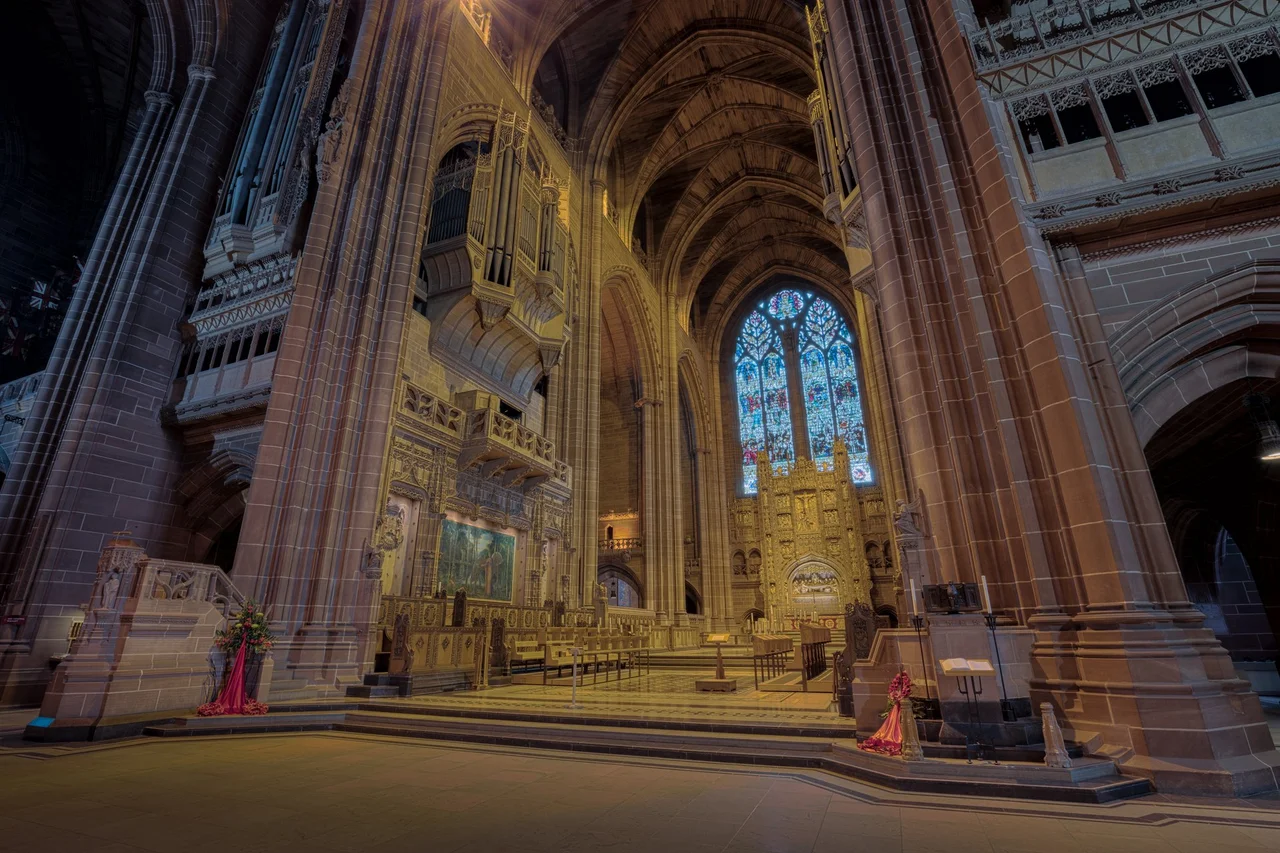

Liverpool Cathedral
The choice was contentious from the moment it was made. In 1903 the Cathedral Committee opened the envelope containing the assessors' recommendation for the architect of their new Anglican cathedral and read the name of a 22-year-old articled pupil from a London practice. Worse, when they checked, Giles Gilbert Scott was a Roman Catholic. They hired him anyway. He worked on the building for the next 57 years until his death in 1960, and the cathedral he designed was finally consecrated in 1978 -- a building so vast that Liverpool Cathedral is now the largest cathedral, and the largest church of any denomination, in Britain. The peal of bells hangs 220 feet above the floor. The pipe organ has 10,268 pipes. The tower rises 331 feet, and on a clear day from the top you can see the mountains of Snowdonia across the Irish Sea.
A Competition, A Quarrel
Two architects assessed the field for Liverpool in late 1901: George Frederick Bodley, a Gothic Revival master, and Richard Norman Shaw, an eclectic who had drifted from Gothic toward what one biographer called "full-blooded classical or imperial architecture." The committee insisted on Gothic. Robert Gladstone, a committee member and great-nephew of the Prime Minister, declared that no other style could produce "so devotional an effect." Reginald Blomfield and other architects protested in print, calling Gothic "a worn-out flirtation in antiquarianism." The Times agreed in an editorial: imposing such a restriction was "unwise and impolitic." Eventually the assessors compromised, agreeing to consider Renaissance and Classical proposals as well. They received over 100 submissions. They asked five architects to develop their designs further. And then they recommended the one nobody had heard of.
The Twenty-Two-Year-Old
Giles Gilbert Scott was articled to Temple Moore's practice in London when he submitted his designs. He was the grandson of Sir George Gilbert Scott, the most famous church architect of the previous generation. He was unmistakably talented, and unmistakably very young. The committee was prepared to be persuaded by talent, but when they discovered his Catholicism in the depths of Protestant Liverpool, where sectarian feeling ran hot in the early twentieth century, the appointment nearly collapsed. The compromise was elegant: Scott would design, but Bodley -- one of the assessors -- would be paired with him as joint architect, supervising the work of the prodigy until Bodley's death in 1907. After that, Scott was on his own. He kept revising the design as he matured. The twin western towers in his winning entry became a single massive central tower over the crossing. The plan grew steadily larger and bolder. By the time the Lady Chapel was completed in 1910, Scott had already moved past his original drawings.
Built Through Two World Wars
Construction began in 1904 and continued, with interruptions for two world wars and the Great Depression, until 1978 — 74 years from foundation stone to final consecration. Scott did not live to see it finished; he died in 1960 with the great nave still under construction. The Luftwaffe bombed Liverpool intensively in 1941 and damaged the partly-built cathedral. Building continued anyway. The red sandstone came from Woolton Quarry, just outside the city. The vault rises 175 feet above the nave floor. The tower above the crossing reaches 331 feet, one of the world's tallest non-spired church buildings. When the bells were finally hung, they sat at 220 feet above the floor — the highest and heaviest ringing peal in the world. The largest of them, Great George, weighs 14.5 long tons and is the second largest working bell in the British Isles, beaten only by St Paul's Great Paul in London.
Largest Organ in Britain
Inside, the scale is hard to absorb. The nave is so long that the building dwarfs every cathedral in England — the floor area exceeds 100,000 square feet, the total volume places it fifth among cathedrals worldwide. Above the choir hangs the great organ, built by Henry Willis and Sons and completed in 1926. It is the largest pipe organ in the United Kingdom and one of the largest musical instruments in the world. Two five-manual consoles control 10,268 pipes ranging from less than an inch to more than thirty-two feet in length. When the full organ plays at the closing of evensong, the sound moves through the stone like weather. The choir at Liverpool has its own tradition stretching back to the cathedral's first organist, Frederick Hampton Burstall, and the building's reverberation is so generous that pieces written for medieval cathedrals come into their own here in ways their composers never heard.
Hope Street
Liverpool Cathedral stands at the south end of Hope Street, on St James's Mount, looking down across the old churchyard quarry where the dead of Victorian Liverpool were buried in layered terraces. From its lantern tower, the view runs north along Hope Street to the Metropolitan Cathedral — Frederick Gibberd's circular concrete crown, completed in 1967, eleven years before Scott's was finished. Two cathedrals on one street, both built in the twentieth century, one Catholic and one Anglican, one a great Gothic mountain and one a glass-topped tent. Liverpudlians sometimes call the Anglican "Paddy's Wigwam" and the Catholic "the funnel" — they get the names mixed up the way the city gets its allegiances mixed up, with affection and irreverence. Tracey Emin's pink neon sign in the cathedral, installed in 2008, reads "I felt you and I knew you loved me." It hangs in the west window, glowing into the dusk over the Mersey, and somehow it fits perfectly into a building that took 74 years to make.
From the Air
Located at 53.398N, 2.973W on St James's Mount in central Liverpool, at the southern end of Hope Street. From the air the cathedral is unmistakable -- a vast red sandstone mass with a single massive central tower (331ft), the largest church building in Britain. The Metropolitan Cathedral's circular form stands at the northern end of the same street, making the pair easy to spot together. Nearest airport: Liverpool John Lennon Airport (EGGP), approximately 7nm southeast. Best viewed from 2,500-5,000ft.
Nearby Stories
- RAF Wrexham 3.3 km away
- Birkdale Palace Hotel 3.7 km away
- Turton Tower 4.1 km away
- Tatton Park 5.6 km away
- Abergele Rail Disaster 9.6 km away
- Diglake Colliery Disaster 13 km away
- Ysbyty Ifan 16 km away
- Celtic Array 62 km away