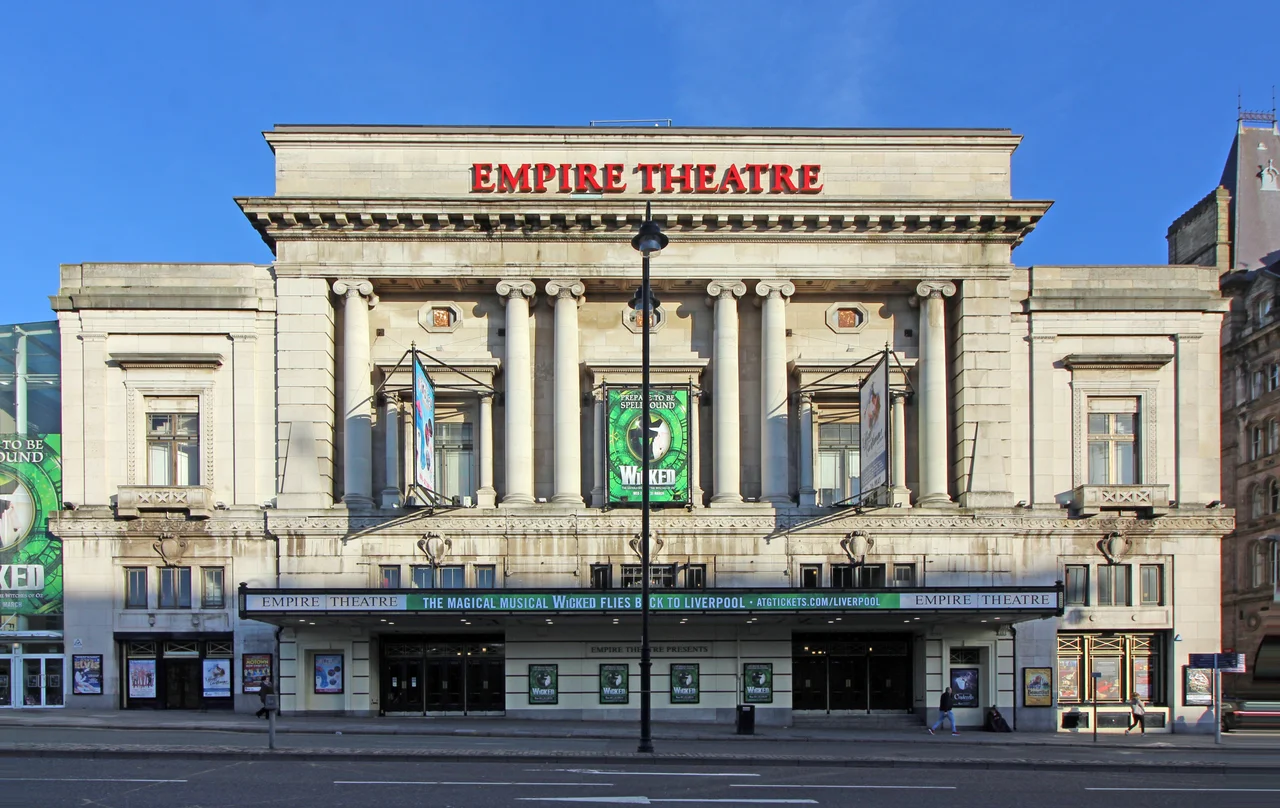

Liverpool Empire Theatre
In 1976, midway through the extended instrumental in "Death Trip," Steve Harley walked too close to the edge of the Liverpool Empire stage and tipped over into the orchestra pit. He broke three ribs on the way down. He climbed back up and finished the song as if nothing had happened. The rest of the tour had to be cancelled. That kind of evening is what the Empire Theatre on Lime Street has been hosting since 1925, when it opened as the second theatre on this corner of Liverpool — the first having stood here from 1866 until it was demolished the year before. With 2,348 seats stacked in the largest two-tier auditorium in the United Kingdom, the Empire is the kind of Victorian-scale palace that the city built in its imperial pomp and then somehow never demolished, even when the cinemas next door were coming down all around it.
The Royal Alexandra and Its Successor
There has been a theatre on this corner since 15 October 1866, when the New Prince of Wales Theatre and Opera House opened with what was then the largest auditorium in Liverpool. Nine months later, in July 1867, it changed its name to the Royal Alexandra in honour of the new Princess of Wales. It ran successfully for nearly sixty years, hosting the great variety performers of the Victorian and Edwardian stage — Dan Leno, the king of music-hall comedy; George Formby Sr., father of the more famous ukulele-strumming son; Florrie Forde, the Australian singer who could fill a hall with "Down at the Old Bull and Bush." By the early 1920s the building was no longer big enough. On 16 February 1924 the Royal Alexandra closed its doors for the last time. The next day the demolition crews moved in. Within fifteen months a new theatre rose from the cleared site.
Milburn and Moss Empires
The brothers W. and T. R. Milburn designed the new Empire for Moss Empires, the powerful music-hall chain that operated theatres across Britain. They built it on a steel frame faced in Portland stone, in a free Neoclassical style — five bays across the front, the central three rising to an attic above the lateral pair, paired Ionic columns flanking the recessed balcony windows. Inside, E. O. Griffiths carved the auditorium ornament. The seating layout was unusually steep, raked sharply to give every patron a clear sightline to the stage. The first production in the new building was a musical comedy called Better Days, starring Stanley Lupino, and the place was full. Liverpool in 1925 still had the money and the audiences to fill 2,348 seats night after night. The Empire would be the city's largest live venue for the next century, never bettered.
The Quarrymen Come Home
In 1957 a local schoolboy skiffle group called the Quarrymen, fronted by a 16-year-old John Lennon, appeared at the Empire. Nobody noticed them much. They came back in 1959 calling themselves Johnny and the Moondogs, and again nobody noticed them much. They returned a third time in 1962, by which point they were the Beatles, had just signed with EMI, and were about to upend popular music. The Empire was their hometown stage — the room where the boys who had grown up around Lime Street and the docks finally played to a Liverpool audience as something more than a club act. Through the 1970s and 1980s the Empire booked everyone. Led Zeppelin played there. Queen. Kate Bush in 1979, on her one and only concert tour, treating a Lime Street audience to the choreography of "Wuthering Heights" in full Victorian dress. AC/DC. Black Sabbath. Iron Maiden. Cilla Black, the Scouse girl who became Britain's biggest TV personality of the 1970s. Shirley Bassey. Elton John. The room held them all.
Two Ghosts and a Royal Command
Every Victorian theatre worth visiting has its ghost story, and the Empire keeps two. The first is Len, a former scenic painter who is said to walk the upper levels and occasionally be glimpsed by stagehands during late get-outs. The second is a girl of about nine or ten in Victorian dress, sometimes seen sitting alone in the circle, sometimes drifting down the centre aisle. Neither has ever been recorded saying anything; they keep to the corners of long evenings, as theatre ghosts traditionally do. The living have been more vocal. Two Royal Command Performances took place at the Empire in the 1970s, royalty coming north from London because no London theatre had the seating capacity. Today the Empire is part of the Ambassador Theatre Group and stages everything from the West End musical tours to opera and even professional wrestling. Each summer, a Stage Experience programme produces a full musical with local teenagers — Summer Holiday in 2007, The Wiz in 2008, working through Bugsy Malone, Fame, West Side Story, Annie, Grease, Cats, and Rent. It is, by some margin, the largest single-stage producing theatre in north-west England. The auditorium has not been bettered. The ghosts, presumably, are pleased.
From the Air
Located at 53.409N, 2.978W on the corner of Lime Street in central Liverpool, opposite St George's Hall. The Portland stone façade with its five bays sits at the north end of Lime Street. From the air the Empire is one of a tight cluster of grand Victorian civic buildings around the Lime Street Station. Nearest airport: Liverpool John Lennon Airport (EGGP), approximately 7nm southeast. Best viewed from 2,000-4,000ft.
Nearby Stories
- RAF Wrexham 3.3 km away
- Birkdale Palace Hotel 3.7 km away
- Turton Tower 4.1 km away
- Tatton Park 5.6 km away
- Abergele Rail Disaster 9.6 km away
- Diglake Colliery Disaster 13 km away
- Ysbyty Ifan 16 km away
- Celtic Array 62 km away