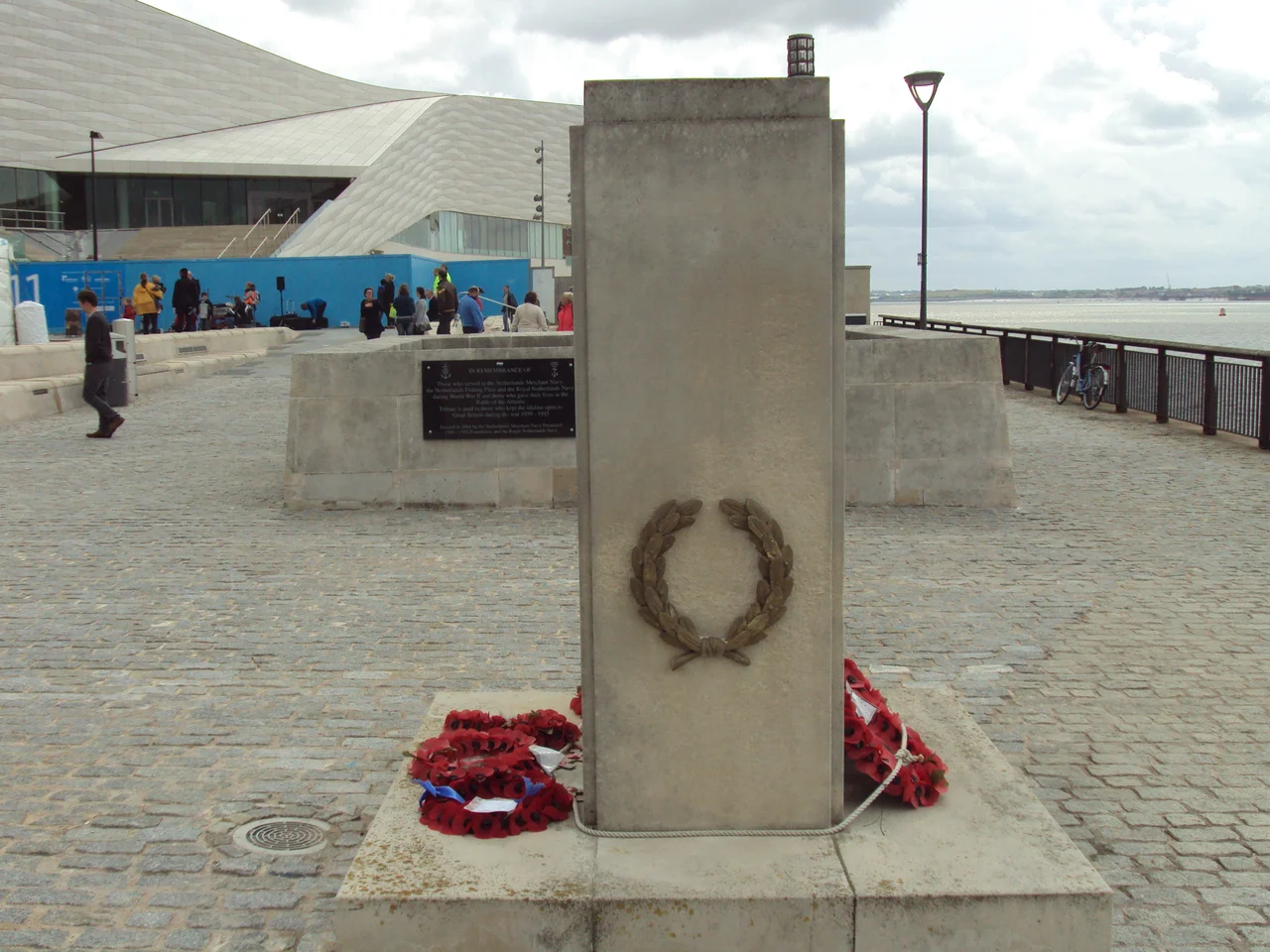

Liverpool Naval Memorial
More than thirteen thousand merchant seamen volunteered. They put down their commercial papers, accepted military discipline, and sailed on armed merchant cruisers and naval auxiliaries throughout the Second World War — still drawing civilian pay, still wearing the Merchant Navy badge, but flying the white ensign and taking the casualties of warships. Of those volunteers, nearly fourteen hundred never came back. Liverpool's Naval Memorial, unveiled on 12 November 1952 at Pier Head beside the River Mersey, carries their names on twenty-five bronze plaques arranged around a curved Portland stone wall. The inscription, in letters meant to last, reads: 'These officers and men of the Merchant Navy died while serving with the Royal Navy and have no grave but the sea 1939-1945.' Rising above the wall is a slender column topped with a glazed lantern designed to look, deliberately, like a lighthouse.
Merchant Sailors in Warships
When the war began, Britain needed more crew than the Royal Navy could supply. The merchant marine — the civilian shipping fleet that carried Britain's trade — had skilled sailors who knew the Atlantic, knew the deck, knew how to keep a ship moving in heavy weather. The Admiralty asked them to volunteer to serve in armed naval auxiliaries: armed merchant cruisers converted from passenger liners, Q-ships, depot ships, fleet auxiliaries. The men kept their merchant-navy ranks and their civilian wages, but they sailed under naval discipline into convoy escort duty, troop transport, and combat. More than thirteen thousand officers and seamen accepted. The depot that registered them was set up at Liverpool — the natural home for such a force, since Liverpool was where the Battle of the Atlantic was coordinated and where most of the British merchant fleet had its registered port. The Western Approaches Command had its headquarters across the Pool of Liverpool. Convoys assembled in Liverpool Bay. Ships came home damaged to the Liverpool docks for repair. And ships did not come home at all.
The Names
The casualties were brutal. The Battle of the Atlantic killed merchant sailors at rates that approached the worst losses of any single theatre of the war — German U-boats, surface raiders, mines, and aircraft sank thousands of Allied merchant ships between 1939 and 1945. Of the men who served with the Royal Navy as auxiliaries from Merchant Navy backgrounds, 1,395 died with no known grave. Some were lost when their armed merchant cruisers were torpedoed in mid-Atlantic. Some went down with their ships in the North Sea, the Mediterranean, the Indian Ocean. The Royal Navy traditionally commemorates its dead-without-graves at three great memorials at Plymouth, Portsmouth, and Chatham. But the men named at Liverpool fit none of those: they were Merchant Navy by trade, Royal Navy by service, and they belonged to neither commemoration. So the Imperial War Graves Commission — soon to be renamed the Commonwealth War Graves Commission — commissioned a memorial of their own. They held a competition, in 1949, open only to architects who had served in the armed forces themselves. The budget was £5,000.
Lantern and Globes
The winning entry came from two architects, Charles Frederick Blythin and Stanley Harold Smith, working with the sculptor George Herbert Tyson Smith — a Merseyside artist whose work decorated several Liverpool buildings, including Lewis's department store and the Cenotaph at Liverpool Town Hall. Their design rejected the obelisk and pyramid forms common to war memorials and reached instead for a maritime metaphor. The column rises from a semicircular Portland stone platform reached by six steps. Around the platform run curved Portland walls bearing the bronze plaques with the names. At the back of the platform stand two stone globes on plinths — one terrestrial, mapping the world the sailors crossed; one celestial, mapping the stars by which they navigated. At the centre rises a narrow cylindrical column. At its top, a glazed lantern with reflective-backed glass lenses meant to resemble, in shape and intent, the lantern of a lighthouse — a light to guide home those who never came home. Admiral of the Fleet Viscount Cunningham of Hyndhope, who had commanded the Mediterranean Fleet in the war, unveiled the memorial on 12 November 1952. It was Grade II listed in 2010.
Pier Head's Other Memorials
The Liverpool Naval Memorial does not stand alone. Pier Head, the open ground between the river and the city's commercial heart, has become Liverpool's principal place of remembrance for the sea. A separate Merchant Navy Memorial — for the merchant sailors who died serving as merchant sailors — was unveiled here in 1998, recognising the 30,000 British Merchant Navy lives lost across both world wars. Around the Pier Head and nearby Canada Dock are plaques and monuments to the seamen of Norway, Poland, China, the Netherlands, and Belgium, allies who sailed out of Liverpool with the convoys. The Chinese memorial in particular tells a difficult story: thousands of Chinese sailors crewed British merchant ships during the war, and many were summarily deported by the British government in 1946 in an operation kept secret for decades. A campaign is underway to build a large Battle of the Atlantic memorial nearby, a recognition that this stretch of riverside is, in effect, the national memorial to the longest-running campaign of the Second World War. The names of the men commemorated at Liverpool are also listed in the Roll of Honour at the Tower Hill Memorial in London, where the merchant sailors of both world wars share a single monument.
Reading the Plaques
Stand close to one of the bronze plaques on a quiet morning, when the tide is high in the Mersey and the ferry crosses to Birkenhead, and the names read like a manifest. Christian name, surname, rank. Some plaques carry a single ship's name beside a cluster of crew — the merchant cruiser HMS Jervis Bay, sunk in November 1940 defending Convoy HX-84 from the pocket battleship Admiral Scheer, lost most of her merchant-volunteer complement together. Some sailors died alone, in a small auxiliary on an ordinary day. The architects placed the lantern high enough that it can be seen from the river, from the Liver Building, from the ferry. The light it holds is just glass and reflective backing, never lit. The intention was always that it should appear lit-from-within at certain angles of the sun, the way a real lighthouse does. The merchant sailors did not have a grave. They have, instead, this lantern that always looks as if it is shining.
From the Air
Located at 53.403N, 2.997W at Pier Head on the Liverpool waterfront, between the Royal Liver Building to the north and the Museum of Liverpool to the south. From the air the memorial appears as a small white circular installation on the open ground between the Three Graces and the river. Nearest airport: Liverpool John Lennon Airport (EGGP), approximately 7nm southeast. Best viewed from 1,500-3,000ft.
Nearby Stories
- RAF Wrexham 3.3 km away
- Birkdale Palace Hotel 3.7 km away
- Turton Tower 4.1 km away
- Tatton Park 5.6 km away
- Abergele Rail Disaster 9.6 km away
- Diglake Colliery Disaster 13 km away
- Ysbyty Ifan 16 km away
- Celtic Array 62 km away