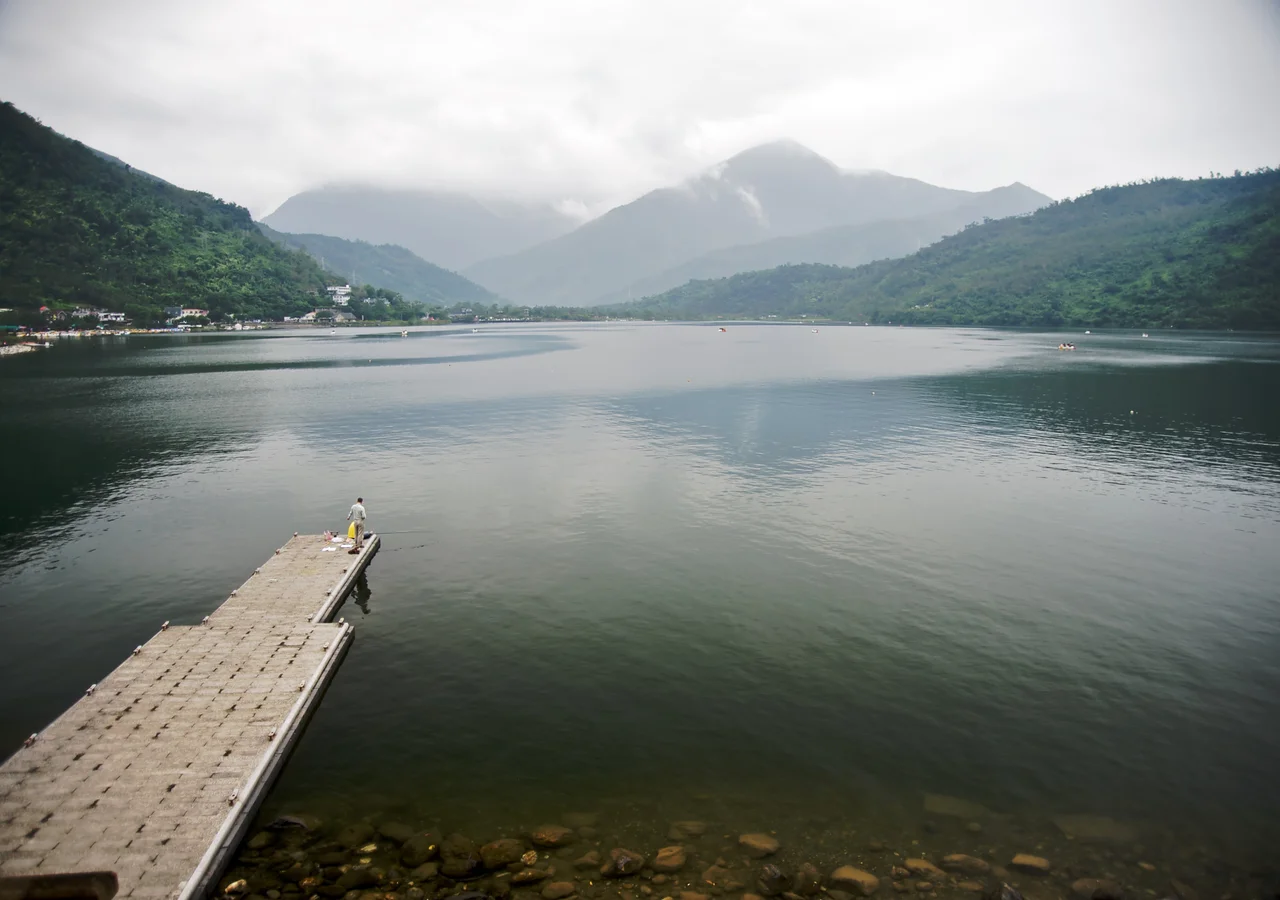

Liyu Lake
Every April, thousands of fireflies rise above Liyu Lake after dark, flashing across the surface of water that reflects the mountains surrounding it. It is a phenomenon that draws visitors to Shoufeng Township specifically for those few weeks — and then keeps them longer than expected. The lake is patient. It does not need to announce itself.
The Lake and the Mountain It Shares a Name With
Liyu means carp in Mandarin, and the lake earned the name not from any single legend but from the fish that have always lived in its water. The name came first from Liyu Mountain, the ridge that rises beside the lake's western edge — the mountain named for its shape, the lake named for the mountain. Both carry the same word, carp, into the landscape.
The lake stretches approximately 1.6 kilometers in length and 930 meters across at its widest point, covering a total area of 104 hectares. Those numbers make it the largest inland lake in Hualien County — a distinction that carries weight in a county otherwise defined by its dramatic coastline and the marble canyon of Taroko Gorge. Liyu Lake is Hualien County's quieter side: forested slopes, reflective water, a pace calibrated not to the ocean but to the mountain that named it.
A Path That Goes Around
The lake has a single-lane bicycle path that circles its entire shore — roughly 5 kilometers of paved trail that follows the water's edge through shade and open stretches and back again. Cyclists pass through sections where the forest presses close to the path, then opens to views across the lake toward the mountain slopes opposite. Walking the path takes an easy hour or two. Cycling it takes less. Either way, the circuit has a satisfying completeness to it — you leave from where you started, having gone all the way around.
Footpaths extend beyond the bicycle loop, threading into the forested areas above the shoreline. The Chinan National Forest Recreation Area occupies the land surrounding the lake, and within it, two very different histories of the forest sit side by side. One is the Mukumugi area, which preserves displays of aboriginal culture from the indigenous communities that have lived in this region for centuries. The other is an exhibit of old logging trains — relics of the industrial era when the forests of eastern Taiwan were harvested on an industrial scale and the railways that served the timber industry were an economic artery of Hualien County.
Fireflies and Changing Seasons
April is the month to come to Liyu Lake if you want to see the fireflies. Thousands of them rise from the lakeside vegetation after dark, their bioluminescent flashes synchronizing and drifting across the water. The species that produce the most spectacular displays prefer the humid, forested margins of still water — conditions that Liyu Lake provides in abundance.
The firefly season is brief, a few weeks at most, before the insects complete their life cycle and the nights return to ordinary darkness. But the lake offers reasons to visit in every season: the summer heat that makes the shaded bicycle path welcome, the autumn clarity that sharpens reflections in the still water, the winter quiet that empties the trails and leaves the carp to their own undisturbed rounds. The lake does not perform for any single season. It simply continues.
Between the Coast and the Valley
Liyu Lake sits in Shoufeng Township, roughly 15 kilometers south of Hualien City along the edge of the East Rift Valley. This puts it at a geographic crossroads: the Pacific Ocean and its dramatic cliffs are minutes to the east, while the valley floor opens westward toward the mountains. Hualien Station provides rail access, with buses running south toward Shoufeng for visitors arriving without their own transport.
The Hualien region has seen intensive development pressure in recent years, with tourism infrastructure expanding along the coastline and into the valley. Liyu Lake, tucked behind the ridge that separates it from the coast, has retained more of its quiet character than some of the higher-profile destinations nearby. The carp are still there, finning through water that carries the mountain's reflection, largely indifferent to the bicycle path that circles them and the visitors who stop to watch.
From the Air
Liyu Lake lies at approximately 23.928°N, 121.510°E in Shoufeng Township, Hualien County, about 15 km south of Hualien City. From the air, it is a clearly visible oval of still water set among forested hillsides in the East Rift Valley — a useful visual reference point when navigating the eastern Taiwan coast. The nearest airport is RCYU (Hualien Airport), approximately 20 km to the north-northeast, sitting on the narrow coastal plain between the Pacific and the Central Mountain Range. Pilots approaching from the north along the coast will note the sharp terrain transition: the valley floor is flat, but ridges rise steeply on both sides. The lake itself, at an elevation of approximately 50 meters, is visible from low cruising altitudes in clear weather as a bright reflective surface among the darker forest.
Nearby Stories
- Paper Dome 6 km away
- Lintianshan Forestry Culture Park 6.8 km away
- Dongshi District 11 km away
- Xitou Nature Education Area 16 km away
- Taiping Mountain Forest Railway 27 km away
- Sinking of MV Sewol 1172 km away
- Yellow Sea 1228 km away
- Twin Forts of Romblon 1240 km away