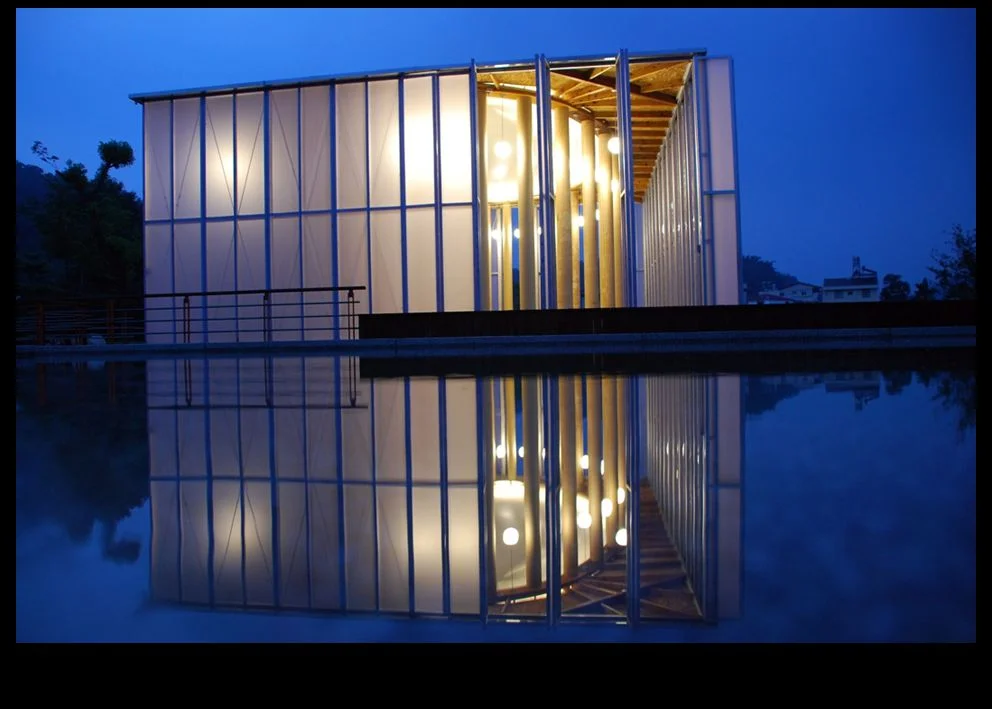

Paper Dome
Fifty-eight cardboard tubes hold up a church. That sentence sounds like the setup to a riddle, but the Paper Dome is real, standing today in a lush valley in central Taiwan, far from the Japanese city where it was born. Designed by architect Shigeru Ban in the aftermath of the 1995 Great Hanshin earthquake, this temporary structure was never meant to last. It was built in five weeks by 160 volunteers to replace the Takatori Catholic Church in Kobe, where 60 percent of all buildings had been destroyed. A statue of Jesus survived the quake unscathed, and the community took that as a sign to rebuild immediately. Ban, already known for using paper in architecture and for designing shelters for refugees in Africa and South America, created something startlingly elegant from the humblest of materials.
From Rubble to Gathering Place
The Paper Dome was never just a church. From its first day in Kobe on September 17, 1995, it served as community center, meeting hall, and emotional anchor for a neighborhood in shock. Ban shaped 58 cardboard tubes into an elliptical frame, each tube 33 centimeters in diameter and about 1.5 centimeters thick. Despite weighing only 60 kilograms apiece, each tube can support up to 1,500 kilograms. The taller pillars bear loads of up to 6,900 kilograms. The entire structure rises 5 meters high, light enough to feel temporary but sturdy enough to shelter a congregation for a decade. Nicknamed the Paper Dome almost immediately, it became the spiritual and social heart of its corner of Kobe.
A Second Life Across the Sea
By 2005, the Kobe congregation had outgrown its paper walls and planned a permanent replacement. The dome was slated for demolition. Then the president of Taiwan's New Homeland Foundation visited Kobe and proposed a different ending: donate the structure to Taomi Village in Nantou County, Taiwan, a community still recovering from its own catastrophe. The 1999 Jiji earthquake, known in Taiwan as the 921 earthquake, had destroyed 168 of the village's 369 homes and killed 20 residents. On May 29, 2005, the last service was held inside the Paper Dome in Kobe, and the building was carefully dismantled and shipped to Taiwan. Three years of paperwork and preparation followed before Taomi was ready.
Resurrection in a Valley
On May 25, 2008, more than 1,000 people gathered in Taomi Village to reassemble the Paper Dome. Each cardboard tube had been recoated with a water-resistant finish produced locally in Puli Township. The dome opened to visitors the very next day, nine years to the season after the earthquake that had shattered the village. On September 21, 2008, delegates from both Christian and Daoist traditions blessed the land beneath it. The Paper Dome had become something it never was in Kobe: a monument, not to disaster, but to the stubborn human reflex to help strangers rebuild. It now stands as the centerpiece of Taomi's ecological village, drawing tourists who come for the frogs and fireflies and stay to marvel at a building made of paper that outlasted concrete.
The Architect of Necessity
Shigeru Ban built his career on the conviction that architecture should serve people who need it most. Before the Paper Dome, he had designed paper-tube shelters for refugees, discovering that cardboard insulated better than the cheap plastic sheeting aid agencies typically provided. He took no fee for the Kobe project. His approach was radically practical: paper tubes are inexpensive, lightweight, easy to transport, and surprisingly strong. The Paper Dome proved that a building designed to be disposable could acquire meaning no permanent structure could match. Ban went on to win the Pritzker Architecture Prize in 2014, but the Paper Dome remains one of his most poignant works, a structure whose second life in Taiwan validated every principle he built his practice on.
From the Air
Located at 23.94N, 120.93E in the Puli Township valley, Nantou County, central Taiwan. Elevation approximately 450 meters. The dome sits within the Taomi ecological village area, visible amid green valley terrain along the route to Sun Moon Lake. Nearest airport: Taichung Airport (RCLG/RMQ), approximately 55 km northwest. Approach from the west over the coastal plain, crossing into the foothills of the Central Mountain Range.
Nearby Stories
- Shigang Dam 2.7 km away
- Taixi, Yunlin 4.9 km away
- Xitou Nature Education Area 7.2 km away
- Lintianshan Forestry Culture Park 11 km away
- Taroko National Park 20 km away
- Smangus 36 km away
- China Airlines Flight 611 56 km away
- Taiwan Strait 69 km away