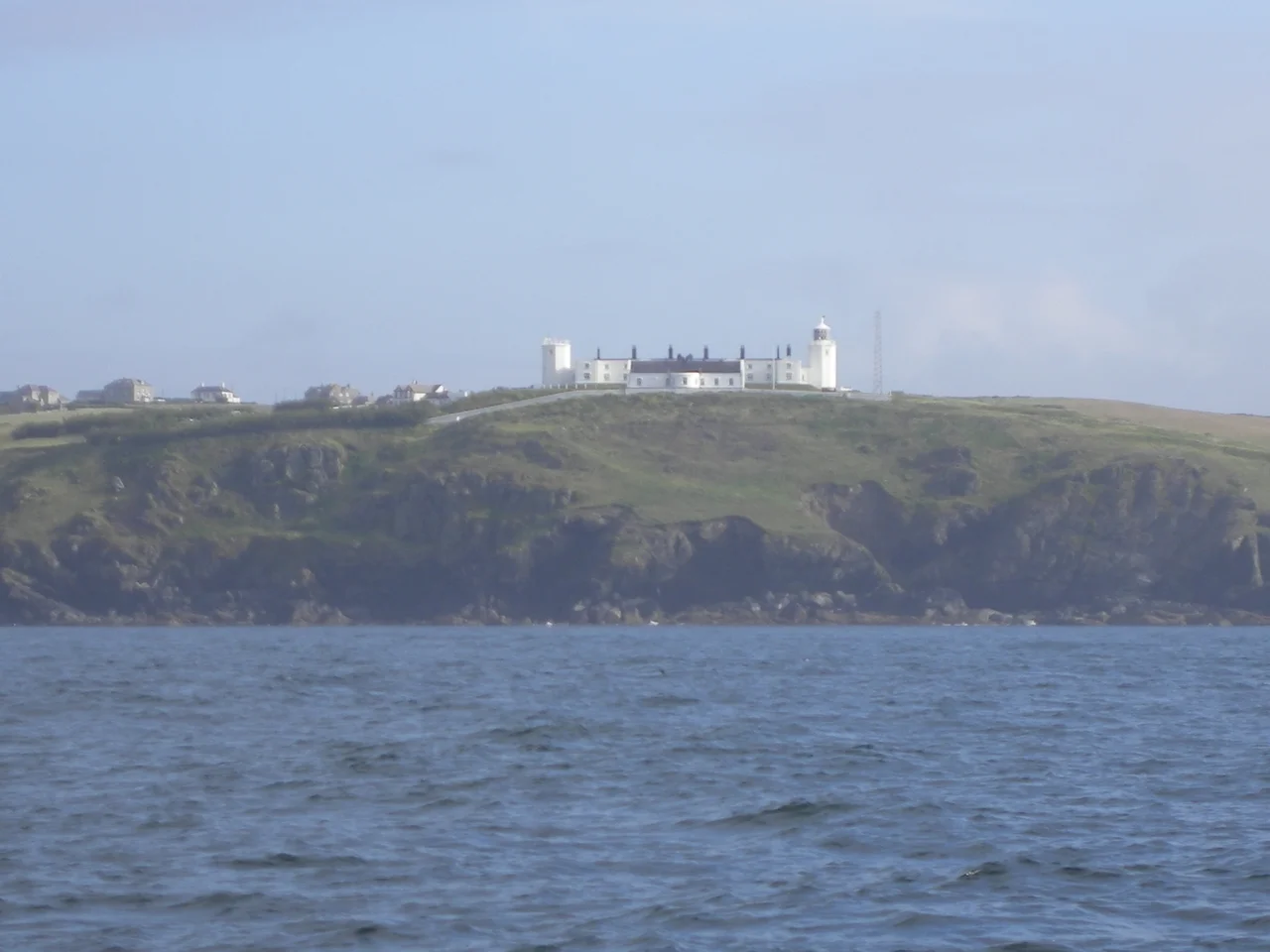

Lizard Lighthouse
Sir John Killigrew did not get rich from his lighthouse. In 1619 he raised a tower at Lizard Point at his own expense, lit it with coal, and watched as the funds to keep it burning failed to materialise. In 1630, eleven years after first light, the tower came down. The Cornish cliffs that had eaten so many ships went dark again. It took another 121 years before someone tried again - and this time the light stayed on.
Two Towers and Nineteen Lamps Each
The current lighthouse was built in 1751 by Thomas Fonnereau, the landowner who finally made the economics work. He did something unusual: he built two towers, joined by keepers' cottages, each topped with a coal-fired brazier. The pair was meant to be unmistakable - any vessel seeing only one light knew it was looking at something else. Inside each tower stood a fixed arrangement of nineteen oil lamps with reflectors. That setup was so durable that by 1873, more than a century later, the original lamps and reflectors were still in use. The wrecks at the Point that year forced the issue. New optics were ordered: medium-sized catadioptric lenses designed by John Hopkinson of the Birmingham firm Chance Brothers, one on each tower. Modernisation had begun.
Electricity Comes to the Cliff
On 29 March 1878, electric lights were first lit at the Lizard, powered by Siemens dynamos. The same year a steam-driven fog siren began sounding, one blast every five minutes through a 15-foot horizontal horn that could be swivelled depending on the wind. In 1885 the dynamos were upgraded to more powerful de Meritens magneto-electric generators. By 1903 a still bigger leap: the western tower's lantern was removed entirely, and a single four-panel rotating optic designed by Thomas Matthews replaced the old fixed lens in the eastern tower. The official announcement called it a 'new revolving light of very great power' visible between 40 and 50 miles. By 1908, automatic systems - emergency acetylene backups, lamp changers, automatic winding for the lens drive - let the station drop its staff from five keepers to three. The machinery aged honourably. The 1885 magnetos kept turning until 1950, when mains electricity finally arrived and four Gardner diesels were installed as backup. The clockwork that drove the rotating optic ran until 1972.
The Last Compressed-Air Foghorn in Britain
Automation came in 1998. The last keepers left, and the great compressed-air fog siren - by then the last of its kind still operating in the United Kingdom - was silenced and replaced with a modern electronic signal. The rotating optic, more than a century after Thomas Matthews drew it, still turns. The light still reaches forty-some miles out into the Channel. One of the old magneto-electric generators sits today in Thinktank, Birmingham's science museum; the other remains in the engine house at the Lizard, in situ on the floor where it earned its keep for sixty-five years. Two of the four Gardner diesels went to the Internal Fire Museum of Power in Wales. The other two stayed put.
The Welcome Beacon
For generations of sailors crossing back from the Americas, Africa, or the Mediterranean, the Lizard light was the first piece of England that announced itself. On a clear night its reflected glow could be seen 100 miles out at sea. Captains kept their watches on, sometimes for days, waiting for the first faint pulse on the horizon. The lighthouse heritage centre, set in the old engine room with two of the original compressors still in place, told that story to visitors until it closed in 2023 with no sign of reopening. The cottages around the towers are holiday lets now. The white twins on the cliff still do their job. Britain, from the south, still starts here.
From the Air
Lizard Lighthouse stands on the southern tip of mainland Britain at 49.9602 degrees north, 5.20206 degrees west. From the air look for the distinctive white double-tower complex on a green clifftop above sheer rock; the light is on the eastern tower. Nearest commercial airport is Newquay (EGHQ), about 65 km north. RNAS Culdrose (EGDR, military) is 14 km north and is the most likely traffic in the vicinity. Best viewed at 1,500 to 3,000 feet in clear weather; the lighthouse is most photogenic with low side-lighting in the late afternoon.
Nearby Stories
- Logan Rock 3.6 km away
- Polperro 7.4 km away
- Great Wheal Charlotte 10 km away
- Battle of Plymouth (1652) 26 km away
- SS Irma (1905) 30 km away
- Black Swan Project 75 km away
- HMS Affray 77 km away
- 1979 Fastnet Race 100 km away