
Llanbadrig
In 1884 the chancel of a small medieval church on the north Anglesey cliffs was restored, and the man paying for the work was Henry Stanley, 3rd Baron Stanley of Alderley. Stanley had converted to Islam while travelling in Arabia, and on his return to England he became the first Muslim member of the House of Lords. When his ancestral chapel of St Patrick at Llanbadrig was crumbling beyond repair, he insisted on something local tradition had never seen: the new stained glass would carry no biblical figures, only geometric and floral patterns in blue and red. Blue and gold tiles were fitted around the sanctuary in the same Islamic-inspired idiom. The Welsh word llan means church, and badrig is Patrick - so Llanbadrig literally means Patrick's church. The result is a Grade II*-listed Christian church on the most northerly point of Wales decorated, in part, like a mosque.
Patrick's Island
Legend dates the church's first founding to 440 CE, when Patrick himself - on his way from Britain to begin the conversion of Ireland - was supposedly shipwrecked on a small rock half a mile offshore. The island is still called Ynys Badrig, Patrick's Isle, though English maps usually mark it as Middle Mouse. From a stile in the churchyard wall you can see it clearly: a low, gull-haunted lump in the Irish Sea. The cove below the church is Porth Padrig. Whether or not the saint ever stood here, the tradition is medieval and the church on the headland is old; the building's oldest fabric is fourteenth century, sitting on what was probably an earlier site. The community at the 2011 census numbered 1,357 - down slightly from 1,392 a decade earlier - spread between the village of Cemaes, the older parish of Llanbadrig and the hamlets of Clygyrog and Tregynrig.
The Promontory Fort
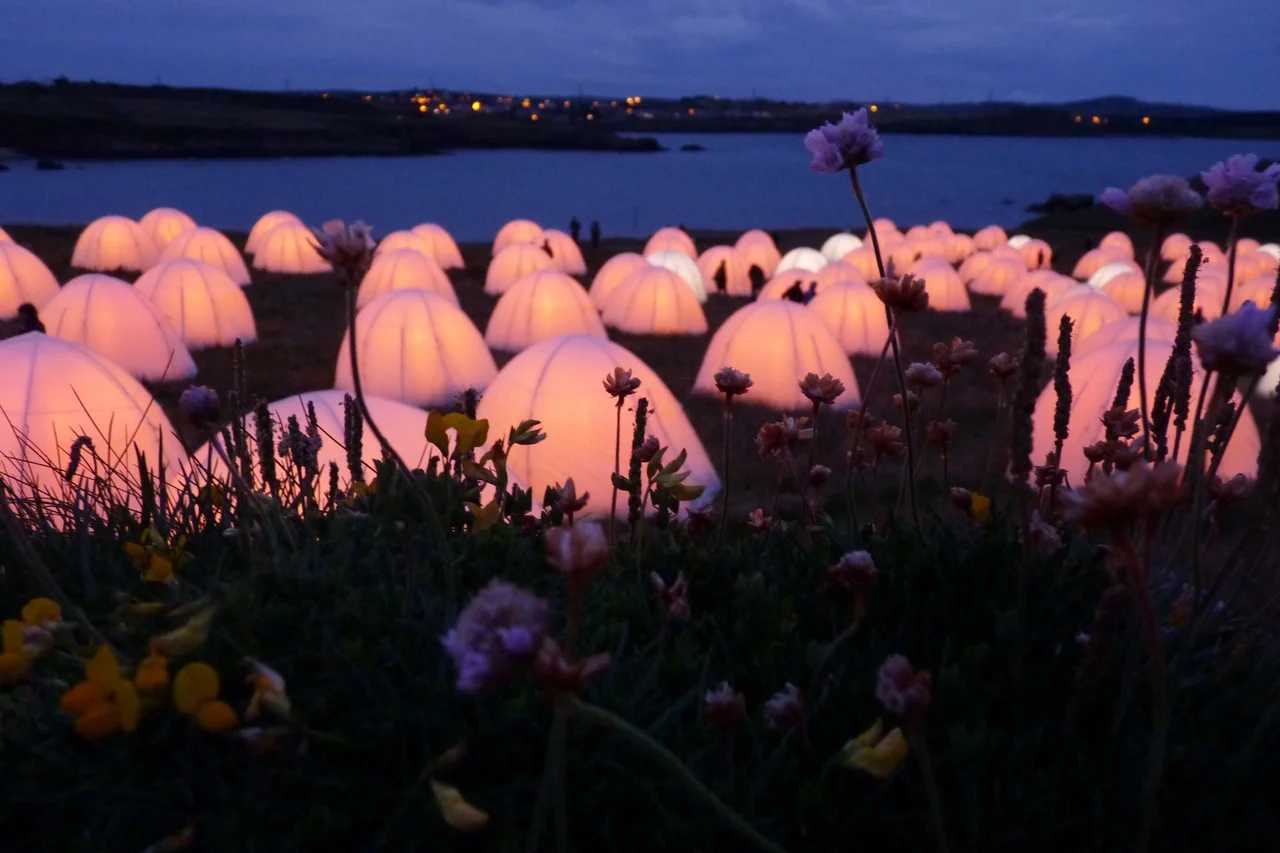
A mile west of the church, on the Llanlleiana headland, rises Dinas Gynfor - an Iron Age promontory fort whose three sea-cliff sides need no walls and whose landward side carries two sets of defensive banks and ditches. The interior has been quarried in places, complicating the archaeology, but the bones of the fortifications remain clear. Towards the tip of the promontory stands a small tower built to mark the coronation of King Edward VII in 1902. Below it, low stone footings trace the medieval Church of Llanlleiana, ruined long before the present age. The headland is also the most northerly point of Wales - a fact Anglesey takes considerable pride in. In July 2012, as part of the Cultural Olympiad surrounding the London Olympics, the headland became one of eight British coastal sites hosting Peace Camp, where glowing dome tents and four nights of recorded love poetry filled the cliff edge.
The Brickworks Below
Two kilometres east of the church, at Porth Wen - 'White Bay' in English - the cliffs hold the substantial remains of a late-Victorian silica brickworks. Three brick beehive kilns, a chimney, the storage hopper, the incline tramroad from the quartzite quarries above: all stand essentially intact on a steep ledge above the cove. Bricks fired here lined the steel furnaces of the late nineteenth century industrial north. The works closed in 1924 according to most sources, though some say 1949. Today the ruins are a scheduled monument with no formal access path; reaching them requires the coastal footpath and a careful scramble. The sea has begun to take the lower buildings. Together with Dinas Gynfor and the church, Porth Wen makes this short stretch of Anglesey coast one of the densest concentrations of layered history on the island - prehistoric, medieval, industrial, and the curious religious experiment of a Victorian peer.
Cinema and Stranger Visitors
In 2006 the headland appeared in the film Half Light, starring Demi Moore - a thriller ostensibly set in Scotland but shot at Llanbadrig because the location did the Scottish coast better than the actual one. The Welsh placename Llyn Padrig (Patrick's Lake) survives inland near Aberffraw, along with Rhosbadrig farm and a medieval site called Tref Was Padrig, 'township of Patrick's servant.' The pattern suggests an old cult of the saint dispersed across the island. Henry Stanley himself was buried on his estate at Alderley in unconsecrated ground, with an Islamic service led by the imam of the Ottoman Embassy in London. His chapel at Llanbadrig remains - a Grade II*-listed parish church whose blue Islamic-inspired tiles around the sanctuary still draw the curious. Cemaes pronounces 'Kem-ice,' and the locals are used to explaining both the saint and the convert.
From the Air
Llanbadrig parish and church at 53.41 N, 4.44 W, on the north coast of Anglesey. From cruising altitude the headland is visible as the most northerly point of Wales, with the small offshore rock of Middle Mouse (Ynys Badrig) just to the north - the closest land feature on the approach from the Irish Sea. The white-painted Cemaes village lies in the bay to the west. Nearest airports: Anglesey/Valley (EGOV) 11 nm south-west, Caernarfon (EGCK) 18 nm south. The coast here is among the most exposed in the British Isles; weather changes quickly with Atlantic fronts. The Wylfa nuclear power station's distinctive twin reactor buildings sit on the coastline immediately east of Cemaes, providing an unmistakable navigation landmark.
Nearby Stories
- Llandudno Lifeboat Station 3.8 km away
- Glynllifon 6.1 km away
- German submarine U-1024 9.4 km away
- Irish Sea Bridge 11 km away
- Ysbyty Ifan 12 km away
- Irish Sea 18 km away
- Celtic Array 18 km away
- Birkdale Palace Hotel 56 km away