
Llandysul
On the 12th of January 1833, the vicar of Llandysul, the Reverend Enoch James, had finally had enough of the football match. Every year on Old New Year's Day, ever since the 1752 calendar reform had thrown 11 days off the British year, the harvest workers of the parish had gathered at the church porch for a feast, then spent the afternoon kicking a ball back and forth between two goals: the porch of Llanwenog Church to the south, and the porch of Llandysul Church itself. Most of the players, by the time they got going, were drunk. The match was rough, the injuries were many, and the vicar replaced it that year with a gathering of Sunday schools from churches within eight miles of Llandysul, to sing anthems, answer catechisms, and recite scripture. The Sunday school custom continues to this day. The original football has not been played since.
St Tysul and the Saintly Family
Llandysul means the church of St Tysul, a 6th-century Welsh saint who founded a religious settlement at a ford on the River Teifi where several ancient tracks met. Tysul lived from approximately 462 to 554. He was the grandson of Ceredig ap Cunedda, the legendary founder of Ceredigion (from whom the county takes its name), and a cousin of St David. The Welsh saints of this period belonged to a tightly interlinked dynastic and ecclesiastical network; Tysul was part of the great age of Celtic Christianity that spread monasteries and churches across the western fringe of Britain. The ancient altar of his church, with an early Christian inscription, was later incorporated into the altar of the Lady Chapel inside the present 13th-century building. Other carved stones are kept in the choir vestry, including the Velvor Stone, a fragment cut from the middle of a larger inscribed slab whose original purpose is unknown.
Glyndwr and the Civil War
The men of Llandysul fought for Owain Glyndwr in 1400, the year the Welsh prince raised the great revolt that nearly broke English rule in Wales. After the rising failed, Henry IV confiscated lands around Llandysul belonging to Glyndwr's supporters. The town has a particular Glyndwr connection: Elen, the mother of Owain Glyndwr, was born somewhere in the parish. In September 2023, a large mural celebrating her was unveiled on the outer wall of Calon Tysul, the community leisure centre. Two and a half centuries after Glyndwr, in 1644, the English Civil War reached the Teifi. Royalist troops defending Ceredigion against the Parliamentary advance demolished one of the three arches of the Llandysul bridge to prevent the Roundheads crossing into the county. The bridge was rebuilt, though not until well after the war.
Gwasg Gomer and Welsh Printing
In a country with a long literary tradition but a small reading market, Welsh-language publishing has always been a labour as much of love as of commerce. Llandysul is the home of Gwasg Gomer, founded in 1892 by John David Lewis and named after the Welsh Baptist minister and journal editor Joseph Harris, whose bardic name was Gomer. Gomer Press is the largest and longest-established Welsh-language publisher in Wales, producing children's books, novels, poetry, religious works, and an extraordinary range of other titles in both Welsh and English. For more than a century, books that no other publisher in Britain would have produced have come out of a printing works on the banks of the Teifi. The press still operates from Llandysul, a quiet but essential anchor for the language.
Paddling on the Teifi
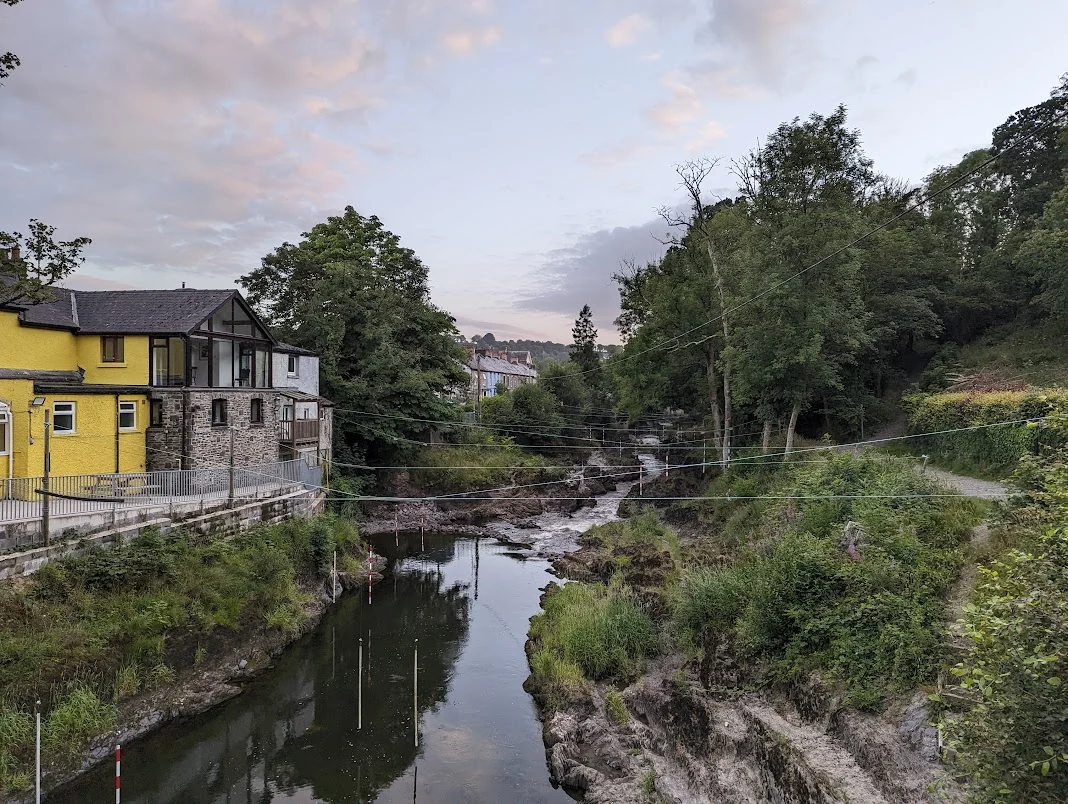
The Teifi at Llandysul is famous for two things: fishing and canoeing. The Llandysul Angling Association holds rights to over thirty miles of fishing on the river, which is renowned for salmon, sea trout (sewin), and brown trout. The Llandysul Paddlers Canoe Centre opened in October 1998, housed in a riverside building that originally generated electricity for the local community. The centre runs courses, holds canoeing competitions, and provides accommodation for up to 35 visitors. The Teifi here offers a full range of water conditions, from gentle pools above the town to a roaring grade-three rapid below the bridge in spate. Canoeing has become one of the few growing economic activities in a town that has otherwise lost most of its industry: the woollen mills closed long ago, the railway closed to passengers in 1952, and the last of four high-street banks shut its doors in 2017.
Harps and the Quiet Damage
For a few years in the 2000s and 2010s, Llandysul was the only place in Wales where harps were being made. Telynau Teifi Harps, founded in 2004 by harp-maker Allan Shiers with help from Ceredigion County Council and European Union funding, produced Celtic and folk harps with all manufacturing done on site. The business closed in 2022. In 2024, the empty building made national news as the unexpected base of an illegal cannabis farm with plants worth a reported two million pounds. Shortly after the police shut down the operation, the building caught fire twice. The damage to the former primary school was substantial. The story is unusual but characteristic of a kind of decline familiar in small Welsh towns: a creative business gone, a building empty, an opportunistic crime, a fire. Llandysul has not given up, but it has had a hard couple of decades.
Notable Llandysulers
The town has produced more interesting people than its small population would suggest. Christmas Evans (1766-1838), the great Welsh Baptist preacher, was born in the parish. The physicist Evan James Williams (1903-1945), born in nearby Cwmsychbant, attended Llandysul school before going on to work on subatomic particles at Cambridge under Rutherford. Hywel Davies (1919-1965) became a pioneering Welsh radio broadcaster and TV interviewer. Menna Elfyn (born 1952) is one of the most distinguished living Welsh-language poets, and lives in the town. Fflur Dafydd (born 1978) is a novelist and singer-songwriter who writes in both Welsh and English. The Welsh-language coverage in the area remains high; the 2011 census put it around 60 percent in the wider electoral ward, a figure that drops year by year but stays well above the national average. The Calan Hen Sunday school tradition still runs every January, two centuries after the football was put away.
From the Air
Located at 52.04 degrees north, 4.31 degrees west, in the Teifi valley about 14 miles east of Cardigan. Cruise altitude 2,500-4,000 feet shows the river winding through farmland toward Newcastle Emlyn to the west and Lampeter to the north-east. The MoD Aberporth danger area lies to the west; check NOTAMs. Nearest civil airport is Haverfordwest (EGFE); Swansea (EGFH) further south-east.
Nearby Stories
- RAF Haverfordwest 3.7 km away
- Great Western Railway in West Wales 7.7 km away
- West Wales 9.9 km away
- Fishguard Lifeboat Station 13 km away
- Battle of Mynydd Hyddgen 15 km away
- Strata Florida Abbey 18 km away
- Neath and Tennant Canal 21 km away
- HMS Tyler 44 km away