
Llaneilian
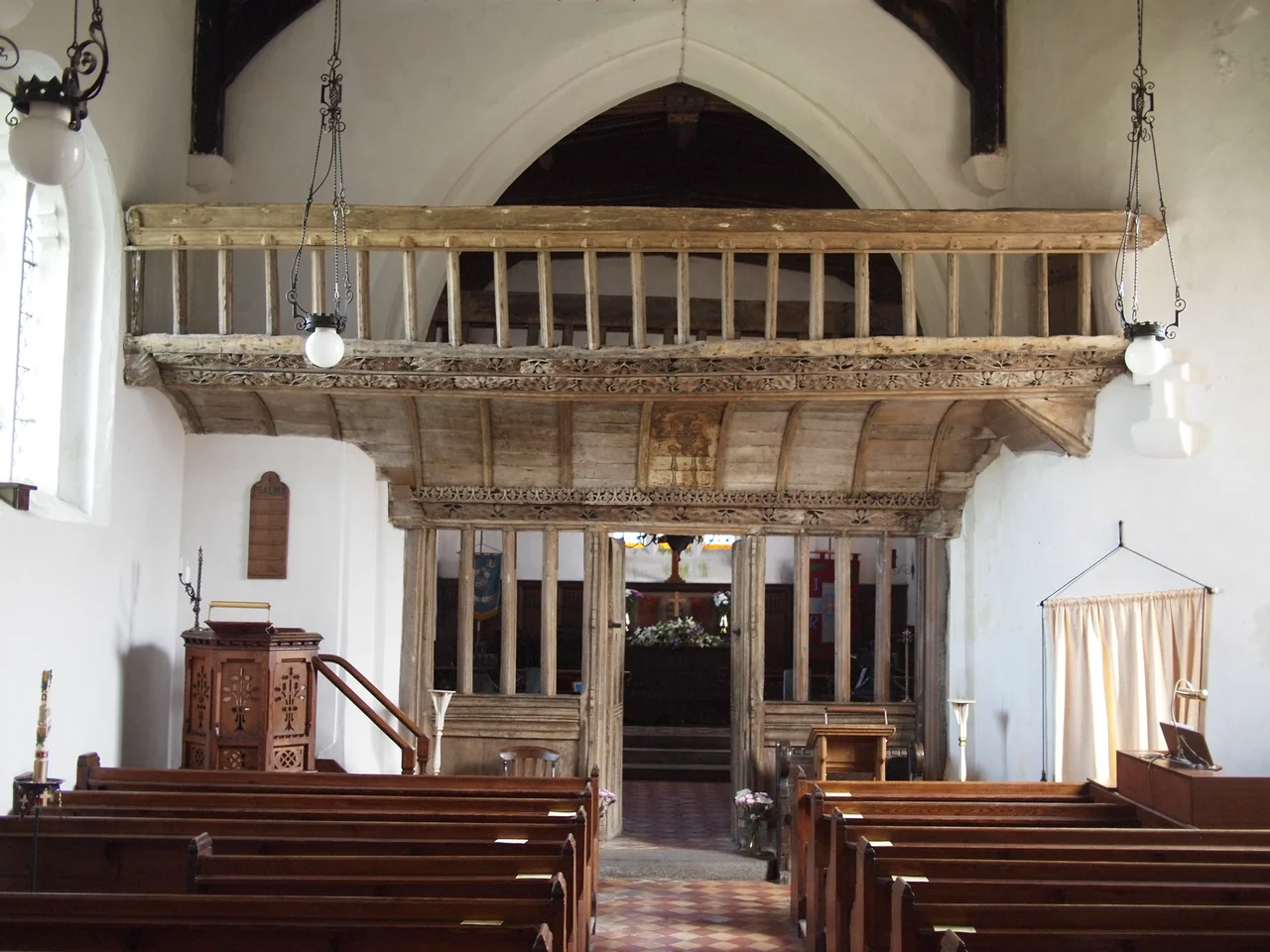
Inside St Eilian's Church at Llaneilian, a 15th-century wall painting depicts a skeleton carrying a scythe. Beneath it runs a Welsh inscription: Colyn angau yw pechod - 'sin is the sting of death.' The phrase comes from 1 Corinthians 15, and the figure is a memento mori of the sort that survived the Reformation only in remote rural churches where iconoclasts never quite got round to whitewashing the walls. Beyond the painting, in the same building, stands a 15th-century rood screen of carved oak - one of the most complete in north Wales - and a 12th-century tower attached to a 14th-century chapel. The church is Grade I listed. It sits in a parish on Anglesey's north-east coast that also takes in the dramatic lighthouse at Point Lynas, the offshore refuge tower of Ynys Dulas, and the supposed site of a 5th-century royal court.
Eilian and the Skeleton
Saint Eilian, also called Eilianus or Eilian of Rome, came from Italy to Britain in the sixth century and lived as a hermit on this north Anglesey coast. His feast day is 13 January. The church bearing his name is a Celtic clas church - a kind of monastic college - whose tower dates from the twelfth century. The fourteenth-century chapel attached at the east end and the fifteenth-century nave and chancel give the building its current cruciform shape. The painted skeleton in the chancel is one of the few surviving examples of pre-Reformation wall painting on Anglesey; most were limewashed during the sixteenth and seventeenth centuries on the grounds that images encouraged idolatry. The fifteenth-century rood screen survives complete with its loft above - a wooden gallery once used to display the Rood, the great crucifix that hung above the entrance to the chancel. Royal Navy graves from the First World War lie in the churchyard.
Llys Caswallon
Half a mile from the church, in a field near Mynydd Eilian, a faint earthwork marks what tradition holds to be the court of Cadwallon Lawhir ap Einion, fifth-century King of Gwynedd. He was the grandson of Cunedda, the founder of the Gwynedd royal dynasty. The site appears on an 1889 Ordnance Survey map; by the mid-twentieth century most archaeologists had largely discredited the claim, since no visible above-ground evidence survives. The lineage matters in its own right. Cadwallon's descendants included Rhodri the Great - who in the ninth century united Gwynedd, Powys and Seisyllwg and fought both Saxons and Vikings before being killed on Anglesey in 854 - and, two generations later, Hywel Dda, the king whose tenth-century legal codes shaped Welsh law for centuries. Whether or not the field really held Cadwallon's court, the parish was once close to the centre of Welsh kingship.
Point Lynas and the Refuge Tower
At the north-eastern tip of the parish, the headland of Point Lynas carries a lighthouse unusual in not having a tower - the light sits on top of a building set on the hilltop itself, high enough that no additional height is needed. The first Mersey Docks and Harbour Board light went up in 1779 to guide ships into Liverpool; the current building dates from 1835. Trinity House took over only in 1973, and the lights were automated in 2001. The cottages are now private. On a clear day, looking north, the Isle of Man is visible from this stretch of coast, with the streetlights of Douglas glowing on the horizon after dark. Out in Dulas Bay rises the small island of Ynys Dulas, crowned by a refuge tower that James Hughes of Llysdulas built in 1821. The tower was stocked with food so that shipwrecked sailors could survive until rescue. The coast here drowned ships for centuries; the tower acknowledged that some would always be wrecked anyway.
Stained Glass from Burnt Churches
Down at Dulas, St Gwenllwyfo's Church was built in the mid-nineteenth century by the Bangor architect Henry Kennedy. It is Grade II* listed, and what makes it remarkable lies in its windows. The nave and chancel hold fifteenth- and sixteenth-century Flemish stained glass, removed from former Roman Catholic churches that had been taken over by Protestants who considered the religious imagery theologically unsound. Other panels from the same dispersal turn up in the Victoria and Albert Museum, the Burrell Collection in Glasgow, and the Metropolitan Museum of Art in New York. The current church replaced a medieval one that stood over a mile away at the other end of the dispersed village; the old building is now reduced to low stone walls within a quiet churchyard. The communities of Llaneilian - including Dulas, Penysarn, Nebo and Brynrefail - had 1,186 people at the 2011 census, scattered across a coast where every cove holds something unexpected.
From the Air
Llaneilian parish on the north-east coast of Anglesey, centred near 53.39 N, 4.30 W. Point Lynas headland marks the easternmost point of north Anglesey - its lighthouse is a distinctive low building on the hilltop rather than a traditional tower. Ynys Dulas, a small offshore island with a stone refuge tower, lies east of Dulas Bay. The hill of Mynydd Eilian (177 m) rises just inland of the church. Nearest airports: Anglesey/Valley (EGOV) 16 nm west, Caernarfon (EGCK) 18 nm south-west. From cruising altitude on a clear day, the Isle of Man is visible 40 nm to the north. The coast here is the Anglesey Area of Outstanding Natural Beauty and the parish is crossed by the Anglesey Coastal Path.
Nearby Stories
- Llandudno Lifeboat Station 3.8 km away
- Glynllifon 6.1 km away
- German submarine U-1024 9.4 km away
- Irish Sea Bridge 11 km away
- Ysbyty Ifan 12 km away
- Irish Sea 18 km away
- Celtic Array 18 km away
- Birkdale Palace Hotel 56 km away