
Llangrannog
On the beach at Llangrannog there is a tall thin stack of rock standing alone in the surf. It is called Carreg Bica, which in old Welsh means the pointed rock. The local legend explains it differently. A giant named Bica once lived in Ceredigion, the story goes, and one day he suffered a toothache so violent that he had to pull the offending tooth from his mouth and spit it out. It landed point-up on the sand and turned to stone. Today the rock is what remains of a much larger Ordovician outcrop that has been weathered into the open sea over millions of years. A piece broke away some decades ago. The geological story and the folk story sit comfortably side by side at Llangrannog. There is room here for both.
The Valley Squeeze
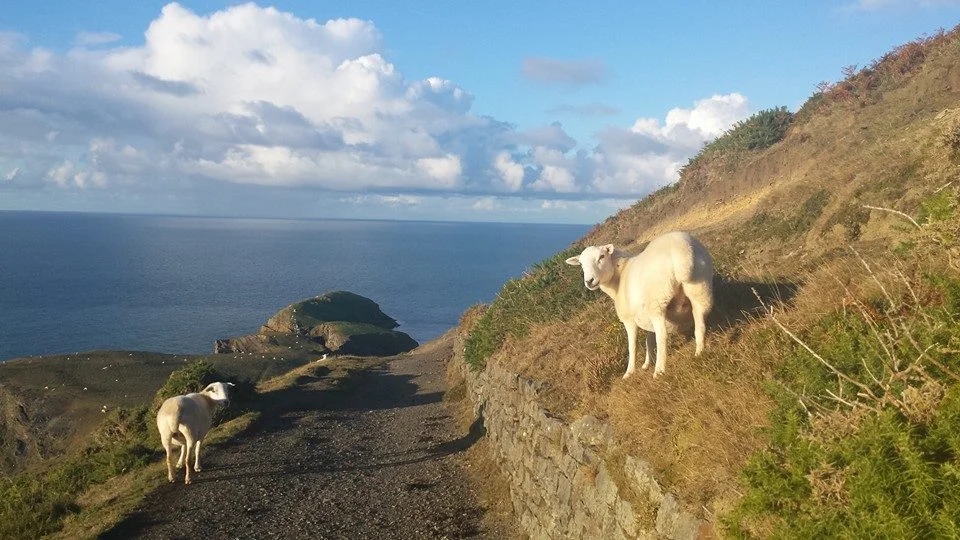
Llangrannog is squeezed into the narrow steep-sided valley of the River Hawen, six miles south-west of New Quay on the Ceredigion coast. The village is built along the river, which falls as a small waterfall near the centre of the houses and then crosses the beach to the sea. A second smaller stream, the Nant Eisteddfa, joins it on the sand. The houses cling to both sides of the gorge, painted in soft greys, whites, and ochres against the green of the surrounding hills. The Wales Coast Path runs through the village, climbing steeply out at either end. From the cliff path north of the harbour you look down into a perfect bay rimmed by Ordovician cliffs, the rock weathered into stacks and ledges where seabirds nest in spring. The beach itself holds a Blue Flag for water quality, and an RNLI lifeguard service operates during the summer.
Cranogwen
Llangrannog was the birthplace of one of the most remarkable Welsh women of the Victorian age: Sarah Jane Rees, known by her bardic name Cranogwen. Born in 1839, the daughter of a sea captain, she learned navigation from her father by the age of fifteen and went on to obtain her Master Mariner's Certificate, an extraordinary qualification for a woman at any point in the 19th century. She returned home and founded a school in Llangrannog where she taught navigation to local seamen, helping them advance in the merchant marine. In 1865, at the National Eisteddfod in Aberystwyth, she won the crown for poetry under the bardic name of Cranogwen, beating both male and female competitors at a time when women rarely entered such contests. She became a popular lay preacher, gave up her school to concentrate on ministry, and in 1901 founded the South Wales Women's Temperance Union to address the harm done by alcohol in working-class communities. She is buried in the churchyard at Llangrannog. A statue of St Carannog, the village's patron saint, stands beside her grave.
The Urdd Camp
On the cliffs above the village stands one of the most important institutions in modern Welsh-language education: Gwersyll yr Urdd Llangrannog, the Urdd camp. Founded in 1932, the camp is run by Urdd Gobaith Cymru, the Welsh League of Youth, and offers residential courses for children and young people entirely through the medium of Welsh. Tens of thousands of young people pass through the camp each year, taking part in everything from horse-riding and quad-biking to drama and craft workshops, all in Welsh. For many children from English-speaking families, it is their first immersive exposure to the language. For Welsh-speaking children, it reinforces a national community that can otherwise feel scattered. The camp has expanded enormously since 1932, but it retains its original purpose: to give Welsh-speaking youth a place that is unambiguously theirs.
Visitors and Writers
Llangrannog has long attracted artists and writers. Edward Elgar, the English composer, spent a holiday in the village in the early 20th century. The Welsh painter Christopher Williams, RBA, visited and painted here; his picture Holidays - Village Girls at Llangrannog now hangs at the National Library of Wales. The poet Dylan Thomas, then living up the coast in New Quay during 1944 and 1945, came to drink at the Ship Inn at Llangrannog with friends including Tommy Herbert, the Aberaeron vet, and Ira Jones, the First World War Welsh fighter ace who shot down at least 40 enemy aircraft. T. Llew Jones (1915-2009), the prolific Welsh-language children's writer, lived nearby in Pentrecwrt. The maritime historian J. Geraint Jenkins (1929-2009) and the Welsh broadcaster Beti George (born 1939) both grew up in the area.
Ynys Lochtyn and the Path North
Walk north on the Wales Coast Path from the village and the cliffs climb. After about a mile you reach the headland of Pen y Badell and look down on Ynys Lochtyn, a small green island just offshore that, depending on the tide, can briefly become accessible across a rock causeway. Atlantic seals haul out on the rocks below. Choughs, the red-billed cliff crows that are increasingly rare in Britain, sometimes nest on the cliff faces; you can occasionally see them tumbling in the updrafts, their distinctive curved beaks visible against the sea. The 46.5% Welsh-speaking proportion recorded in the 2011 census (down from 51.8% in 2001) is similar to many Ceredigion coastal communities: a high baseline for the language that nevertheless slips year by year. The population stood at 775 in 2011 and was estimated at 759 in 2019. The village is small, beautiful, and quietly devoted to keeping its language and its sea alive.
From the Air
Located at 52.16 degrees north, 4.47 degrees west on the Ceredigion coast, about 6 miles south-west of New Quay. Cruise altitude 2,000-4,000 feet, ideal for capturing the deep valley cleft, the sea stacks, and the curve of Cardigan Bay. The MoD Aberporth danger area lies just to the south-east; check NOTAMs. Nearest airfields are Aberporth (MoD, EGUC) to the south and Haverfordwest (EGFE) further south.
Nearby Stories
- RAF Haverfordwest 3.7 km away
- Great Western Railway in West Wales 7.7 km away
- West Wales 9.9 km away
- Fishguard Lifeboat Station 13 km away
- Battle of Mynydd Hyddgen 15 km away
- Strata Florida Abbey 18 km away
- Neath and Tennant Canal 21 km away
- HMS Tyler 44 km away