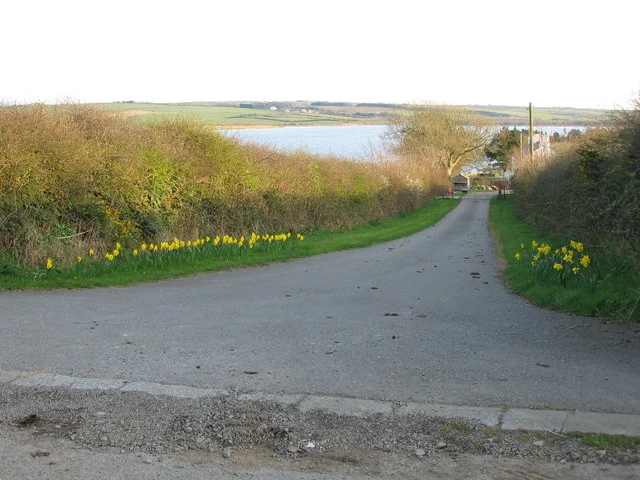

Llyn Alaw
It is the largest body of water on Anglesey, but only by area, not by volume. Llyn Alaw stretches 4.3 kilometres long across a flat northern landscape and covers 3.6 square kilometres, yet at its deepest it is only 5.2 metres - which is to say, shallower than a typical Olympic diving pool. The reservoir was made in November 1965 by closing a dam across the existing marsh of Cors y Bol; filling completed in January 1966, and the official opening came on 21 October the same year. Because the site was already marshland, no farms or hamlets had to be abandoned. The reservoir supplies drinking water to the northern half of the island at a rate of 35 million litres a day, run by Dwr Cymru Welsh Water. But what makes Llyn Alaw remarkable is what its shallowness invites: a winter sky filled with ducks, swans and geese arriving from the Arctic.
A Lake Filled by Rain
There are no major rivers running into Llyn Alaw. Its catchment is mostly agricultural, and the lake fills almost entirely by trapping winter rainfall. In summer the level is drawn down to meet demand, exposing mud flats around the margins and creating low islets where the bed lifts above the water. The result is a body of water unusually shaped by the calendar - deeper in spring than autumn, wider in winter than summer, and rich with the seasonal life that thrives at the edge between water and land. Trout do well in these conditions. The lake holds wild brown trout and is stocked with rainbow trout for sport, and is considered one of the most productive fisheries in Wales. Cormorants work the surface; otters move along the margins after dark. The water is faintly tea-coloured from peaty drainage, with low islets breaking the horizon.
The Winter Visitors
Llyn Alaw is designated a Site of Special Scientific Interest because of the variety and numbers of waterfowl that visit. The biggest concentrations come in winter. Whooper swans arrive from Iceland - the wild swans that breed nowhere south of the Arctic and pass through Anglesey on their way down to the milder British wetlands. Eurasian teal, the smallest dabbling duck in Europe, gather here in flocks that can hold several thousand birds at peak. Northern shoveler join them, conspicuous with their huge spatulate bills. Mallard, wigeon, common goldeneye, common pochard, tufted duck and ruddy duck use the lake through the colder months; pink-footed geese drop in occasionally on passage. The mix shifts week by week and year by year. For ornithologists Llyn Alaw is one of the most reliable winter wildfowl sites in north Wales, and the small visitor facilities - a car park, three picnic sites, several miles of footpath - exist mainly to keep human disturbance manageable.
Edge and Margin
What was flooded in 1965 was Cors y Bol, a marsh of considerable ecological interest in its own right. The reservoir replaced one wetland with another, in effect; the difference is that the engineered lake fluctuates more sharply and supports rather different birds. The shore is bordered by vegetation, with bushes and scrub in places, fading to mud flats in dry summers. The surrounding landscape stays flat and faintly bleak - a wide-skied corner of Anglesey north of Llannerch-y-medd. Recent improvements have added nature-conservation facilities and way-marked walks around the margins, though no path makes a full circuit of the lake. The lake's shape, on a map, is a sprawling letter that resembles a sleeping animal with a long tail. In summer, when the level falls, the tail almost disconnects. In winter, when the rain returns and the geese come down from the Arctic, the lake fills back in and the noise of wings overhead is constant for weeks.
From the Air
Llyn Alaw at 53.35 N, 4.41 W, in the north of Anglesey. The reservoir is unmistakable from cruising altitude as the largest body of water on the island - a long, irregular pale-grey shape orientated roughly east-west, about 4.3 km long. The hamlets of Llannerch-y-medd lie immediately east, Rhosybol to the north. Nearest airports: Anglesey/Valley (EGOV) 9 nm south-west, Caernarfon (EGCK) 18 nm south-east. The surrounding landscape is flat agricultural plateau; the lake serves as a useful navigation landmark when overflying central-north Anglesey. Winter brings large concentrations of wildfowl - whooper swans, teal, shoveler - so low-level overflight should be avoided October through March to minimise disturbance.
Nearby Stories
- Llandudno Lifeboat Station 3.8 km away
- Glynllifon 6.1 km away
- German submarine U-1024 9.4 km away
- Irish Sea Bridge 11 km away
- Ysbyty Ifan 12 km away
- Irish Sea 18 km away
- Celtic Array 18 km away
- Birkdale Palace Hotel 56 km away