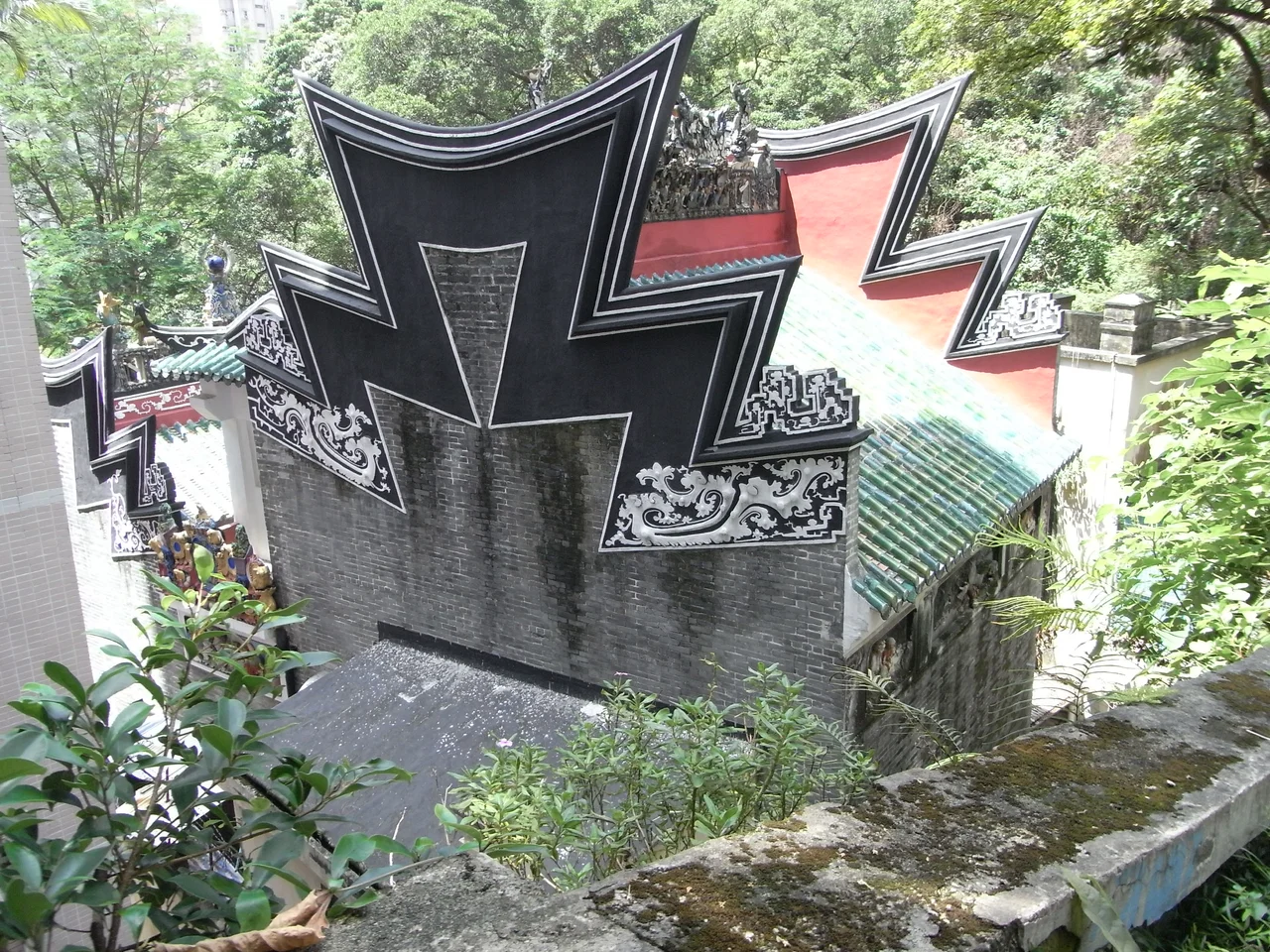

Lo Pan Temple
Every year on the thirteenth day of the sixth lunar month, construction workers climb 200 steps from Belcher's Street to pray for a safe year on the job. They are climbing to visit a carpenter. Lo Pan — also written Lu Ban — was a real person who lived during China's Spring and Autumn period, a carpenter and engineer so gifted that later generations made him a god. The temple on Ching Lin Terrace in Kennedy Town is the only one in Hong Kong dedicated to him alone, and it was built in 1884 by the people whose livelihoods depended on his blessing: the contractors, the builders, the tradespeople who raised Hong Kong's streets and tenements and towers.
The God Who Was a Craftsman
Lo Pan's legend begins with omens. Folk tradition holds that cranes circled above his home at birth and his room filled with a celestial fragrance — signs that this was no ordinary child. What he became was extraordinary in practical terms: a carpenter, engineer, philosopher, inventor, and military thinker whose technical innovations during the Spring and Autumn period of ancient China remained influential for centuries. After his death, he was deified. The temples built in his name on the Chinese mainland typically place him alongside other deities, one god among many. The Hong Kong temple is different. It was erected for Lo Pan specifically, by an industry that understood patronage in concrete terms — if you build things for a living, you honor the god of building above all others.
Built by the Trade, for the Trade
The numbers carved into a stone inside the temple tell the founding story plainly: more than 1,172 people from different towns across Guangdong province contributed money to build it. The Contractors Guild organized the effort in 1884. This was not a civic gesture or a wealthy patron's donation — it was an industry funding its own spiritual infrastructure, town by town, craftsman by craftsman. The land changed hands several times before being acquired in 1921 by the Kwong Yuet Tong, the body that still manages the temple today. In 1949, Kwong Yuet Tong was formally registered as a legal entity. The staff, then as now, consists primarily of builders. The temple is a Grade I historic building — one of Hong Kong's highest heritage classifications — and it has changed little since it was built.
Twenty-Six Paintings on the Walls
Lo Pan Temple holds the largest number of wall-paintings of any Chinese temple on Hong Kong Island. There are 26 mural pieces in total, covering a range of subjects in traditional Chinese style: butterflies and narcissi, Bodhidharma crossing waves on a reed, evening scenes at the Red Cliff, figures in landscapes, ladies beside rocks. Different styles of calligraphy are worked into the murals as captions, turning the walls into something between an illustrated manuscript and a decorative program. Clay sculptures appear on the exterior walls and gables — unusual for Hong Kong Island temples, where such work is rare. The sculptures take Chinese history and mythology as their theme. Inside, a stone carving from the Qing dynasty records the temple's founding purpose: to honor Lo Pan as the god of Chinese architecture and remind future generations to remember where they came from.
The Festival Climb
On the thirteenth day of the sixth lunar month each year, the birthday of Lo Pan transforms Ching Lin Terrace. Builders make a pilgrimage up the 200 steps from Belcher's Street. Lion dances and dragon dances play outside. Meals are distributed. The Labour and Welfare Bureau holds a ceremony to recognize construction workers who have performed with outstanding skill — a secular award embedded within a religious occasion, which captures the temple's function exactly. It is simultaneously a trade association gathering, a religious festival, and a safety prayer. Taoist priests chant inside to comfort those who died on construction sites during the year. The government and builders donate toward the upkeep. It is a working institution, not a preserved one.
A Narrow Terrace, a Lasting Purpose
Ching Lin Terrace is not a street that appears on tourist itineraries. Kennedy Town, at the western end of Hong Kong Island's tram line, sits far from the polished districts that draw most visitors. The temple's two-hall structure with its jagged roofline and fire-type parapet walls — an architectural style meant to ward off conflagration — sits in a neighborhood that feels functional rather than picturesque. That is appropriate. Lo Pan Temple was never built to be admired from a distance. It was built to be used: by workers who needed somewhere to ask for safety, by an industry that understood the risks of building things on Hong Kong's rocky, precipitous hillsides, and by a community that chose to honor a craftsman with the same seriousness it brought to the craft itself.
From the Air
Lo Pan Temple sits at 22.2830°N, 114.1320°E in Kennedy Town, at the western tip of Hong Kong Island. From the air at 1,000 ft, Kennedy Town appears as a compact residential district fronting the western approach to Victoria Harbour. Hong Kong International Airport (VHHH) lies roughly 28 km to the west on Lantau Island. Victoria Peak rises immediately to the east, a useful visual landmark at 552 m. The Stonecutters Island channel and the container port beyond it are visible to the northwest on clear days.
Nearby Stories
- Lok Ma Chau Loop 2.3 km away
- Portas do Cerco 2.3 km away
- Kweilin Incident 17 km away
- Wanshan Archipelago Campaign 34 km away
- Nanxiong Formation 115 km away
- Battle of Nanpeng Island 148 km away
- Heyuan 169 km away
- Cape Maobitou 632 km away