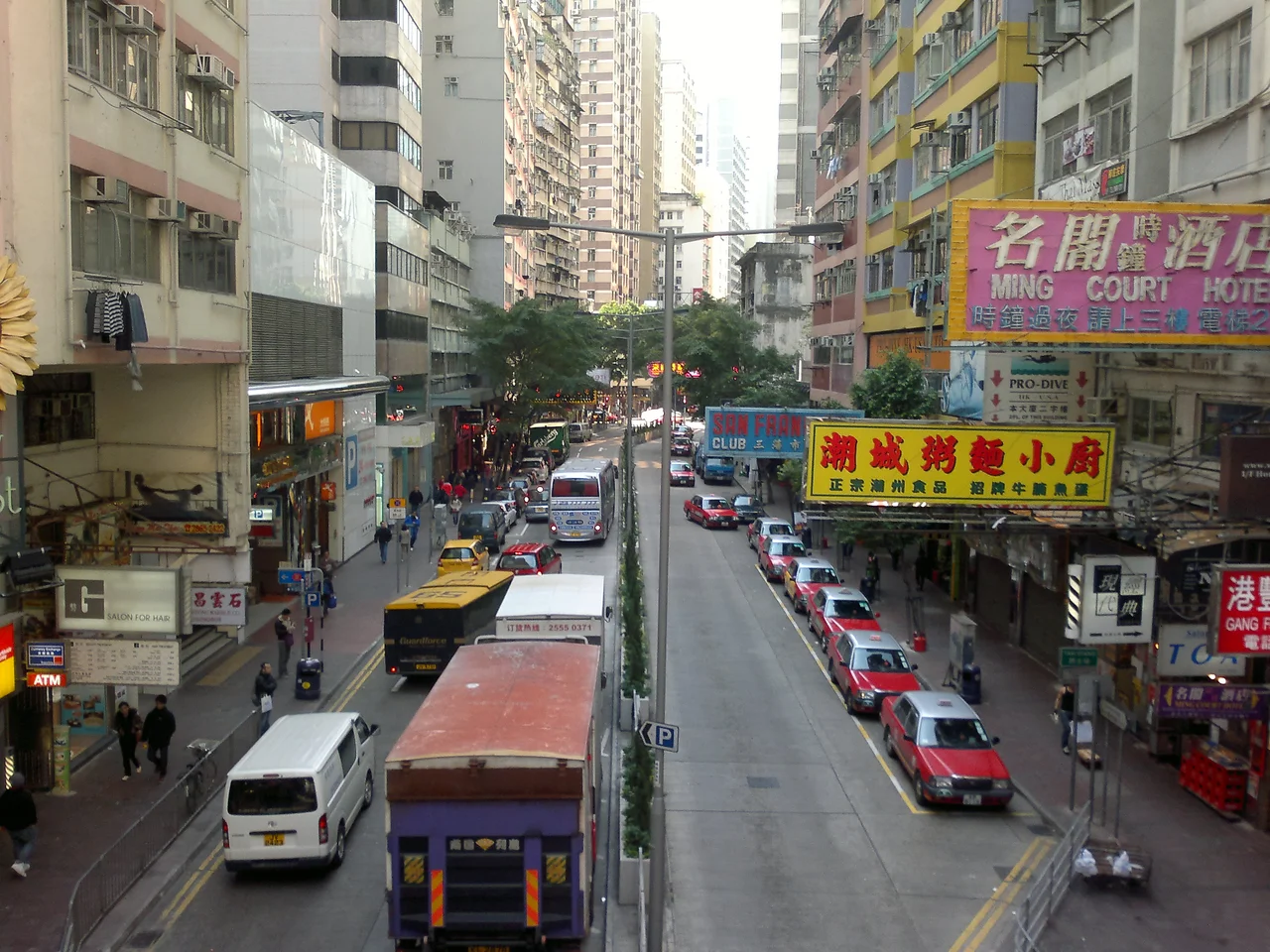

Lockhart Road
The man the road is named after spent two years negotiating the lease that extended British Hong Kong into the New Territories. Sir James Stewart Lockhart, Colonial Secretary from 1895 to 1902, signed the Convention for the Extension of Hong Kong Territory in 1898 and secured a 99-year arrangement that would define the territory's fate. His name was put on a street in Wan Chai. The street became famous for reasons Lockhart almost certainly did not anticipate: a novel, a film, and a bar district that spent decades as the most talked-about nightlife corridor in the city.
The Full Length of Wan Chai
Lockhart Road runs east to west across the entire breadth of Wan Chai district on Hong Kong Island, beginning at Arsenal Street in the west and ending at East Point Road in East Point. As a piece of urban geography it is unremarkable — a secondary street running parallel to the harbor, one block inland from the main artery of Hennessy Road. What makes it distinctive is not its alignment but its character, which shifts as you walk it. The western section, near Luard Road, is the nightlife stretch. Moving east, the street passes through a more mixed commercial zone, the bar signs giving way to offices, restaurants, and ordinary shophouses. The whole road takes perhaps twenty minutes to walk end to end.
Suzie Wong's Street
Richard Mason's 1957 novel *The World of Suzie Wong* was set in this part of Wan Chai. The story of a British painter who falls in love with a Wan Chai bar girl was adapted into a film in 1960, and both novel and film fixed an image of Lockhart Road in international imagination that persisted for decades. Wan Chai's bar district was then, as the story depicted it, a place where sailors, expatriates, and local women who worked the bars occupied a social world unto itself. The World of Suzie Wong did not romanticize this world without complication — the novel is more ambivalent than its film adaptation — but it gave the street a literary address that outlasted the specific circumstances it described.
From Red Light to Mixed District
For much of the postwar period, the western end of Lockhart Road was understood primarily as a red light district — a place of girlie bars catering to foreign sailors and soldiers, particularly during the Vietnam War era when Hong Kong was a major R&R destination for US military personnel. The character of the street has since shifted. The area is now much more mixed: bars, pubs, restaurants, and nightclubs share the block with more ordinary commercial activity. Some of the older-style establishments remain, their operations visible from the street. Compared to the more upmarket Lan Kwai Fong and SoHo districts on Hong Kong Island, Lockhart Road has always been the less polished option — louder, cheaper, and less self-conscious about what it is.
December 2005
On December 17, 2005, during the World Trade Organization Ministerial Conference held in Hong Kong, a group of South Korean protesters broke through the police defensive line on Lockhart Road and attempted to force entry to the Hong Kong Convention and Exhibition Centre in Wan Chai North. The confrontation escalated into a significant clash with the Hong Kong Police Force — one of the most dramatic incidents of street-level protest the city had seen in years. The WTO Conference brought activists from around the world, but it was the South Korean farmers and labor organizers, many of them wearing traditional dress and deploying coordinated shield formations, whose tactics drew international attention. Lockhart Road was briefly something other than a nightlife street.
The Name That Stuck
James Stewart Lockhart served Hong Kong's colonial administration through a period of significant territorial expansion and administrative change. His role in signing the 1898 Convention was consequential — the lease for the New Territories, set to expire in 1997, became the ticking clock that governed Hong Kong's entire postwar relationship with Britain and China. A civil servant who signed a 99-year lease, memorialized on a street that became famous for its nightlife: the gap between what a person does in their working life and how they are remembered is one of the more reliable features of urban naming. Lockhart Road is his, and it is not quite what either of them might have imagined.
From the Air
Lockhart Road lies at approximately 22.2782°N, 114.1730°E in Wan Chai, Hong Kong Island. From the air at 1,500 ft, the Wan Chai waterfront is identifiable by the Hong Kong Convention and Exhibition Centre's distinctive curved roof extending into Victoria Harbour — Lockhart Road runs one block south of the harbor, parallel to the reclaimed foreshore. Hong Kong International Airport (VHHH) is 28 km to the west on Lantau Island. The Central district's skyscraper cluster and the distinctive IFC tower lie 2 km to the west; Causeway Bay's typhoon shelter is visible 1 km to the east.
Nearby Stories
- Lok Ma Chau Loop 2.3 km away
- Portas do Cerco 2.3 km away
- Kweilin Incident 17 km away
- Wanshan Archipelago Campaign 34 km away
- Nanxiong Formation 115 km away
- Battle of Nanpeng Island 148 km away
- Heyuan 169 km away
- Cape Maobitou 632 km away