
Logan Circle (Washington, D.C.)
During the Civil War, the patch of muddy ground that is now Logan Circle was called Camp Barker - a military barracks converted into a refugee settlement for newly freed people who had walked north from plantations in Virginia and Maryland. By the 1870s the camp was gone and Mayor Alexander Robey Shepherd had laid streetcar tracks through the swamp to encourage development. By the 1890s, Victorian rowhouses were rising around a circular park modeled on European boulevards. By 1901, an equestrian statue of Union General John A. Logan was unveiled at the center by President McKinley. The neighborhood had become, in a single generation, one of Washington's most fashionable addresses. The patterns of its later transformations - from white wealth to Black community to disinvestment to gentrification - would all turn around this same iron horse.
Iowa Circle
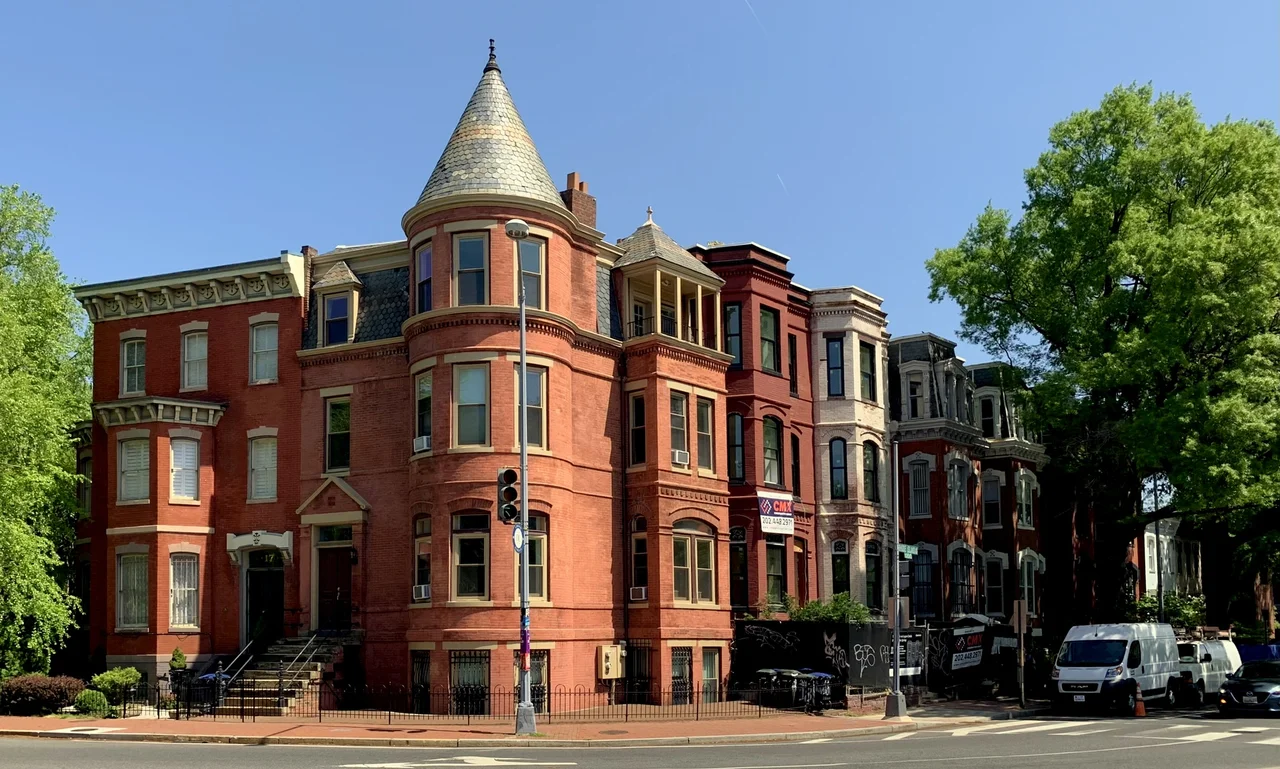
Pierre L'Enfant's 1791 plan for Washington had marked the spot as a large triangular plaza - much bigger than what eventually became the circle, and differently shaped. Through most of the nineteenth century, the area remained undeveloped marshland north of downtown. It was called Iowa Circle. The construction boom that filled in the surrounding streets began in earnest in the 1870s as Boss Shepherd's public works program brought streetcars, elm trees, and paved roads into the area. The result was a dense ring of Victorian rowhouses and ornate Late Victorian and Richardsonian Romanesque mansions, many with carriage houses and servants' quarters. The upper-middle-class buyers wanted Washington to look like London or Paris - a city of broad boulevards anchored by formal parks. For thirty years it did. General Logan himself - Civil War commander, founder of Memorial Day, U.S. senator from Illinois, and 1884 vice-presidential nominee - lived at 4 Logan Circle. In 1930, Congress renamed the circle in his honor. The equestrian bronze at its center, sculpted by Franklin Simmons on a base by Richard Morris Hunt, had been dedicated by President McKinley on April 9, 1901.
The Color Line at 16th
By the early twentieth century, Washington's geography of racial segregation had hardened. White residents of the upper middle class began moving farther west, into Dupont Circle and Kalorama, while the rowhouses around Logan Circle - the same Victorian houses originally built for Washington's bourgeoisie - became home to a growing Black middle class. The unofficial dividing line was 16th Street NW, a few blocks west. Logan Circle sat just east of it, sandwiched between the white neighborhoods to the west and the African American neighborhood expanding from U Street to the north. Within this enclosed corridor, an extraordinary generation of Black Washingtonians lived in the surrounding houses. Mary McLeod Bethune, who in 1943 purchased the rowhouse at 1318 Vermont Avenue that became the operational headquarters of the National Council of Negro Women she had founded in 1935, lived and worked in the neighborhood. Alain LeRoy Locke, the first African American Rhodes Scholar and central figure of the Harlem Renaissance, kept a residence here. So did Mary Jane Patterson, the first African American woman to earn a bachelor's degree. John A. Lankford, the first Black architect in Washington. Charles Manuel Sweet Daddy Grace, founder of the United House of Prayer for All People. And Ella Watson, the federal cleaning woman whose portrait Gordon Parks had photographed for the Farm Security Administration in 1942 - the image now known as American Gothic, Washington, D.C.
After 1968
The 1968 riots that followed Martin Luther King Jr.'s assassination devastated the commercial corridors of 14th Street and U Street that bordered the neighborhood. Many middle-class residents - both Black and white - left in the years after. The grand Victorian houses, already subdivided into apartments and rooming houses, fell into deeper neglect. In 1956, the city had already paved three inner lanes of 13th Street straight across the circle to speed suburban commuters through it - an act that broke the park and reduced Logan Circle to a traffic loop. By the 1980s and 90s, the neighborhood was widely considered unsafe; open drug markets and street prostitution had moved in. Fourteenth Street, NW became known as the city's red-light district. The Victorian houses, mostly still intact, remained spectacularly under-priced. Small independent theater companies, drawn by cheap rent, took over storefronts north of the circle - the start of what would become the 14th Street theater corridor.
Whole Foods, December 2000
The neighborhood's transformation in the twenty-first century can be dated precisely. In December 2000, a Whole Foods Market opened on a 14th Street site that had been an abandoned service garage. There had been no full grocery store in the area for decades. The Whole Foods became, within a few years, one of the chain's highest-grossing stores in the country. The 1980 closure and removal of the 13th Street inner lanes had already restored the circle as a park. Now the surrounding rowhouses began to sell. Through the 2000s and 2010s, derelict buildings were renovated and gut-rehabbed, and Logan Circle became one of Washington's most expensive neighborhoods. Between 2010 and 2020, the Black share of the population dropped from about one quarter to about one tenth, while the non-Hispanic white share rose from around 59 percent to around 70 percent. The neighborhood also became one of Washington's most prominent gay enclaves.
Layers Around the Circle
The Logan Circle Historic District, an eight-block area around the park, was added to the National Register of Historic Places on June 30, 1972. It contains 135 late-nineteenth-century residences. The larger Fourteenth Street Historic District was added in 1994. Among the surviving landmarks: Luther Place Memorial Church, built between 1870 and 1873 in the corner of Thomas Circle, renamed in 1884 after a bronze Martin Luther was installed on the lawn. The Gladstone and Hawarden, the first documented twin apartment buildings in Washington, designed by George S. Cooper in 1900. The Old Korean Legation Museum, at 15 Logan Circle, which served as the Korean legation from 1889 until Japan dissolved the Korean state in 1905. The Iowa, an 1901 building by Thomas Franklin Schneider where anthropologist Julian Steward was born. General Logan still sits on his horse at the center of it all, looking south down Vermont Avenue toward the White House. The wave of redevelopment that swept around him in the early 2000s changed nearly everything but the bronze.
From the Air
Logan Circle sits at 38.9098 N, 77.0294 W, in Northwest Washington, about a mile north of the White House. Best viewed from 1,500 to 2,500 feet AGL. The circular park is a clear circular landmark amid the grid of rowhouses, with five streets - Vermont Avenue, Rhode Island Avenue, 13th Street, and others - radiating outward in classic L'Enfant style. The Capitol dome lies about 1.5 miles southeast. Reagan National (KDCA) sits four nautical miles south. The site is inside the Washington Flight Restricted Zone; GA overflight prohibited. The circle is most distinct in aerial photography when contrasted with the surrounding rowhouse blocks.
Nearby Stories
- Gunston Hall 1.1 km away
- 2023 Baltimore Shooting 4.9 km away
- Battle of Middleburg 6.6 km away
- Crownsville Hospital Center 10 km away
- Battle of Loudoun Heights 13 km away
- First Battle of Rappahannock Station 20 km away
- Howard County, Maryland 21 km away
- Harriet Tubman Underground Railroad 50 km away