.jpg)
Long Melford
The name is a description. Long Melford is built along a single three-mile stretch of road, and when Daniel Defoe rolled through on his tour of Great Britain he wrote that the village was, as one might guess, very long, and was 'richer, and has more wealthy masters of the manufacture in it, than in Sudbury itself.' That was around 1724, a full two centuries after the wool boom had peaked. The wealth had stuck. Today the village contains around a hundred listed buildings, two of England's great country houses, and one of the eighteen English parish churches that Simon Jenkins rated five stars. All of it grew out of one industry: making blue broadcloth for export.
Romans, Saxons, Cloptons
Long Melford was already old when the cloth merchants arrived. Mesolithic finds discovered during a 2011 dig pushed early settlement here back as far as 8300 BC, with Iron Age finds in the same central area. The Romans built two roads through, including the main route from Chelmsford to Pakenham; in 1828 Roman remains turned up in a gravel pit on what is now the village football ground, and in 1997 a villager's garden produced complete skeletons, part of the original Roman road, and intact samian ware pottery. Then in 2013 Carenza Lewis from Cambridge University, leading a student dig, found Saxon and Bronze Age evidence in the north of the village. The Domesday Book of 1086 records the manor as having 41 villagers, eight plough teams, 140 pigs, and 300 sheep. The wool was already there before anyone yet knew what to do with it.
The Wool Church and Its Patron
Holy Trinity Church stands at the north end of the village green, which is itself one of the largest in England. The church was rebuilt between 1467 and 1497, financed largely by John Clopton of Kentwell Hall. The Cloptons had a violent fifteenth-century story: John was arrested in 1461 and charged with treason for Lancastrian sympathies in the Wars of the Roses, was imprisoned in the Tower of London with John de Vere, 12th Earl of Oxford, and was the only one of his group not executed. He returned to Suffolk and poured his energy into the church. Holy Trinity is now one of the richest wool churches in East Anglia, noted for its flushwork, its Clopton chantry chapel, the Lady Chapel at the east end, and one of the finest collections of medieval stained glass of any village church in England. The First World War poet Edmund Blunden is buried in the churchyard. The almshouse next door, the Hospital of the Holy and Blessed Trinity, was founded by Sir William Cordell in 1573.
Two Halls, One Queen
The village holds two great country houses, both visited by Elizabeth I in the sixteenth century, both built from wool money. Kentwell Hall, the Clopton family seat, sits at the north end of the village beyond Holy Trinity. Melford Hall, the residence of Sir William Cordell after Henry VIII granted him the manor at the Dissolution of the Monasteries, stands beside the village green. Both are open to visitors. Melford Hall has been a National Trust property since 1960 and is still partly lived in by the Hyde Parker family. Daniel Defoe was not exaggerating about the masters of the manufacture; what he was looking at was the visible residue of two hundred years in which Long Melford had been an export-grade wool-cloth town and the cloth merchants had married into the gentry.
Coconut Riots and Glenn Miller
By the nineteenth century the wool was gone and the village had reinvented itself, with horsehair weaving, an iron foundry, a flax works, and coconut matting production all running by 1851. Three horsehair manufacturers employed over 200 men, women, and children. In November 1865 Prince Bertie, later King Edward VII, visited with Princess Alexandra and large welcome archways were built across the streets. But in the 1880s, wage cuts in the coconut industry led to a strike and to a full riot on polling day in December 1885; troops were summoned by train from Bury St Edmunds, marched from Melford station, and read the Riot Act from the steps of the Police Station. The Second World War brought the Americans. The 487th Bomb Group flew B-17s and B-24s from RAF Lavenham just up the road. In 1944 the bandleader Glenn Miller and his orchestra played for wounded airmen at the 136th Station Hospital between Long Melford and Acton, a few months before Miller's own plane disappeared over the English Channel.
Lovejoy Country
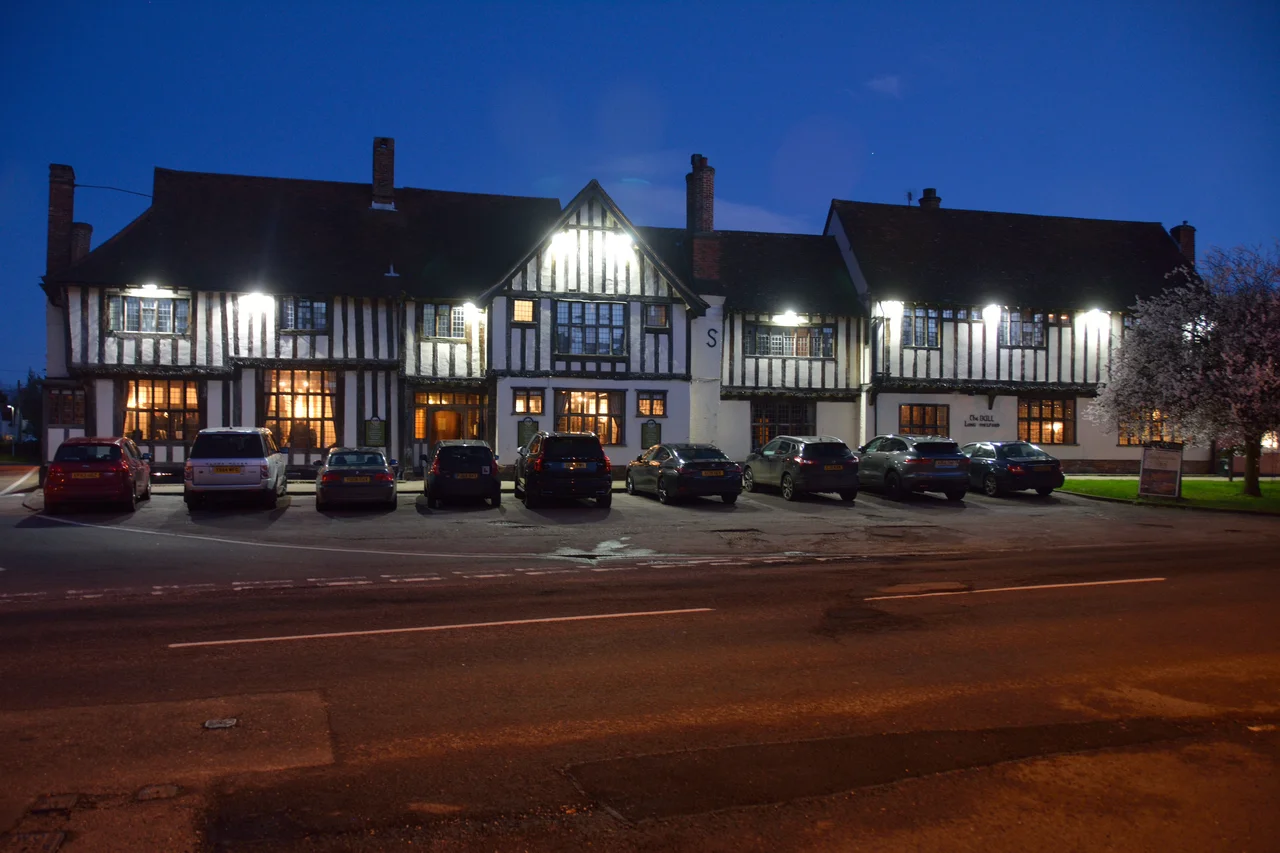
In the 1990s, Long Melford was the principal location for the BBC drama Lovejoy, with Ian McShane as the slightly dodgy antiques dealer; the village and its inns appear in scene after scene. The 1968 film Witchfinder General was partly shot here, as was Terry Jones's 1996 Wind in the Willows. The frontage of Kentwell Hall was digitally added into the 2005 Chronicles of Narnia. In 2015 the Times rated Long Melford one of the top ten most desirable villages in Britain. From the air the village reads as a long ribbon of pale roofs along a single road, with the church at the north end overlooking a vast triangular green, Kentwell Hall set behind a long drive beyond, and Melford Hall to the south. The Nethergate Brewery, in the Rodbridge hamlet at the southern end of the village, still operates.
From the Air
Long Melford lies at 52.08°N, 0.72°E, along the A134 in west Suffolk, with the village strung north-south for roughly three miles. Holy Trinity Church at the north end with its distinctive flushwork tower, and the long village green stretching south from it, are the most obvious aerial features. Kentwell Hall sits in parkland beyond the church to the northwest; Melford Hall to the east near the village green. RAF Wattisham (EGUW) is 13 nm east. Sudbury 3 nm south. The wartime RAF Lavenham control tower at Alpheton stands 5 nm to the northeast.
Nearby Stories
- Ely Cathedral 6.2 km away
- Aldeburgh Festival 8 km away
- Bungay Castle 8.4 km away
- Thetford Castle 9.1 km away
- White House Farm murders 12 km away
- RAF Bottisham 12 km away
- North Weald Airfield 20 km away
- Broadstairs 55 km away