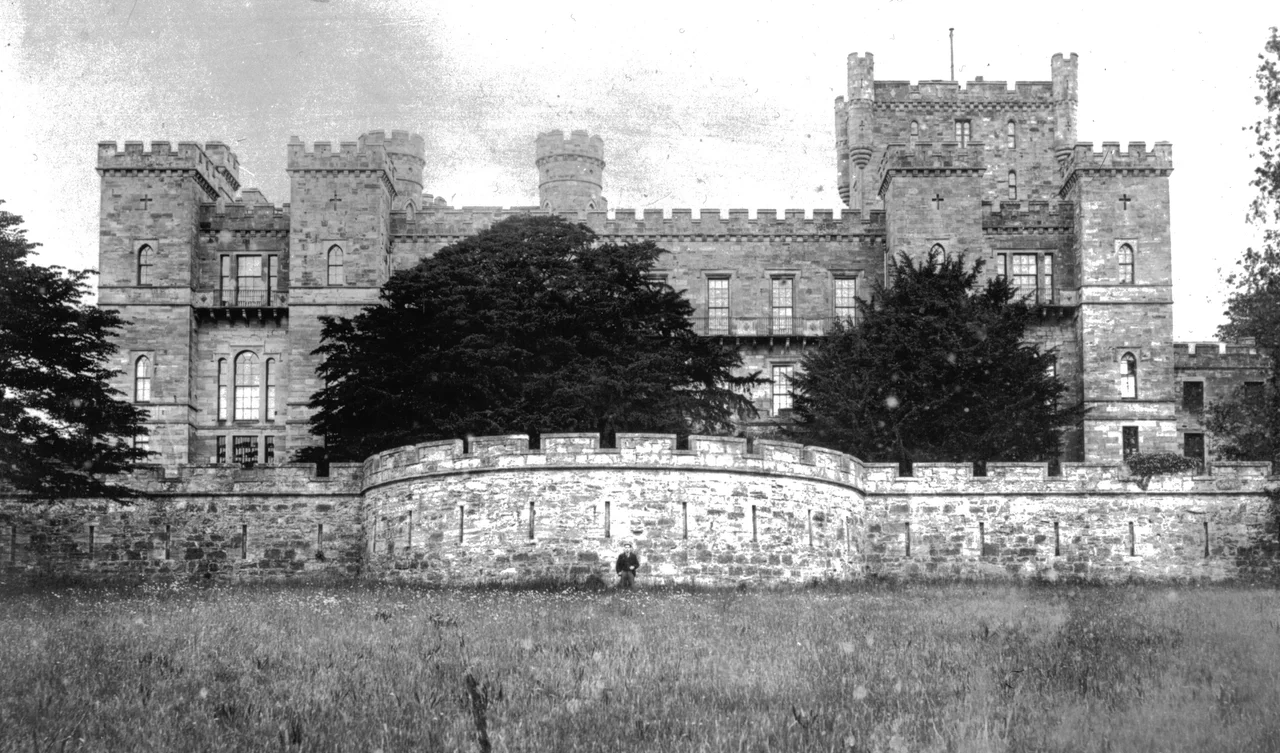

Loudoun Castle
It cost over £100,000 to build, the equivalent of more than £3.5 million today, and its library on the south front ran a hundred feet end to end and held more than eleven thousand volumes. They called it the Windsor of Scotland. In 1941 the whole thing burned, and it has stood as a hollow shell ever since. In 1995 someone tried to convert the grounds into a theme park; that closed in 2010. The ruins are protected today as a Category A listed building, the highest level of architectural protection in Scotland, watching the Ayrshire weather from a height that ninety apartments and four hundred years of family history once filled.
A Castle Built on Castles
Loudoun Castle stands near Galston in the Loudoun area of Ayrshire, ruined now but unmistakable in scale. Most of what is visible was built between 1804 and 1811 for Flora Mure-Campbell, 6th Countess of Loudoun, who married Francis Rawdon-Hastings, 2nd Earl of Moira and later Marquess of Hastings, on 12 July 1804. The architect Archibald Elliot drew up the plans in 1805. The new Georgian mansion absorbed a 17th-century extension and the original 15th-century keep, layering generations of building on a single site. The cost - over £100,000 between 1804 and 1811 - represented an extraordinary investment, equivalent to more than £3.5 million in today's money. The main tower at the rear of the building dominated the silhouette, and the south front held the regal library, a hundred feet long, with more than eleven thousand books.
The Sword of William Wallace
Family tradition held that one of William Wallace's swords had hung at Loudoun for centuries before being relocated in 1863 to the Marquis of Hastings's seat in Leicestershire. On his death in 1868 the sword passed to the Countess of Loudoun, who restored it to the castle's entrance hall. The connection ran through Wallace's mother, a daughter of Loudoun, and through his uncle Sir Reginald Crawford of Loudoun, who was hanged by the English at Ayr. The hall in which the sword was hung measured roughly seventy feet by thirty - vast even by aristocratic standards. Whether the sword that hung at Loudoun was the same blade now displayed at the Wallace Monument in Stirling remains a matter of careful historical debate, but the family's claim to custodianship was treated by them as a sacred trust passed mother to daughter.
The Fire
In 1941 fire swept through Loudoun Castle. Britain was at war, the great country houses across the country were being requisitioned for military use, and many of them suffered fates from which they never recovered - through fire, neglect, or both. Loudoun was not rebuilt. The shell stayed standing, weathered through decades of Scottish rain, its window frames empty, its hundred-foot library reduced to roofless stone. The family had not yet finished with the building, however. The 15th Earl of Loudoun, Simon Abney-Hastings, made a visit to Loudoun County in Virginia in 2015 - the American county that takes its name from his ancestor's title - and posed for photographs with Loudoun County Board of Supervisors Chairman Scott York.
The Theme Park Years
In 1995 the surviving grounds were converted into the Loudoun Castle theme park, a strange afterlife for a ruined aristocratic seat. The park positioned its rides against the dramatic backdrop of the burned-out mansion, drawing visitors to a corner of Ayrshire that had not seen many before. Operations continued for fifteen years before the park closed in 2010, leaving the ruin to its weather and its weeds. The Herald newspaper in 2020 described the site as a decaying theme park, with a slow process of nature reclaiming what had briefly been Disney-meets-Adam-Smith. The shell of the Windsor of Scotland still stands, listed Category A, technically protected but practically vulnerable to time.
Names and Inheritance
The castle's ownership history reads like a manual of British inheritance law. When Lady Edith Rawdon-Hastings inherited the estate, Sir Charles Abney-Hastings - a natural grandson of the 10th Earl of Huntingdon - attached a condition by Royal Licence and Act of Parliament that whoever inherited the Abney family estate must take on the surname Abney-Hastings. The current 15th Earl of Loudoun carries that surname today. The Mure-Campbell family had been at Loudoun before the Rawdon-Hastings arrived through marriage; the Campbells of Loudoun before them held it from about 1690. Each generation added a layer to a place that was, in the end, more about the names attached to it than the stones themselves. Today's ruin is a monument to all of them.
From the Air
Loudoun Castle ruins stand at 55.61°N, 4.37°W, near Galston in the Irvine Valley about seven miles east of Kilmarnock. Recommended viewing altitude 2,000-3,500 feet. The site is open and visible from the air, with the shell of the burned mansion still standing among parkland. Nearest airports: Glasgow Prestwick (EGPK) about 15 nm west-southwest and Glasgow (EGPF) about 22 nm north-northwest. Loudoun Hill, the volcanic plug rising 1,037 feet to the east, is a useful navigational reference.
Nearby Stories
- Clydebank 0.4 km away
- Dunoon 5.5 km away
- HMS Dasher (D37) 6.1 km away
- New Lanark 6.3 km away
- Falkirk Wheel 11 km away
- Drumlanrig Castle 11 km away
- Ailsa Craig 18 km away
- Maybole Castle 18 km away