
The Dragon's Lake
According to the people who have lived along the Labi road for generations, a dragon once meditated in a deep hole in the forest. When it finally woke, it swung its tail, the earth cracked open, and water filled the void. The dragon departed for the sea via a nearby river, leaving behind a lake teeming with fish and ringed by strange, dark-watered swampland. Whether or not a dragon carved Luagan Lalak, something did. The 270-hectare freshwater swamp sits in the Labi Hills Forest Reserve of Brunei's Belait District, about a hundred kilometers from the capital, its tea-colored waters stained by tannins and its surface choked with dense stands of purun sedge. It is, by any reckoning, one of the most quietly extraordinary places on Borneo.
Where the Water Does Not Flow
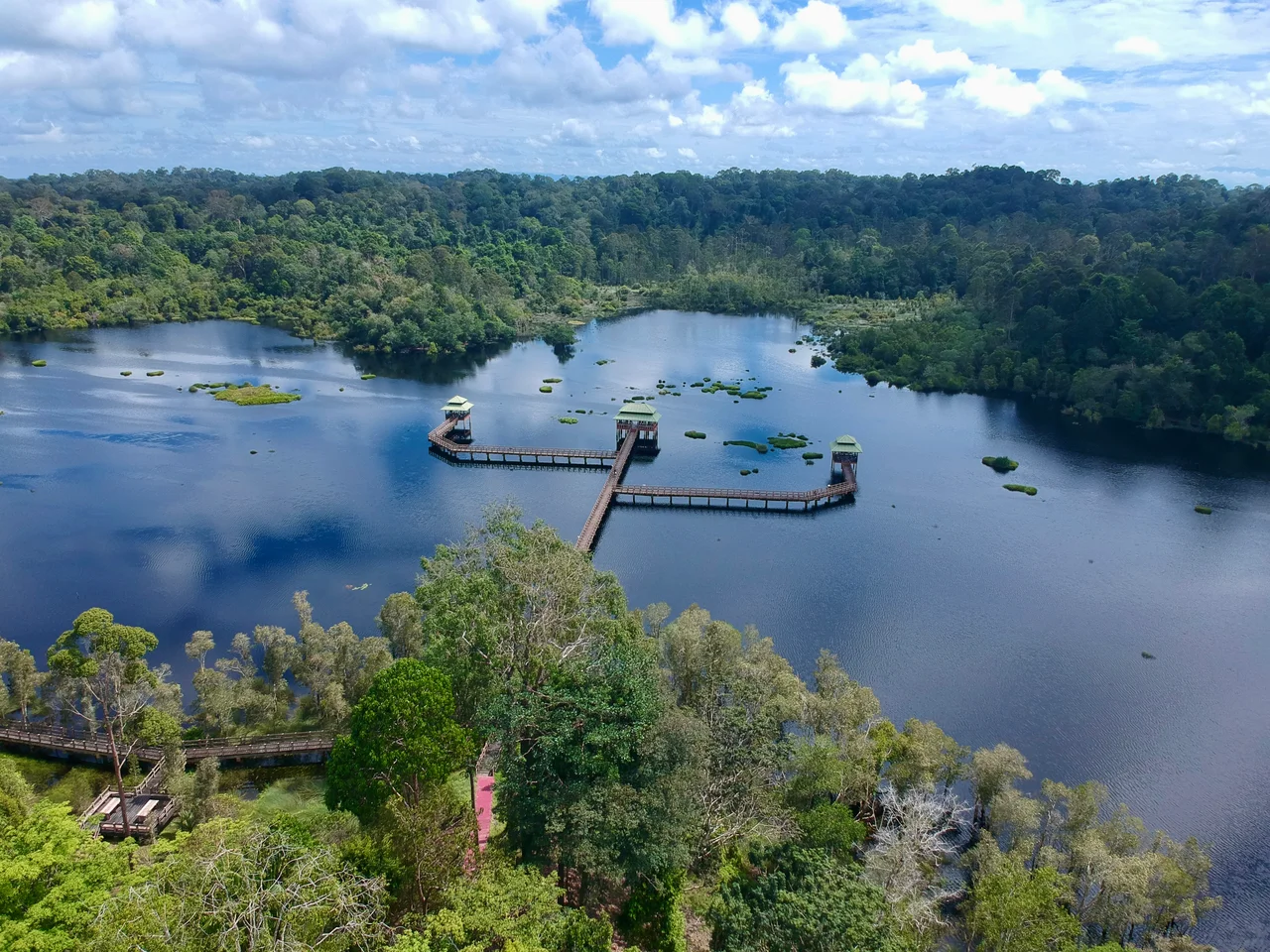
The name gives away the secret. In Malay, luagan means a body of water that does not flow -- a distinction that matters in a landscape defined by rivers and tidal channels. Luagan Lalak is an alluvial freshwater swamp fed entirely by rainwater, not connected to any river system. Its waters are shallow and dark, stained the color of strong tea by decaying vegetation. Fields of Lepironia articulata, the purun sedge, stretch across the surface in thick mats, broken only by the occasional gazebo standing on stilts. Three of these gazebos punctuate the swamp, connected to the shore by a 200-meter wooden bridge that serves as the park's main access route. The effect, especially at dawn, is of a flooded prairie in miniature -- flat, still, and eerily quiet but for the birds.
A Birdwatcher's Confession
The birding community knows Luagan Lalak the way anglers know a secret fishing hole: reluctantly. The park's isolation -- no public transport reaches it, and the twenty-five-kilometer drive down the Labi road from the highway turnoff discourages casual visitors -- has preserved an avian diversity that would draw crowds anywhere more accessible. Storm's stork, one of the rarest stork species in Southeast Asia, has been spotted here. The Bornean bristlehead, found nowhere outside Borneo, calls from the canopy. Rhinoceros hornbills crash through the treetops with wingbeats audible from hundreds of meters away. Garnet pittas forage on the forest floor in jewel-toned plumage. Buffy fish owls hunt over the still water at dusk while common kingfishers work the shallows by day. Photographers have documented at least three species of broadbill -- black-and-yellow, black-and-red, and green -- along with the crested fireback, red-billed malkoha, and great slaty woodpecker, the largest woodpecker in Southeast Asia.
Creatures of the Understory
The mammals are harder to find, which is precisely the point. Sunda pangolins move through the forest at night, their armored bodies curling into defensive balls at the first sign of disturbance. Brunei was the first country in Asia to ban shark finning nationwide, and its public campaigns to protect pangolins reflect a broader national attitude toward wildlife -- the animals are considered a threatened treasure. Maroon leaf monkeys, their rust-colored fur distinctive among primates, occupy the mid-canopy. Colugos, the so-called flying lemurs that are neither lemurs nor truly capable of flight, glide between trees on membranes stretched between their elongated limbs. And then there are the tarsiers. Horsfield's tarsier, with its enormous eyes adapted for nocturnal hunting, grips vertical branches with padded fingertips, waiting for insects with the patience of something that has been perfecting its technique for forty-five million years.
The Fisherman Who Stayed
The second legend of Luagan Lalak involves a fisherman who had exhausted every fishing spot in the district. Tired and defeated, he fell asleep under a shady tree and dreamed of the same dragon that had carved the lake. The dragon showed him a vast body of water to the north, brimming with fish. The fisherman woke, followed the dream's instructions, and found the lake. He caught so many fish that he lost his way back. Eventually he stopped trying to leave and simply settled at the water's edge. The story reads as myth, but it also reads as description. Luagan Lalak has that quality -- a place so removed from the coastal towns and oil fields that define modern Brunei that arriving here feels like stepping sideways out of the country altogether. The park established in 1980 has added gazebos, walkways, benches, and a barbecue pit, and clean restrooms sit across the road from the entrance. But the swamp itself remains indifferent to amenity. It was here before the park, before the fisherman, before the dragon. It will outlast them all.
From the Air
Located at 4.515N, 114.475E in Brunei's Belait District interior. From the air, Luagan Lalak appears as a distinctive open wetland clearing within dense Borneo rainforest along the Labi road, roughly 25 km south of the main highway. The dark freshwater swamp contrasts sharply with the surrounding jungle canopy. Three small gazebo structures on stilts may be visible at lower altitudes. Nearest airport: Brunei International Airport (WBSB) approximately 100 km northeast. Anduki Airfield in Seria is closer at roughly 50 km northwest. Recommended viewing altitude: 2,000-4,000 feet to distinguish the swamp clearing from surrounding forest.
Nearby Stories
- The Town That Splits a Nation 5.3 km away
- The Fort That Ended the Feuds 13 km away
- Where the River Meets the Sea 19 km away
- Brunei's Green Jewel Across the Bay 25 km away
- Niah National Park 47 km away
- The Ants of Borneo 48 km away
- Similajau National Park 139 km away
- Luconia Shoals 198 km away