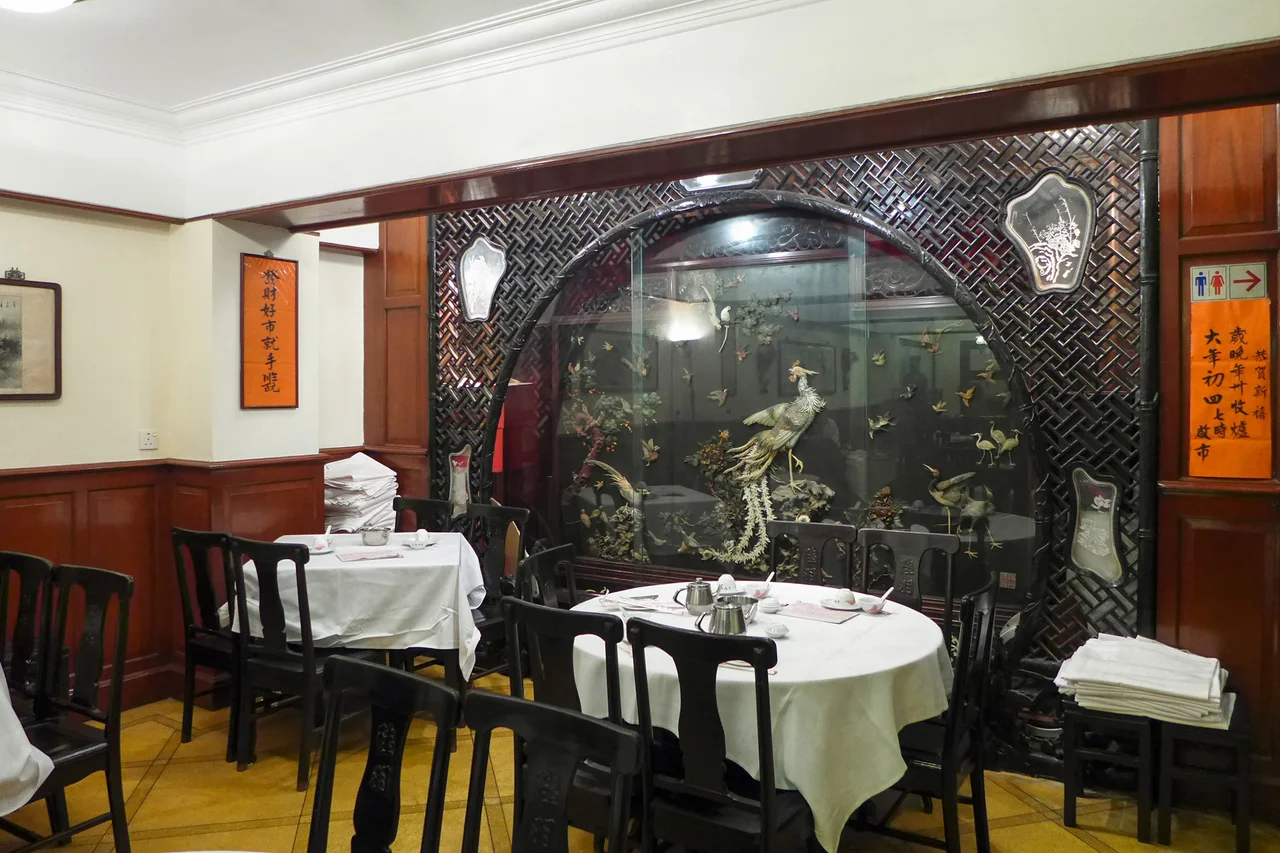

Luk Yu Tea House
The name belongs to a poet who lived twelve centuries ago. Lu Yu — romanised in Cantonese as Luk Yu — was a Tang dynasty scholar who devoted his life to the study of tea, writing *The Classic of Tea*, a text so thorough it earned him the title Tea Sage. When a teahouse opened on Stanley Street in Central Hong Kong in 1933, its founders reached back to that legacy for their name. More than ninety years later, the teahouse is still there, still serving dim sum from the same address, still wearing the same colonial-era fitted wood paneling and stained-glass windows. It is the oldest restaurant in Hong Kong — and it carries its age with unmistakable authority.
A Room That Hasn't Changed Its Mind
Step inside Luk Yu Tea House and the twentieth century closes around you. The ceiling fans rotate. The wooden booths line the walls. Waiters in white jackets move between tables with an unhurried confidence that suggests they have served the same regulars for decades — because many of them have. The first floor is, by unwritten rule, reserved for long-standing customers. There is no sign declaring this. No formal reservation policy. It is simply understood, as so many things are at Luk Yu, that tradition outranks novelty.
The building itself dates to 1933, the year the restaurant opened under the dense commercial streets of Central. The interior design is high colonial Hong Kong: dark timber fittings, brass fixtures, tile floors worn smooth by generations of morning footfall. Photographers and filmmakers seeking the Hong Kong of memory often find it here, largely unchanged.
The Tea Sage and His Inheritance
Lu Yu lived from approximately 733 to 804 CE and spent much of his life in what is now Zhejiang province, studying the cultivation, preparation, and ceremony of tea. His *Cha Jing* — *The Classic of Tea* — is the world's first monograph on tea culture, covering everything from soil conditions for growing tea plants to the proper vessels for brewing and serving. It remains one of the most influential texts in Chinese culinary literature.
The teahouse bearing his name takes that inheritance seriously. Luk Yu carries an extensive selection of Chinese teas, including varieties that require real knowledge to order well. The ritual of *yum cha* — literally 'drink tea' — is as important here as the food. Customers arrive in the early morning hours for tea and conversation, replenishing their cups throughout the meal. It is an experience built around staying, not rushing.
Dim Sum with a Pedigree
The kitchen at Luk Yu still makes dishes that have almost disappeared from contemporary Cantonese menus. Sauteed fillet of pigeon with crispy Kam Wah ham — a preparation that requires both skill and confidence in sourcing — sits alongside Sweet and Sour Pork with Young Ginger, whose use of fresh ginger rather than the usual pickled variety marks it as a deliberate choice, not a shortcut. Grouper Toast and Pig Liver Shiu Mai round out a menu that reads like an archive of mid-century Cantonese cooking.
The dim sum baskets arrive by pushcart, as they always have. The pacing is slow by design. Luk Yu has never adopted the frantic efficiency of newer dim sum halls. Eating here is closer to visiting a library than a canteen — you arrive with time to spend, and the kitchen obliges.
A Murder at Breakfast
On the morning of 30 November 2002, a businessman named Harry Lam Hon-lit was shot dead at point-blank range while eating breakfast at Luk Yu. His killer was Yang Wen, a hitman hired by a Hong Kong triad boss. The murder — committed in the open, in a room full of diners, at a table under those colonial ceiling fans — became one of the most notorious gangland killings in the city's modern history.
The restaurant did not close. It did not move. The wood paneling absorbed the event as it had absorbed decades of Hong Kong history before it. Within days, the morning regulars were back, filling the first floor booths, reading their newspapers and ordering tea. Luk Yu's composure in the face of infamy felt, to many who knew the place, entirely in character.
Stanley Street and What Endures
Stanley Street sits in the heart of Central, a short walk from the financial towers and government buildings that define Hong Kong's commercial core. The restaurants and shops around it turn over constantly. Luk Yu does not. It sells its branded tea in Hong Kong and the United Kingdom — a small concession to modernity — but the restaurant itself maintains its resistance to change as a form of identity.
For a city that demolishes and rebuilds with extraordinary speed, a teahouse that has stood in the same room since 1933 represents something unusual: a place where continuity is not nostalgia but operating principle. You can argue about whether the dim sum is the best in Hong Kong. You cannot argue that nothing else quite like Luk Yu still exists.
From the Air
Luk Yu Tea House sits at approximately 22.2822°N, 114.156°E in Central Hong Kong Island, just inland from the waterfront. Flying into Hong Kong International Airport (VHHH) from the west, the approach over Lantau Island gives way to the densely packed towers of Central and Western District — the Mid-Levels rise steeply behind them. Stanley Street is in the commercial core, invisible from altitude but oriented roughly parallel to the harbor. Recommended viewing altitude is 2,000–3,000 feet on a harbor flyover, which puts Victoria Harbour and the Central skyline in full frame. The Bank of China Tower and HSBC Building are useful landmarks for orienting to this part of the island.
Nearby Stories
- Lok Ma Chau Loop 2.3 km away
- Portas do Cerco 2.3 km away
- Kweilin Incident 17 km away
- Wanshan Archipelago Campaign 34 km away
- Nanxiong Formation 115 km away
- Battle of Nanpeng Island 148 km away
- Heyuan 169 km away
- Cape Maobitou 632 km away