
Lung Yeuk Tau
Five walled villages occupy a shallow valley northeast of Fanling, each one a fortress in miniature, each one built by the same clan. The Tang have lived at Lung Yeuk Tau since the Song dynasty, and the proof is written in granite — in gate towers, enclosing walls, ancestral halls, and study rooms that outlasted empires. Most visitors to Hong Kong's New Territories pass within a few kilometers of this place without ever knowing it exists.
The Five Wais
A *wai* is a walled village — a self-contained fortified settlement where a single clan could defend itself, store grain, and anchor its identity across generations. Lung Yeuk Tau has five of them: Lo Wai, Ma Wat Wai, San Wai (also called Kun Lung Wai), Tung Kok Wai, and Wing Ning Wai. Each has its own entrance tower and enclosing walls, though the degree of preservation varies considerably. Lo Wai's entrance tower and walls are declared monuments. So is the Kun Lung Gate Tower at San Wai, along with the Kun Lung Walls themselves. These aren't ruins — families still live inside some of these structures, and the narrowness of the lanes, the height of the walls, and the smell of incense from interior shrines make the past feel genuinely close. Beyond the five wais, six open villages — the *tsuens* — complete the settlement, including Wing Ning Tsuen, also known as Tai Tang.
The Tang Clan and Their Ancestral Hall
The Tang are one of the great indigenous clans of the New Territories, with branches spread across Yuen Long, Tai Po, and northern districts, but Lung Yeuk Tau is among their oldest strongholds. The Tang Chung Ling Ancestral Hall, a declared monument, stands as the spiritual center of this community — a formal, three-hall structure where the clan has gathered for ceremonies, dispute resolution, and collective worship for centuries. Ancestral halls of this scale weren't merely religious buildings. They were the administrative heart of village life, recording lineages, managing communal property, and mediating between families. The hall at Lung Yeuk Tau still functions as a ceremonial space, and during major festivals it draws Tang descendants from across Hong Kong and beyond.
A Railway That Came and Went
Not everything here is ancient. From 1911 to 1928, the Sha Tau Kok Railway ran through this area, and Lung Yeuk Tau had its own station, opened on 21 December 1911. The light railway connected the market towns of the northeastern New Territories, running roughly 12 kilometers before the line was abandoned. What replaced it was the road network and eventually the modern MTR. The station is gone, and the tracks are long since removed, but the railway era is a reminder that Lung Yeuk Tau was not a place frozen in time — it adapted, it changed, it participated in the modern territory's early infrastructure even as its walled villages stood firm around it.
Walking the Heritage Trail
The Lung Yeuk Tau Heritage Trail, established and promoted by the Antiquities and Monuments Office, links the major historic sites of the area into a walkable route. Along the way, visitors encounter the Tang Chung Ling Ancestral Hall, the Tin Hau Temple (another declared monument), the historic wais, the Shin Shut Study Hall, Shek Lo, and the various village clusters. The trail takes roughly two to three hours to walk at a leisurely pace, and it passes through working villages rather than sanitized heritage precincts. Chickens may cross the path. Laundry hangs from windows set into centuries-old masonry. The heritage here is lived-in, which is both its challenge and its most powerful quality.
Continuity in Stone and Custom
Lung Yeuk Tau is a recognized village under Hong Kong's New Territories Small House Policy, which grants indigenous male villagers the right to build a small house on ancestral land. That policy is contested and politically complex, but it speaks to a deeper reality: these communities have maintained continuous legal identity across British colonial rule and the handover of 1997. The Tang who farm, run businesses, and raise children in Lung Yeuk Tau today are the documented descendants of the Tang who built these walls. The Tin Hau Temple, the ancestral hall, the gate towers — none of it is a theme park reconstruction. It's a community's accumulated material memory, and it has survived because the people inside it insisted that it should.
From the Air
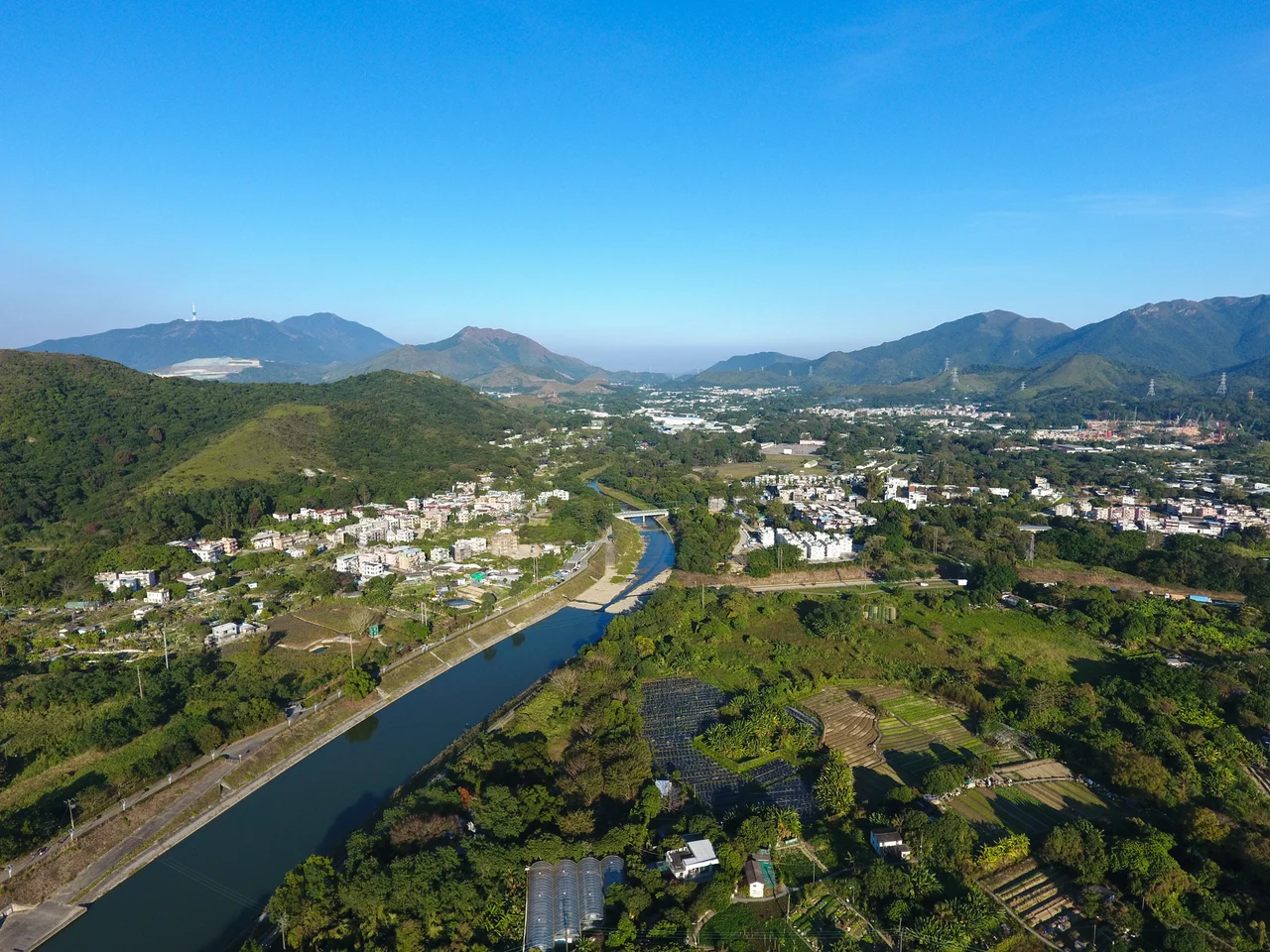
Lung Yeuk Tau sits at approximately 22.50°N, 114.15°E in Hong Kong's North District, northeast of the Fanling urban area. From the air at 2,000-3,000 feet, the cluster of walled villages is visible as a dense, compact settlement pattern distinct from the surrounding low-rise suburban development. The Ng Tung River winds nearby. The nearest major airport is Hong Kong International (VHHH), approximately 35 nautical miles to the southwest. Shenzhen Bao'an International (ZGSZ) lies about 20 nautical miles to the northwest across the border. On clear days, the walled village rooflines and the surrounding hillsides of the North District make for a distinctive visual signature at low altitude.
Nearby Stories
- Hong Kong Disneyland 4.1 km away
- Mount Guanyin (Dongguan) 7 km away
- 2024 Lixinsha Bridge Collapse 7.4 km away
- Portas do Cerco 12 km away
- Lotus Hill 15 km away
- Nanxiong Formation 78 km away
- Heyuan 130 km away
- Checheng Fu'an Temple 629 km away