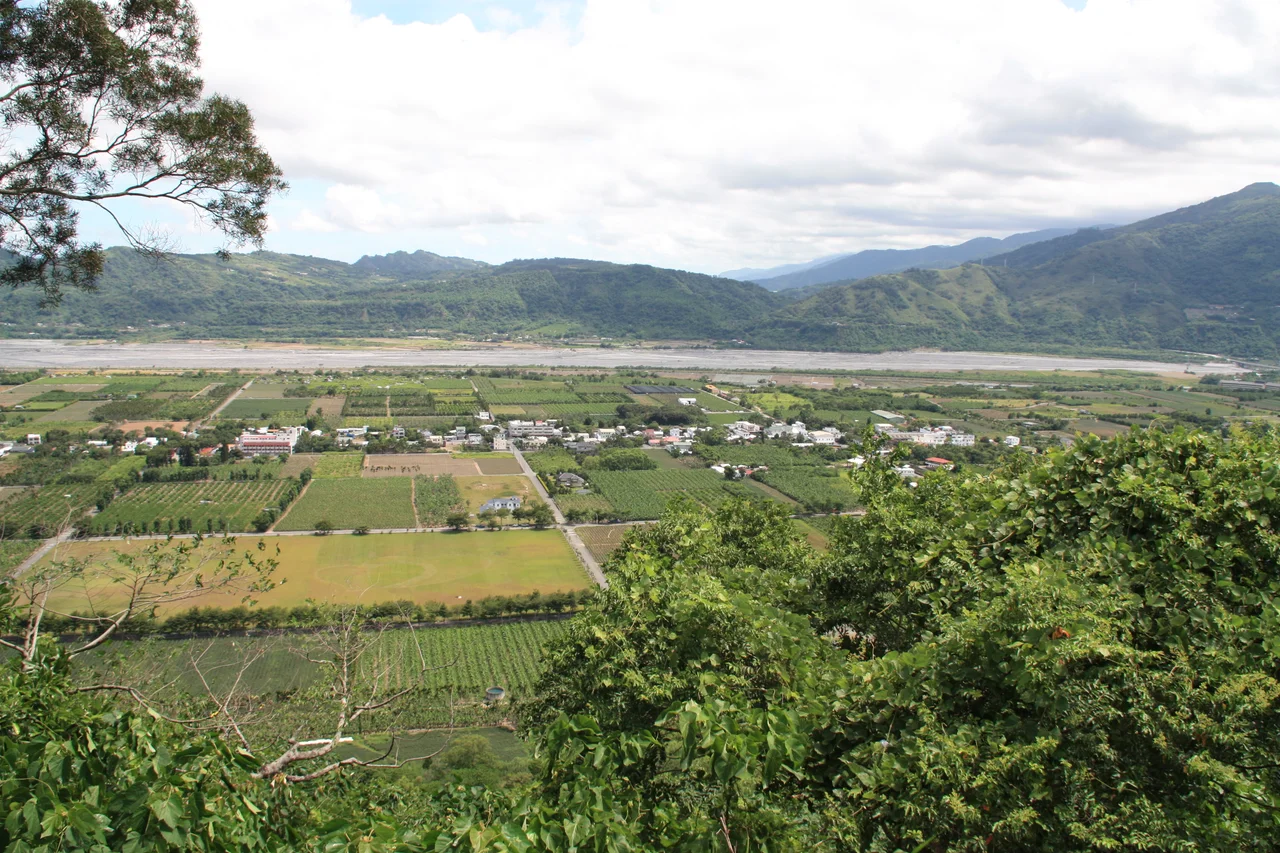

Luye
Every summer, the sky above Luye Highlands fills with color. Hot-air balloons — dozens of them, in bold geometric patterns — rise from the grassy plateau above the valley floor and drift through air that smells of tea. The Taiwan International Hot Air Balloon Festival, held at the Luye flight grounds, has turned this rural township in the Huatung Valley into an unlikely spectacle destination. But Luye was worth visiting before the balloons arrived, and it will be worth visiting when the festival season ends. Tea, hot springs, temples, and the particular quality of light in a high mountain valley — these things do not pack up and leave in September.
Where the Valley Rises
Luye Township occupies a portion of the Huadong Valley in Taitung County, the long agricultural corridor that runs between the Central Mountain Range to the west and the Hai'an Range to the east. Within the township, the terrain rises from the valley floor to the Luye Highlands, a plateau at higher elevation that provides both the balloon festival's launch site and some of the best views in eastern Taiwan. Seven villages make up the township: Luye, Longtian, Yong'an, Ruilong, Ruiyuan, Ruihe, and Ruifeng. The railway reaches the township through Luye Station, Ruihe Station, and Ruiyuan Station on the Taiwan Railways Taitung Line, placing this mountain-and-valley landscape within comfortable train distance of Taitung City to the south.
Tea in the Eastern Hills
Long before balloons, Luye was developing a reputation as a tea-growing area. The township government has worked to establish Luye as a significant tea production zone on Taiwan's east coast, and the high-altitude terrain has proven well suited to the task. The Luye Stage Tourist Tea Garden is one of the places where visitors can see the process directly — the terraced rows of tea bushes on hillside slopes, the careful picking, the fragrance that hangs over the fields in the cooler morning hours. Eastern Taiwan's tea is less famous internationally than the island's high-mountain oolongs from the west, but the Huadong Valley climate, with consistent moisture and altitude-moderated temperatures, produces leaves with a character of their own. Local growers are patient about this. Quality takes time.
Longtian and the Kunci Temple Grounds
Longtian Village, one of Luye's seven villages, anchors the township's historical and spiritual geography. Kunci Temple stands here, a Taoist temple whose grounds contain a reconstructed Shinto shrine — a physical reminder of the Japanese colonial period when Longtian was settled as an immigration village in 1912. The eighty-year-old chinaberry tree on the temple grounds is perhaps the most resonant living landmark in the township: it was beneath this tree that a young nun named Cheng Yen spent time in meditation and teaching in 1960, before she went on to found the Tzu Chi Foundation. For Tzu Chi adherents, visiting Kunci Temple has something of the quality of pilgrimage. For everyone else, the quiet courtyard and the improbably large tree are simply good reasons to stop.
Odd Terrain and Volcanic Mud
Luye has a diverse portfolio of natural oddities. The Thunder Fire Mud Volcano is exactly what it sounds like: a geological formation where natural gas and mud erupt from the ground together, occasionally with a flicker of flame — a reminder that Taiwan's eastern coast sits atop an active tectonic zone. Two Level Ground's Moon World is a badlands terrain of eroded clay hills, pale and lunar in dry weather, resembling a smaller version of the famous Moon World near Tianliao in southern Taiwan. The Wuling Green Tunnel, a road shaded by a canopy of old trees, offers a calmer experience: a cool, green corridor that makes the summer drive through the valley noticeably more pleasant. Luye Steam Nourishing Health Hot Spring adds thermal waters to the township's offerings, a natural complement to the cool highland air.
The Sky Season
The Taiwan International Hot Air Balloon Festival, held annually at the Flight Ground on Luye Stage, typically runs across several weeks in the summer months and draws large crowds to the highlands plateau. The festival has become one of the best-known annual events in Taitung County and a significant draw for domestic tourism across Taiwan. Dozens of balloons representing various designs and national origins participate, and tethered rides allow visitors to rise above the plateau and look out over the Huatung Valley — the mountain ranges on both sides, the agricultural patchwork below, the Pacific somewhere beyond the eastern ridge. From that vantage point, the reason people settled this valley becomes obvious. From that height, it looks like exactly what it is: one of the more beautiful pockets of land on the island.
From the Air
Luye Township is centered at approximately 22.953°N, 121.163°E in the Huatung Valley, Taitung County. Taitung Airport (RCFN) lies roughly 25 kilometers to the south-southeast and is the nearest commercial airport. The Luye Highlands plateau is visible from altitude as the elevated terrain on the western edge of the valley — look for the broad grassy plateau above the valley floor, which is where the hot-air balloon festival is staged each summer. During festival season, the balloons themselves are visible from considerable altitude. Approach from the south along the valley for the best view of the Luye terrain; the township's agricultural villages dot the valley floor while the highland plateau rises distinctly to the west. Best viewed at 2,000 to 3,500 feet on a clear morning.
Nearby Stories
- Liudui Hakka Cultural Park 3.3 km away
- 2025 Tainan–Chiayi Earthquake 3.4 km away
- Meinong Hakka Culture Museum 4.3 km away
- Chiaming Lake 13 km away
- Taimali 13 km away
- 1951 East Rift Valley Earthquakes 78 km away
- 2021 Hualien Train Derailment 142 km away
- Mavulis Island 176 km away