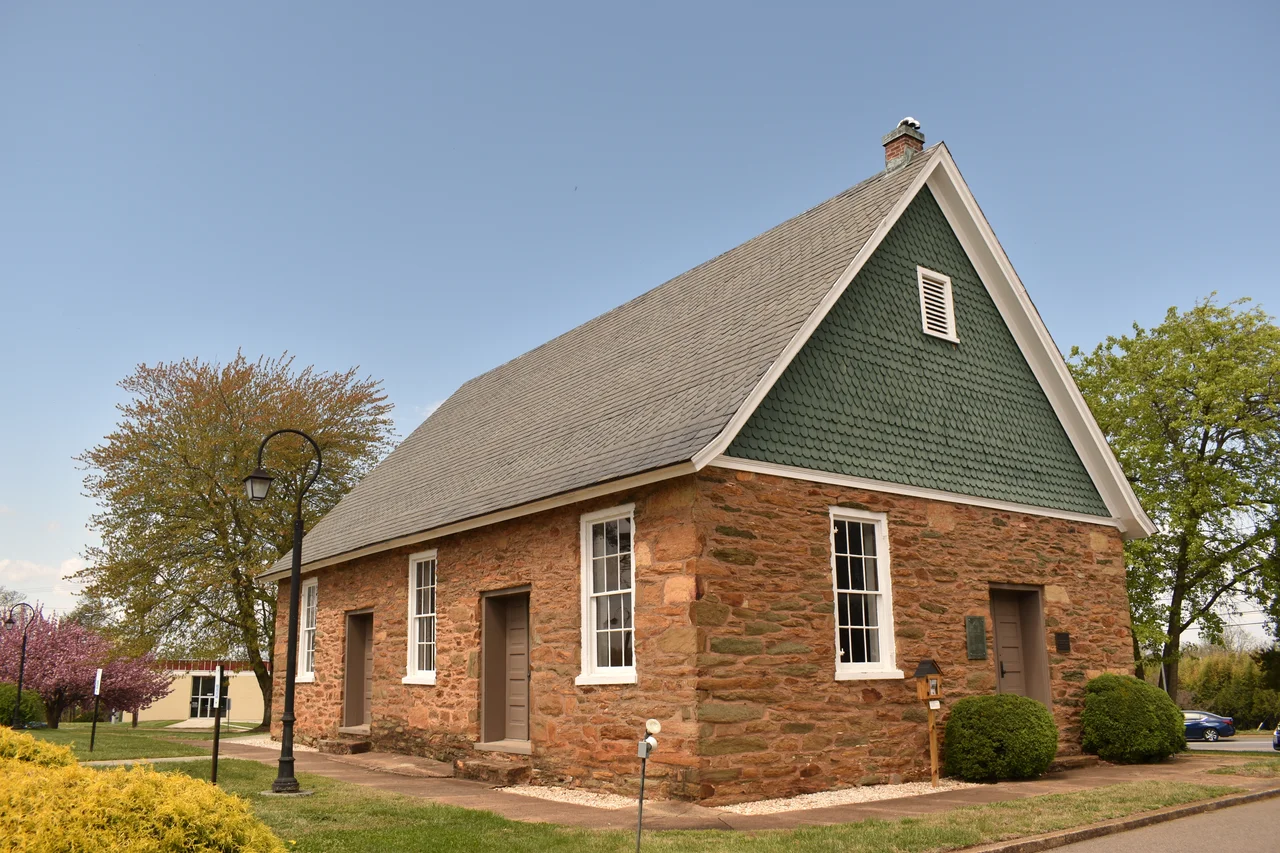
_Meeting_House_2.jpg)
Lynchburg, Virginia
John Lynch was seventeen years old in 1757 when he started running a ferry across the James River. He was the son of Quaker farmers, and the ferry was a practical matter — there was no good way to cross the river between Richmond and the Blue Ridge, so he built one. By 1786 the Virginia General Assembly chartered a town on his land and named it after him. Despite a stubborn rumor, neither John nor the town has any connection to the word "lynching" — that may have originated with his older brother Charles, a Revolutionary-era militia officer. The city John Lynch's ferry started grew up on seven hills above the James, made its fortune on tobacco, and survived the Civil War as a Confederate supply depot rather than a battlefield. Today about 79,000 people live here, on hills called College, Garland, Daniel's, Federal, Diamond, White Rock, and Franklin.
Seven Hills, One River
The James River runs east through central Virginia from the Blue Ridge to the Chesapeake Bay, and Lynchburg sits on the south bank where Blackwater Creek joins it. The seven hills nickname is literal — the city climbs and descends and climbs again, with downtown sitting low along the river and residential districts spreading up the bluffs above. Spring is short and unstable, summers hum at ninety degrees with thick humidity, autumns settle into a long mild spell, and winters can bring repeated foot-deep snowstorms. Locals call the city "Drenchburg" for the way rain systems hang over the hills for days. The warmest part of the day, oddly, tends to be late afternoon — around five, not noon. The Peaks of Otter rise visibly to the west; on clear days the Blue Ridge sketches the horizon.
Tobacco, Rail, and Brick
Through the nineteenth century, Lynchburg made plug tobacco. Farmers across the Piedmont brought leaf in by wagon, factories along Fifth Street and the river processed and pressed it, and the Virginia and Tennessee Railroad and later Norfolk Southern hauled the finished product south and east. James Albert Bonsack, born in Lynchburg in 1859, invented the first practical cigarette-rolling machine in 1880 at the age of twenty-one — a device that transformed the American tobacco industry by automating what had been skilled hand labor. Beyond tobacco, the city built brick: most of downtown's Federal and Greek Revival commercial blocks date from the second and third quarters of the nineteenth century. During the Civil War, Lynchburg's industrial capacity and rail connections made it a Confederate supply hub and hospital town. Jubal Early — the Confederate general buried in the city — defended it from a Union assault in June 1864.
Layers of History
The Old City Cemetery, established in 1806 on land John Lynch donated, holds an estimated 18,000 to 20,000 burials — roughly two-thirds of them African American, including more than 90% of Lynchburg's enslaved and free Black residents from 1806 to 1865. Point of Honor, the 1815 Cabell-family mansion on Daniel's Hill, was both a stately Federal house and, eventually, home at various times to the Langhornes — a family whose daughters included the original Gibson Girl and Nancy Astor, the first woman to take her seat in Parliament. The Anne Spencer House on Pierce Street was the home of the Harlem Renaissance poet and the place where Marian Anderson stayed after a 1934 concert, where Langston Hughes and W. E. B. Du Bois and Thurgood Marshall and Martin Luther King Jr. were guests. Thomas Jefferson's octagonal retreat villa, Poplar Forest, sits about twelve miles west in Bedford County. Lynchburg holds an unusual density of layered American history per square mile.
A City Reshaped
The modern story of Lynchburg has been reshaped by Liberty University, founded in 1971 by Jerry Falwell Sr. The university now enrolls roughly 96,000 students between its residential campus and online programs, and its 275-foot Freedom Tower has surpassed the 1931 Allied Arts Building as the tallest structure in town. Politically Lynchburg has long been conservative, though by 2020 the city narrowly voted Democratic for the first time since 1948 before flipping back in 2024. The Amtrak Northeast Regional reaches Kemper Street Station twice a day; the Lynchburg Hillcats play Class-A baseball at Calvin Falwell Field. Notable native sons and daughters include astronaut Leland Melvin, country singer Phil Vassar, actress Connie Britton, and Medal of Honor recipient Desmond Doss — the World War II combat medic whose Okinawa rescue of 75 men was dramatized in Hacksaw Ridge.
From the Air
Lynchburg is an independent city of about 79,000 in central Virginia, approximately 37.40 N, 79.17 W, on the south bank of the James River where it meets Blackwater Creek. The downtown grid is on hills above the river, with the Allied Arts Building and Liberty's 275-foot Freedom Tower as the two tallest landmarks. The Peaks of Otter rise to the west in the Blue Ridge. Nearest airport: Lynchburg Regional / Preston Glenn Field (KLYH) on the south side of town, served by American Eagle to Charlotte. Pattern altitude around 1,800 feet MSL.
Nearby Stories
- Appomattox-Buckingham State Forest 4.8 km away
- Hollins University 12 km away
- Franklin County, Virginia 13 km away
- Buena Vista, Virginia 15 km away
- Smith Mountain Lake 24 km away
- Alleghany County, Virginia 26 km away
- Murder of Hannah Graham 36 km away
- Staunton River State Park 44 km away