
M+
When the name was chosen, the inaugural director explained it simply: the museum would be 'a museum and more.' M+. The plus sign is not decoration. It signals ambition — a refusal to be contained by the conventional model of the art museum, with its orderly galleries of paintings and sculptures arranged by period and provenance. The institution that opened on 12 November 2021 on the Kowloon waterfront encompasses visual art, yes, but also design, architecture, moving image, animation, video games, and what the curators call 'time-based intangibles.' It occupies 700,000 square feet of a building shaped like an upside-down T, designed by Herzog & de Meuron in collaboration with Farrells, and it cost HK$5.9 billion to build. The ambition was never in doubt. What remained to be seen, after it opened, was how much freedom that ambition would actually be permitted.
The Building as Statement
The architectural competition that produced M+ attracted six of the world's leading firms, including SANAA, Renzo Piano, Shigeru Ban, Snøhetta, and Toyo Ito. Herzog & de Meuron, working with Hong Kong firm Farrells, won in June 2013 with a design that made a virtue of constraint. The site sits directly above the Airport Railway tunnels that run beneath the West Kowloon Cultural District. Rather than treating the tunnels as a problem, the architects proposed using the surrounding space as 'found space' — a subterranean exhibition and performance area that no other museum in the world can claim.
Above ground, the main horizontal slab housing exhibition spaces is lifted off the ground, opening the base to pedestrian flow beneath it. A tower rises above, housing restaurants, lounges, gardens, offices, and research facilities. The building's glass facade doubles as a screen: an integrated LED lighting system turns the museum's exterior into a surface for displaying art, visible across Victoria Harbour from Hong Kong Island. Construction began in 2014. In 2015, a time capsule containing schoolchildren's artwork was sealed in the foundations, set to be opened a century later. The building was completed in December 2020.
A Collection Built from Scratch
M+ opened with a collection of roughly 8,000 works — assembled entirely from scratch over the preceding decade, without the inherited holdings that give established museums their foundations. The process required both vision and speed. Swiss collector Uli Sigg donated 1,463 works by 325 artists, conservatively valued at HK$1.3 billion, in what remains one of the largest single gifts to any museum. A further 47 works were purchased from Sigg for HK$177 million. That founding Sigg Collection focuses on Chinese contemporary art from the 1970s onward.
The museum's curators expanded well beyond it. Works by Tsang Tsou Choi — the 'King of Kowloon,' whose obsessive calligraphic graffiti covered walls, mailboxes, and lamp posts across the city for decades — entered the permanent collection. The archive of Archigram, the influential British architecture collective, was acquired in 2019 despite attempts to block the sale overseas. The collection encompasses everything from architectural models to neon signs, the latter salvaged from a Hong Kong streetscape that was fast losing them to redevelopment.
Art That Made Enemies Before Opening
The museum's founding director, Lars Nittve, stated publicly in 2013 that M+ would 'not steer away' from politically sensitive issues — a direct response to a warning from a pro-Beijing Legislative Councillor not to mix art and politics. That commitment was tested in 2021, before the museum had even opened, when pro-Beijing politicians and newspapers alleged that certain works in the collection violated Hong Kong's national security law.
Among the contested works were photographs by Liu Heung Shing documenting the aftermath of the 1989 Tiananmen Square crackdown. More prominently, after accusations that a piece by Ai Weiwei 'spread hatred against China,' the museum chose not to display the work and removed its image from the museum's website. Ai Weiwei criticised the decision publicly, arguing that a museum subject to such pressure could not achieve its stated ambition of becoming a world-class cultural institution. West Kowloon Cultural District head Henry Tang responded that the museum must comply with Hong Kong law. The tension between that compliance and the museum's founding mandate has not resolved.
The Exhibition Programme
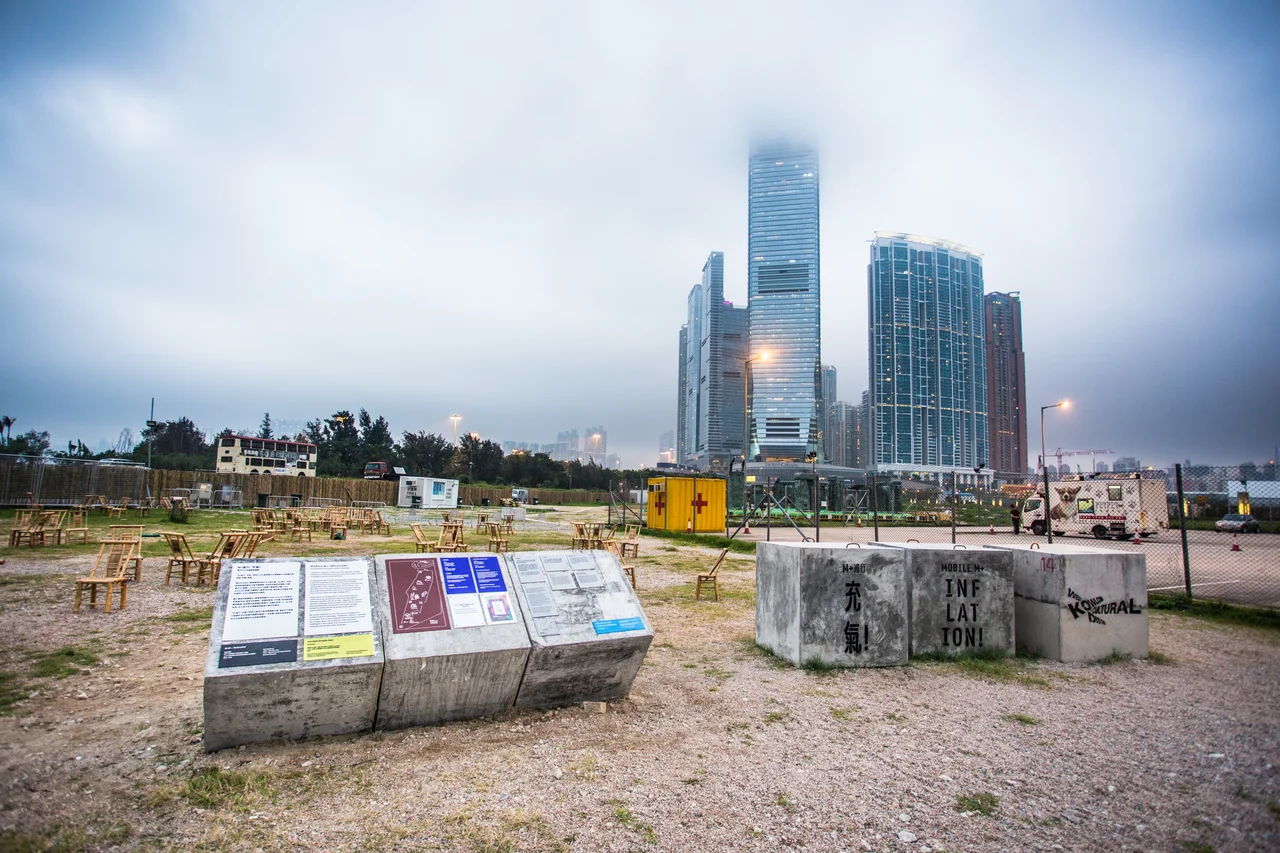
M+ did not wait for its building to begin programming. From 2012 onward, 'Mobile M+' nomadic exhibitions spread across Hong Kong — installation works commissioned in Yau Ma Tei, inflatable sculptures on the vacant West Kowloon site, an online archive of the city's disappearing neon signage. The pre-opening years built both a collection and an audience before the doors opened.
When they finally did, in November 2021, the opening programme offered six simultaneous exhibitions drawn from the permanent collection. Among them: Antony Gormley's *Asian Field*, an installation of tens of thousands of clay figurines made in five days in 2003 by Gormley together with over 300 villagers from a Guangdong village; and *M+ Sigg Collection: From Revolution to Globalisation*, tracing contemporary Chinese art's development from the 1970s through the early 2000s. The opening weekend ran a full programme of live performances, talks, screenings, and workshops. The museum that had been promised for so long was, at last, an operating institution.
Museum and More
The plus in M+ was always the most important part of the name. The museum's collection resists easy categorisation: it holds performance art documentation, architectural archives, moving image works, graphic design, graffiti, neon signs, and traditional paintings. It encompasses the work of international artists alongside an explicit commitment to Hong Kong visual culture — the city's own aesthetic history, from the colonial period through the handover and into the present.
With 185,000 square feet of exhibition space — comparable to MoMA — and a mandate that extends to design, architecture, and the full range of visual culture, M+ bills itself as Asia's first global museum of contemporary visual culture — a claim about precedent rather than scale, though its 185,000 square feet of galleries places it among the continent's largest. What that means in practice, and how the tension between artistic ambition and political constraint will be navigated over the decades ahead, is a story still being written. The building is there. The collection is there. The question of what the plus can actually hold remains open.
From the Air
M+ is located at approximately 22.3010°N, 114.1596°E in the West Kowloon Cultural District, on the Kowloon waterfront directly across Victoria Harbour from Central Hong Kong Island. The building's distinctive upside-down T silhouette and its LED facade are visible from the water and from the upper floors of buildings on the Hong Kong Island side. Approaching VHHH (Hong Kong International Airport) from the east, the West Kowloon reclamation area — flat, densely developed, extending into the harbor — appears on the right (south) side of Kowloon. The museum sits at the southern tip of that reclamation. Recommended viewing altitude for the harbor transit is 1,500–2,500 feet, which frames both the building and the harbor panorama it was designed to face.
Nearby Stories
- Lok Ma Chau Loop 2.3 km away
- Portas do Cerco 2.3 km away
- Kweilin Incident 17 km away
- Wanshan Archipelago Campaign 34 km away
- Nanxiong Formation 115 km away
- Battle of Nanpeng Island 148 km away
- Heyuan 169 km away
- Cape Maobitou 632 km away