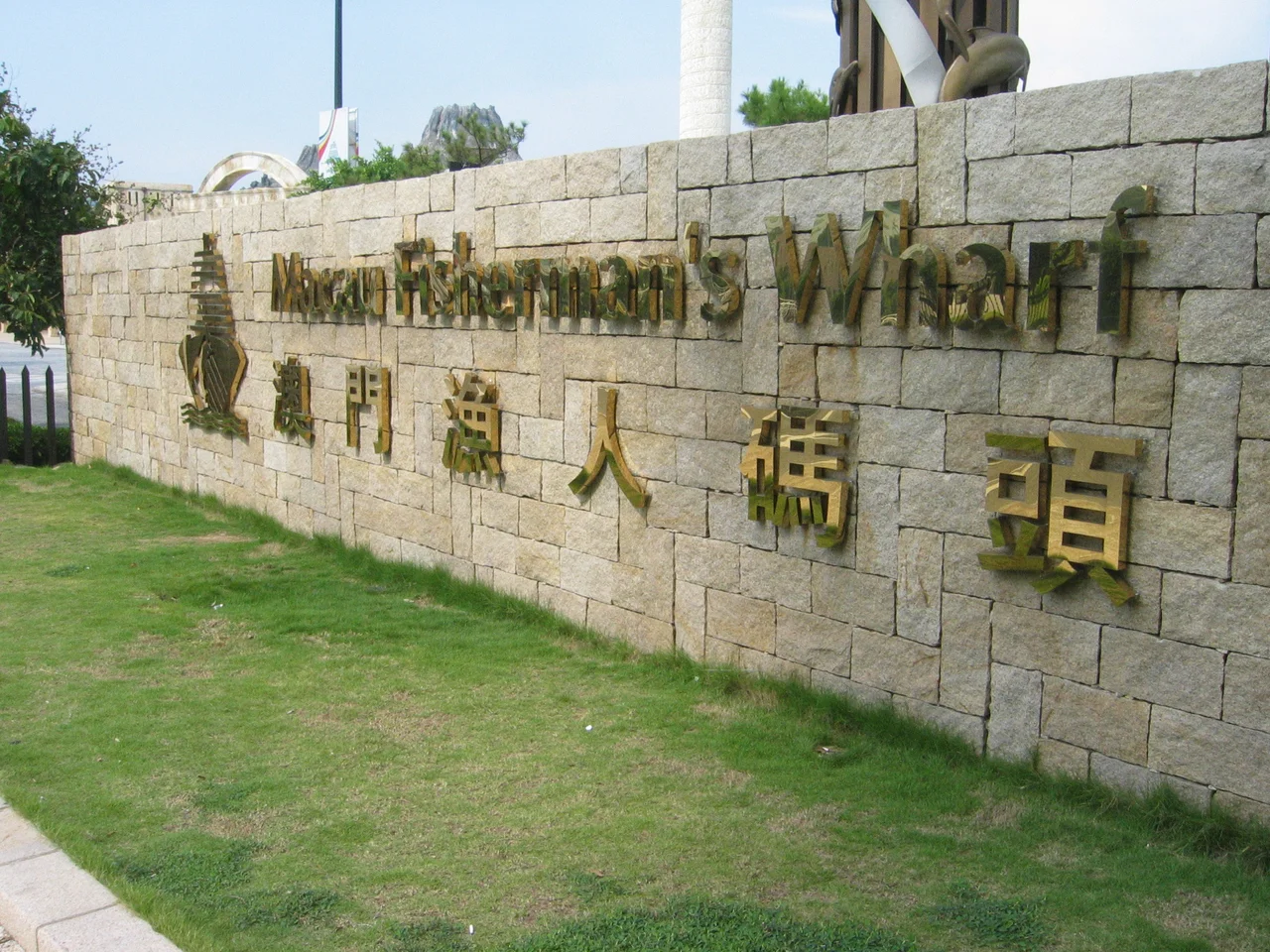

Macau Fisherman's Wharf
The Amsterdam street sits beside a replica of Cape Town's waterfront. The Potala Palace of Lhasa — or a version of it — rises above an artificial volcano that once contained a rollercoaster. A reproduction of the Roman Colosseum hosts concerts on weekends. Macau Fisherman's Wharf is a place that made a considered decision not to be subtle about any of this, and for a certain stretch of years in the mid-2000s it was exactly what Macau thought it wanted: a theme park announcing the city's arrival on the world stage, built on land that didn't previously exist.
Five Years and Forty Percent Reclaimed from the Sea
Construction took five years. When the Macau Fisherman's Wharf opened for a trial run on 31 December 2005 — the Chief Executive of Macau presiding at the ceremony — it covered 133,000 square metres of waterfront in the Sé district. Forty percent of that area was new land, reclaimed from the sea in the same tradition of expansion that has added enormous territory to Macau's original peninsula over the past century.
The full opening came a year later, on 31 December 2006. The complex held over 70 stores and restaurants, a convention and exhibition centre, a marina, two hotels (the Victorian-themed Rocks Hotel and the Czech Baroque-themed Harborview Hotel), and the Babylon Casino. The architectural theme was world seaports: walk through the complex and you passed facades styled after Cape Town, Amsterdam, and other international waterfronts, each one executed with a theatrical conviction that made no apologies for the artifice.
The Rollercoaster Inside the Volcano
At the park's opening, Macau Fisherman's Wharf could claim a genuine distinction: it contained Macau's first rollercoaster, installed inside the artificial volcano at the base of the Potala Palace replica. The ride was designed as an experience rather than simply a thrill — themed dioramas lined the track to give riders the illusion of flying around the world, each scene a different destination. It was the kind of ambitious, slightly absurd entertainment concept that defined the park's ambitions.
The coaster was closed at some point after 2007, following an unspecified accident. The source records do not say what happened or whether anyone was hurt. The volcano and the Potala replica remained, but the machinery inside went quiet, and the park's amusement section — which had also included a magic carpet ride, bumper cars, a flying carousel, a paintball arena, and a children's miniature train — gradually wound down. The Colosseum replica continued operating as a concert venue.
From Theme Park to Commercial District
Macau Fisherman's Wharf's identity has shifted over the years since its opening. The amusement rides are gone. The complex today operates as a commercial district — restaurants, retail, the hotels, the casino, the convention centre — rather than as the entertainment destination it launched as. The Legend Boulevard shopping and dining street runs through the heart of it.
The Colosseum serves as the main performance venue, hosting concerts and events. The waterfront itself remains attractive, and the Marina offers mooring for private vessels. The buildings in their international architectural costumes still stand: the Dutch gables of the Amsterdam quarter, the Victorian ironwork of the Rocks Hotel's district, the Potala dome above the now-silent volcano. Macau has never been shy about the coexistence of the ancient and the fabricated, and the wharf fits comfortably into a city where a genuine sixteenth-century Portuguese streetscape stands a few blocks from casino towers.
From the Air
Macau Fisherman's Wharf sits at approximately 22.191°N, 113.557°E on the northern waterfront of the Macau peninsula, facing the Pearl River estuary. The complex is recognisable from the air by the artificial volcano structure near its centre and the waterfront marina. Macau International Airport (VMMC) is on Taipa Island, approximately 5 km to the southeast across the water. The Hong Kong–Zhuhai–Macau Bridge's western terminus is visible roughly 5 km to the northwest. Approach from the northeast at 1,500 to 3,000 feet for the best view of the waterfront complex and the Macau peninsula below.
Nearby Stories
- Tai Tau Chau (Southern District) 0.7 km away
- Lai Chi Wo 3 km away
- Wanshan Archipelago Campaign 3.2 km away
- Pearl River Delta 3.7 km away
- Battle of Yamen 13 km away
- Jiangmen 15 km away
- Hong Kong 12 32 km away
- Battle of Nanpeng Island 114 km away