
Macquarie Harbour Penal Station
In a single year, 1823, the lash fell nine thousand one hundred times on the men of Sarah Island. The island is small enough to walk in twenty minutes, a green sliver of about eight hectares afloat in a harbour ringed by mountains. There was nowhere to run, and that was precisely the point. When the British wanted to punish convicts who had already been transported across the world for their crimes, men who reoffended in Van Diemen's Land or escaped from softer settlements, they sent them here, to the harshest penal station in colonial Australia. For eleven years, between 1822 and 1833, this was the end of the line.
The Island at the End of the World
Lieutenant John Cuthbertson of the 48th Regiment arrived in January 1822 to take command of a place chosen for its cruelty of geography. Sarah Island sat hundreds of miles from any other settlement, walled off by a wide harbour and a wilderness no one had mapped. The first ships brought soldiers and their families, and sixty-six male and eight female convicts, into a landscape that could not feed them. The island grew almost nothing. Everything had to come by sea, across a harbour mouth so treacherous it was called Hell's Gates. When supply ships were late, malnutrition, dysentery, and scurvy moved through the barracks. In the early years the place was so crowded that men could not lie on their backs to sleep. Punishment was solitary confinement in cells too dark to see in and too small to stretch out in, and floggings administered with a regularity that turned suffering into routine.
The Men Who Ran
Despite everything, they ran. A surprising number of convicts gambled on the wilderness rather than endure the island, and the wilderness rarely let them go. In 1824 the bushranger Matthew Brady and his party tied up their overseer, seized a boat, and somehow reached Hobart. James Goodwin escaped in 1828 and survived, and the colony, recognising what he had learned crossing country no European had charted, pardoned him and put him to work surveying it. The most haunted name belongs to Alexander Pearce, an Irishman who escaped twice. Both times, starving in the bush, he survived by eating the companions he fled with. When he was finally recaptured with human remains in his pockets, the truth of what the island drove men to became impossible to deny. Pearce was hanged in Hobart in 1824. One prisoner, named Trenham, found a darker exit still, stabbing another convict in 1824 so that he would be executed rather than returned to Macquarie Harbour.
The Ship That Never Was
Sarah Island had one strange grace: it built ships. Convict shipwrights, working in a yard at the bottom of the world, became some of the colony's finest boatbuilders, and the brig they laid down as the station was closing gave them their improbable last act. In January 1834, ten men led by the former whaler James Porter seized the Frederick as it prepared to sail, set their guards ashore with provisions, and pointed the bow at the open Pacific. They reached Chile and lived as free men for two years before four were caught and shipped back. In court they argued, with the strange logic of desperate men, that the Frederick had never been officially launched and so could not have been stolen. They were convicted of piracy but escaped the noose. Their story became The Ship That Never Was, now Australia's longest-running play, performed in Strahan a few miles across the water.
What the Ruins Remember
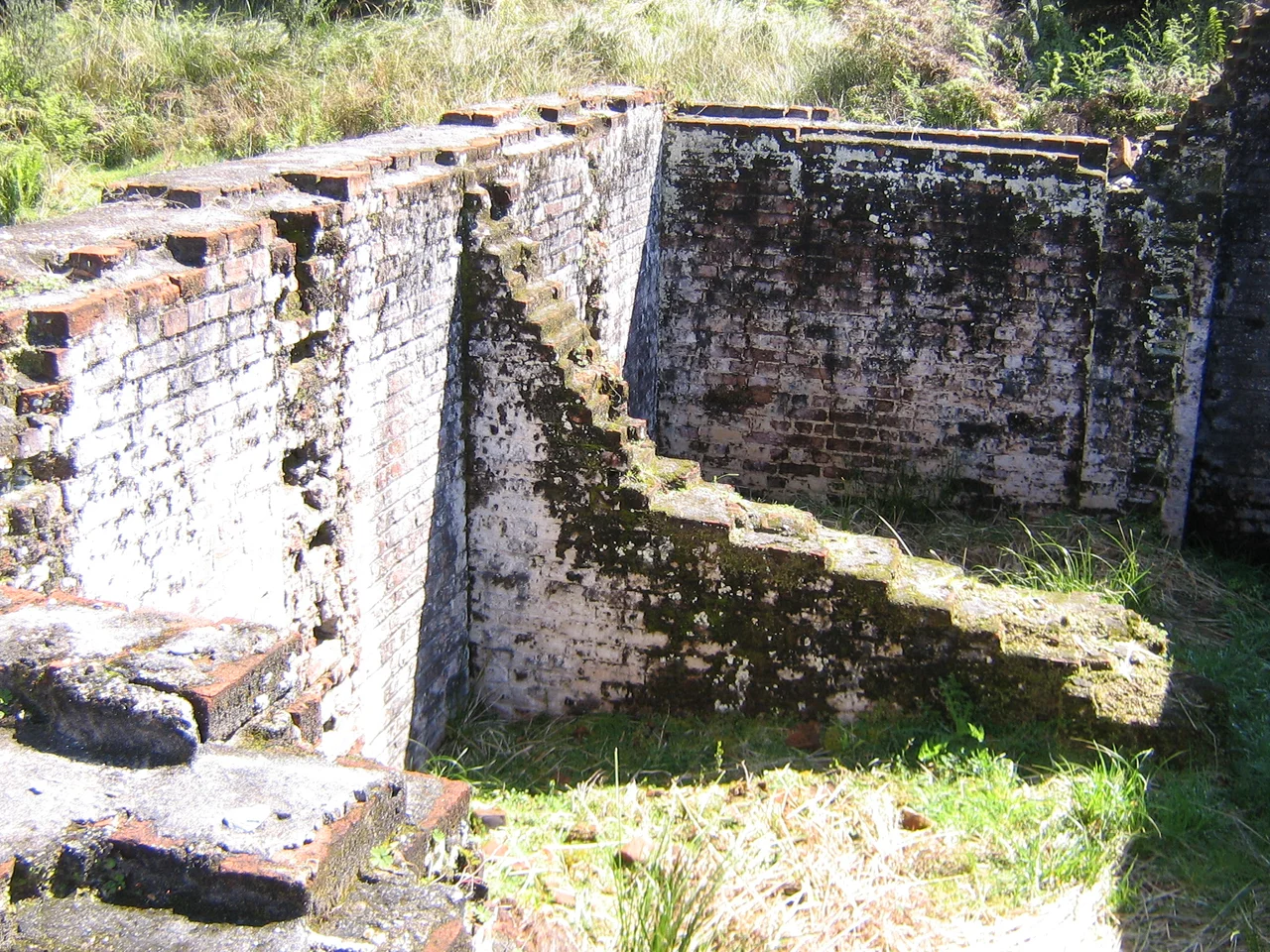
The station closed in late 1833, and most of the remaining men were moved to Port Arthur. For a while the timber-cutters who came after, the piners hunting Huon pine, called the place Settlement Island, but the old name returned. Today the ruins stand quietly within the Tasmanian Wilderness World Heritage Area, less restored and less visited than Port Arthur, reached by ferry from Strahan. You can still find the domed oven of the bakehouse and the black mouths of the solitary cells. The history here is not comfortable, and it should not be. These were people, transported for crimes that ranged from the serious to the petty, then ground down by a system designed to break them. Walking the island's short paths, among the moss and the rain, the silence asks you to remember them as men, not as the cautionary tale the colony made of them.
From the Air
Sarah Island lies at 42.39 degrees south, 145.45 degrees east, a small wooded island in the southern reaches of Macquarie Harbour on Tasmania's remote west coast. From the air it reads as a distinct green landmass set against the dark water of the harbour, with the broad sweep of the Gordon River entering to the south and the narrow channel of Hell's Gates breaking the coast to the northwest. The nearest airfield is Strahan Airport (ICAO YSRN), a few minutes' flight to the north; Cambridge Aerodrome (YCBG) and Hobart International (YMHB) lie roughly 150 nautical miles east across the island. Expect frequent low cloud, rain, and strong westerly winds off the Southern Ocean; clear days are the exception, and a viewing altitude of 2,000 to 3,000 feet best frames the island against the harbour and the mountains beyond.
Nearby Stories
- Strahan 6.1 km away
- Southwest National Park 24 km away
- Cradle Mountain-Lake St Clair National Park 40 km away
- Lake Pedder 57 km away
- Mount Wellington (Tasmania) 153 km away
- Cape Grim Massacre 169 km away
- Cataraqui 281 km away
- Chatham Islands 3108 km away