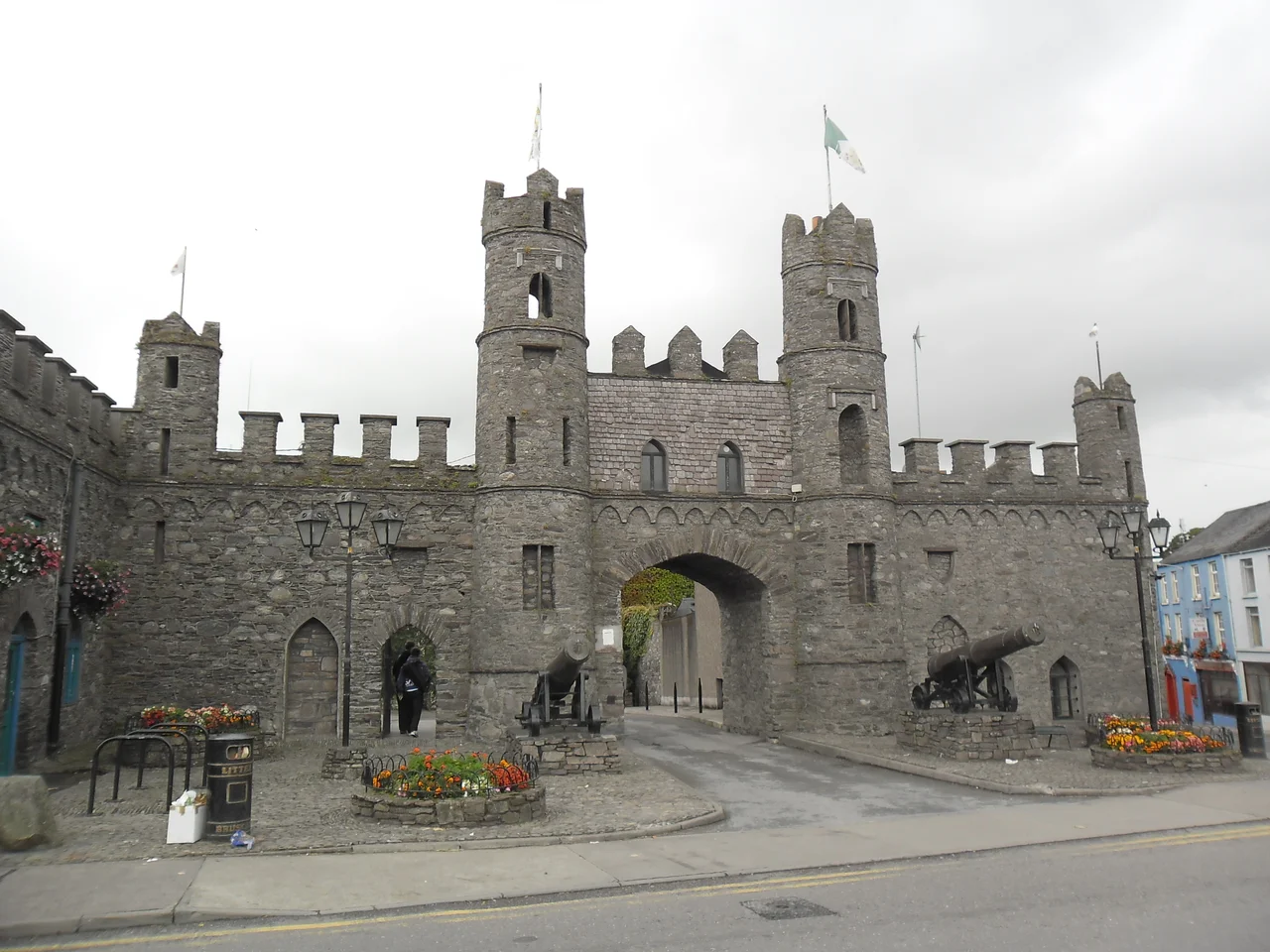

Macroom Castle
Walk into the town square at Macroom and you will see a gatehouse that does not lead to a castle. Two round turrets flank an arched passage. A guard chamber sits above the gate, fronted with slate cut to look like dressed stone. Two cannons stand on stone pedestals before the entrance. This is what Robert Hedges Eyre had built before 1824, a medieval-romantic theatrical folly meant to dress up the marketplace. Walk through it and you find nothing on the other side but a school, a row of houses, and somewhere downhill a ruin near the bridge over the River Sullane. The actual castle stood here for at least six hundred years. It was burned at least five times. The last fire was in 1922.
O'Flynns and MacCarthys
The first castle on this rock probably dates to the time of King John, the late 12th century. The old Irish name, Caislean Ui Fhloinn, points to the O'Flynns, who held much of this part of Muskerry before the MacCarthys arrived. In 1353 Muskerry, with Macroom inside it, was given as an appanage to Dermot MacCarthy, second son of the King of Desmond, who became the first Lord of Muskerry. The MacCarthys held the castle with interruptions for more than three hundred years. Teige MacCarthy, the eleventh Lord, restored and enlarged it and died there in 1565. Two generations later, after Cormac MacDermot MacCarthy backed the Spanish landing at Kinsale in 1601, he was arrested, escaped, and watched the castle fall to English forces under Captain Flower and Charles Wilmot, who took advantage of an accidental fire to capture it in 1602.
The Bishop and the Tree
The most haunting episode at Macroom Castle came in 1650, during the Cromwellian conquest. Bishop Boetius MacEgan, Bishop of Ross, assembled a Confederate army at the castle to resist Lord Broghill's Cromwellian troops. When Broghill approached, the castle garrison set fire to the building before joining the bishop's army in the surrounding park. The Confederates lost the ensuing battle. The bishop was taken prisoner along with Roche, the High Sheriff of Kerry. Roche was shot. MacEgan was offered his freedom on one condition: he was to ride to Carrigadrohid Castle, just downriver, and persuade its garrison to surrender. He went. When he reached the castle, instead of urging surrender he shouted at the defenders to hold out at all costs. The Cromwellian officers hanged him from a tree on the spot. Later in the same war, General Ireton sent troops back to Macroom that burned both the town and what remained of the castle.
The Penn Connection
In 1656, during the Commonwealth, the confiscated castle was given to Admiral William Penn, a senior Royal Navy officer who had served Cromwell. He moved into Macroom Castle that year. His son, also William Penn, was twelve years old. The younger William Penn would later convert to Quakerism, found a colony in North America in 1681, and give his name to the state of Pennsylvania. So for a window of a few years in the 1650s, the boy who would shape Philadelphia spent time at his father's confiscated Irish castle on the Sullane. After the Restoration of the monarchy in 1660, the castle was returned to Donough MacCarty, now the first Earl of Clancarty, who enlarged and renovated it once more. The MacCarthys had it back. They would not hold it long.
Forfeited, Auctioned, Owned
During the Williamite war, the fourth Earl of Clancarty turned Jacobite. On 11 September 1689 he used Macroom Castle as a prison for Protestants who had been evicted from Cork. The castle changed hands twice more in the war before Major Percy Kirke finally relieved it for William III's forces in 1691. It was confiscated and put up for auction in 1703. It was bought by the speculative Hollow Sword Blade Company, which resold it to Francis Bernard, the future first Earl of Bandon. By 1824 it was held jointly by Bandon and Robert Hedges Eyre, who built the gatehouse folly and a new Market House to embellish the town square. When Eyre died unmarried in 1840, the inheritance broke up. William Hedges-White, later third Earl of Bantry, inherited Macroom. When his daughter Olivia, born in the castle in 1850, married Lord Ardilaun of the Guinness family in 1871, the castle passed with her to the Ardilauns.
The Last Fire
During the Irish War of Independence, British Auxiliaries used Macroom Castle as their base in the area. It became one of the targets of the IRA campaign and was associated, by proximity and command structure, with the Kilmichael Ambush. During the Irish Civil War, anti-treaty forces burned the castle on 18 August 1922, one of many destroyed in those years across the country. The main residential block, fashioned before 1750 from the gap between two older towers and dominating the town's skyline, became derelict and unstable. In 1967 the local authorities demolished it completely. The modern wing of Bishop McEgan College now occupies the site. In 1924, the widowed Lady Olivia Ardilaun, a descendant of the MacCarthy chiefs, sold the castle demesne to a group of local businessmen, to be held in trust for the people of Macroom. Today the gatehouse, the surviving tower, and the western facade of the lost west wing are all the visitor sees. The parklands are open. The castle is not.
From the Air
Located at 51.90 degrees N, 8.96 degrees W in the centre of Macroom town, on the east bank of the River Sullane. Cork Airport (EICK) lies about 38 km east. From altitude at 2,000-4,000 feet, the castle gatehouse and surviving tower are visible at the western edge of the historic town square; the demesne parkland stretches south along the river through mature oak and beech. The river bridge marks the divide between the historic town centre and Masseytown to the west. The Boggeragh Mountains rise to the north, the Derrynasaggart range to the west. The town is at the centre of the visible mid-Cork dairy country, halfway between Cork city and Killarney.
Nearby Stories
- Páirc Uí Chaoimh 4.9 km away
- Clonakilty 7.9 km away
- Killarney National Park 8.7 km away
- Carrigeenamronety Hill 9.7 km away
- Ahakista 13 km away
- Tralee 16 km away
- Ballybeg Priory 20 km away
- Walter Siepmann 23 km away