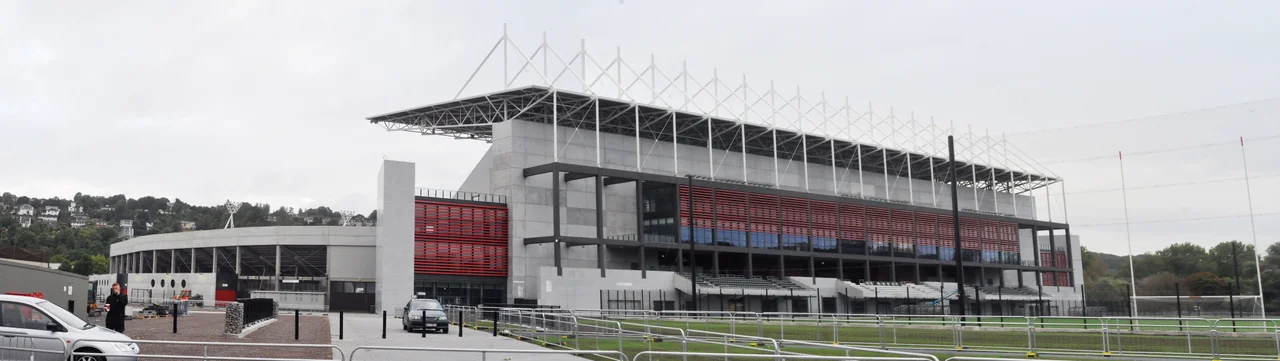

Páirc Uí Chaoimh
Cork people call it The Park. Páirc Uí Chaoimh, the field of O'Keeffe, named for Pádraig Ó Caoimh - the long-serving General Secretary of the Gaelic Athletic Association from 1929 to 1964, the Cork man who built the modern administrative GAA from a Dublin office. The stadium that bears his name sits on the south bank of the River Lee, in the Ballintemple district between Mahon and the city centre. Hurlers in red Cork jerseys come here on summer Sundays to face the men of Tipperary, Limerick, Clare and the great Kilkenny side, and the noise from a Munster final crowd rolls across the river like weather. Bruce Springsteen has played here twice. So has Ed Sheeran. The stadium since February 2024 carries the full title SuperValu Páirc Uí Chaoimh - a sponsorship that locals have absorbed with mixed feelings, the way locals everywhere absorb the renaming of beloved places.
Before the Park
The land has been used for sport since before the Gaelic Athletic Association even existed. By the late 1890s the Cork County Board enclosed part of the site for Gaelic games; the original stadium opened in 1898, and in 1904 the larger Cork Athletic Grounds opened a short distance away on the Monahan Road. The Athletic Grounds hosted All-Ireland finals and Munster finals through the first half of the twentieth century, but by the 1960s, contemporary commentators were describing the facilities as primitive. The County Board began looking for a new site. In 1963 they bought land at Model Farm Road on the western side of the city, intending to build a 70,000-seat stadium. The Model Farm Road plans never proceeded; the land was eventually sold to fund the new development on the original Athletic Grounds site. Construction began in April 1974. Designs by the Cork firm of Horgan and Lynch had been kept under wraps until a press launch at the Imperial Hotel in July of that year.
The 1976 Opening and the Festival That Saved It
The new stadium opened in 1976 with a hurling match between Cork and Kilkenny followed by a football match between Cork and Kerry - the great Munster derbies that have defined Cork sport for a century. Initial capacity was 50,288. The first-stage cost was 1.7 million pounds, up from the 1 million estimate, and the County Board had a 650,000 pound bill it could not easily pay. The escape came from music. The Cork promoter Oliver Barry founded Siamsa Cois Laoi, a weekend folk and country festival held annually at the stadium from 1977 to 1987, against opposition from GAA traditionalists who objected to non-Gaelic events. Don McLean played there in 1979 and again in 1984. Joan Baez in 1980. The McGarrigles, Loudon Wainwright III, Kris Kristofferson and John Denver all came through. The income kept the debts moving. When U2 played in 1985 and Michael Jackson in 1988, the stadium became one of Ireland's serious concert venues. The County Board's share of ticket sales funded the purchase of Christy Ring Park, the secondary Cork venue named for the greatest hurler of his generation.
The Eighty-Six Million Rebuild
By the 2010s the old Park was tired. Safety regulations had progressively cut its capacity from 50,000 down to 32,550. Wooden bench seats, replaced in 2005 by ill-fitting bucket seats, had become a Cork joke - the seat backs had to be cut off because nobody fit in them properly. A full redevelopment, planned since 2010, finally broke ground in early 2015 after a 30-million-euro government grant unlocked the project. The contractors gutted everything except the playing surface. A new three-tier south stand with 13,000 covered seats went up. The north stand was rebuilt for 8,000 covered seats. Two open terraces, each 12,000 capacity, replaced the old ends. The reopening was meant for the 2017 Munster finals but was delayed - the first game in the new bowl was a Cork intermediate hurling fixture between Valley Rovers and Blarney on 19 July 2017, drawing a respectable 10,749 even for a club match. The All-Ireland hurling quarter-finals followed the next week. Total cost ran past 86 million euros, then closer to 110 million by 2018. The capacity is now 45,000, making it the third-largest GAA stadium in Ireland after Croke Park and Semple Stadium.
Liam Miller and the First Soccer Match
On 25 September 2018, for the first time in its history, Páirc Uí Chaoimh hosted association football. The occasion was a benefit match for Liam Miller, a Cork-born Irish international footballer who had played for Celtic and Manchester United, and who had died of pancreatic cancer in February of that year at the age of 36. A Manchester United legends team played a combined Republic of Ireland and Celtic legends team; the match finished 2-2 and was settled 3-2 by United on penalties. The official attendance was 42,878. At half-time, juvenile Gaelic football and hurling exhibition games were played by Éire Óg, the Cork club Miller had represented as a boy. The match raised significant funds for Miller's young family and for cancer support charities. Six years later, in 2024, Cork native Denise O'Sullivan scored the first international goal at the stadium in a UEFA Women's Euro 2025 qualifier against France. Ireland won 3-1. The football world, slowly, has been admitting itself to a stadium designed for the older Irish games.
Rugby Records and the Sheeran Curse
Páirc Uí Chaoimh hosted its first rugby match on 10 November 2022, when Munster played the touring South Africans before 41,400 spectators - the largest crowd ever to attend a rugby match in the province of Munster. On 3 February 2024, Munster beat New Zealand's Crusaders 21-19 at a sold-out Páirc Uí Chaoimh, the kind of result Munster supporters will talk about for years. The redeveloped stadium also reopened to concerts in May 2018 with Ed Sheeran playing three nights of his Divide Tour - and Sheeran returned in April 2023 for two more nights of his Mathematics Tour. Elton John played his Farewell Yellow Brick Tour here on 1 July 2022. Bruce Springsteen has played twice, in 2013 and again in May 2024 to roughly 80,000 fans across two nights. Cork's old story used to be that big music skipped past Cork for Dublin. The new Páirc has reversed that. When a tour comes to Ireland now, the Park is usually on the route - The Boss, Sheeran, Pink, Westlife, every household name. It is still, primarily and first, a hurling ground. Everything else is a side project.
From the Air
Located at 51.90 degrees N, 8.44 degrees W, on the south bank of the River Lee in the Ballintemple district of Cork city. Cork Airport (EICK) lies six kilometers southwest. Best viewing altitude 2,000 to 4,000 feet to see the stadium's distinctive curved south stand roof beside the Lee, the Marina riverside walk extending east, and the city centre upriver to the west. The stadium serves as a trailhead for the Cork Harbour Greenway.
Nearby Stories
- St. Declan's Monastery 0.8 km away
- Aghavrin House 2.4 km away
- Mitchelstown Castle 7.4 km away
- Clonakilty 9.5 km away
- Inislounaght Abbey 16 km away
- Walter Siepmann 23 km away
- Newcastle West 33 km away
- SM U-27 110 km away