
Maidstone Museum
Napoleon Bonaparte sat in this chair and damaged it with his pocket knife. He was on St Helena, exiled and bored, conversing with the Reverend Richard Boys, and he gouged the wood while talking - the small, restless violence of a man with nothing left to conquer. After Napoleon's death the chair came to Kent, and since 1866 it has sat in Maidstone Museum, one of more than six hundred thousand objects in a town collection that quietly outshines what its size would suggest.
Built on a Bequest
The museum opened in 1858 in a Grade II*-listed Elizabethan manor house called Chillington House. A local doctor, Thomas Charles, had assembled a personal collection there earlier in the century; after his death the borough acquired the contents from his executors and called the result the Charles Museum, later renamed for the town. It was one of the first municipal museums opened under the Museums Act 1845, the legislation that allowed local councils to spend ratepayer money on public collections for the first time. In 1909 it became a founder member of the Museums Association. The Victoria Gallery on the western side, added between 1897 and 1899 to commemorate Queen Victoria's Diamond Jubilee, originally housed the town's library. Three of Maidstone's collections are nationally important: the Anglo-Saxon holdings, drawn from what was the richest Anglo-Saxon region in Britain; the Japanese collections, among the largest outside London; and the Brenchley Collection, the worldwide haul of a Victorian explorer named Julius Brenchley.
Ta-Kush of Sudan
In a glass case in the Egyptian gallery rests a mummified woman. Her name is Ta-Kush. She was born in what is now Sudan and buried in Egypt in the second half of the 7th century BCE - a Kushite woman who lived during a remarkable era when kings of her own homeland ruled Egypt as the 25th Dynasty. Her remains came to Maidstone with the museum's collection of over four hundred ancient Egyptian artefacts. A 2020 study used computed tomography to scan her skull and facial bones, attempting to reconstruct what she looked like in life. She was probably in her early twenties when she died. We do not know what killed her. The case label tells visitors who she was, but stops short of speculation - a small dignity, in a discipline that has not always treated ancient African bodies with restraint.
Eight in the World
In 2009 the museum acquired a small ceramic vessel from the Greek island of Melos, dating from the early Cycladic III period - roughly four thousand years old. It is a kernos: a ring-shaped or compound pot designed to hold multiple small offerings at once, perhaps honey, oats, or grains for a household altar. Only eight such kernoi are known in the world. The Maidstone example may once have served on a Bronze Age table somewhere in the Aegean, hands long since dust placing fingers of barley into each cup. The Egyptian and Greek galleries sit alongside Gandhara heads from the meeting-point of Greek and Buddhist art in what is now Pakistan, and Pacific, African, North and South American ethnography brought back by Julius Brenchley. The Lambeth Bible's second volume, a Romanesque illuminated manuscript from the 12th century, lives here too - the first volume across London at Lambeth Palace.
Lady Godiva and the Japanese Wing
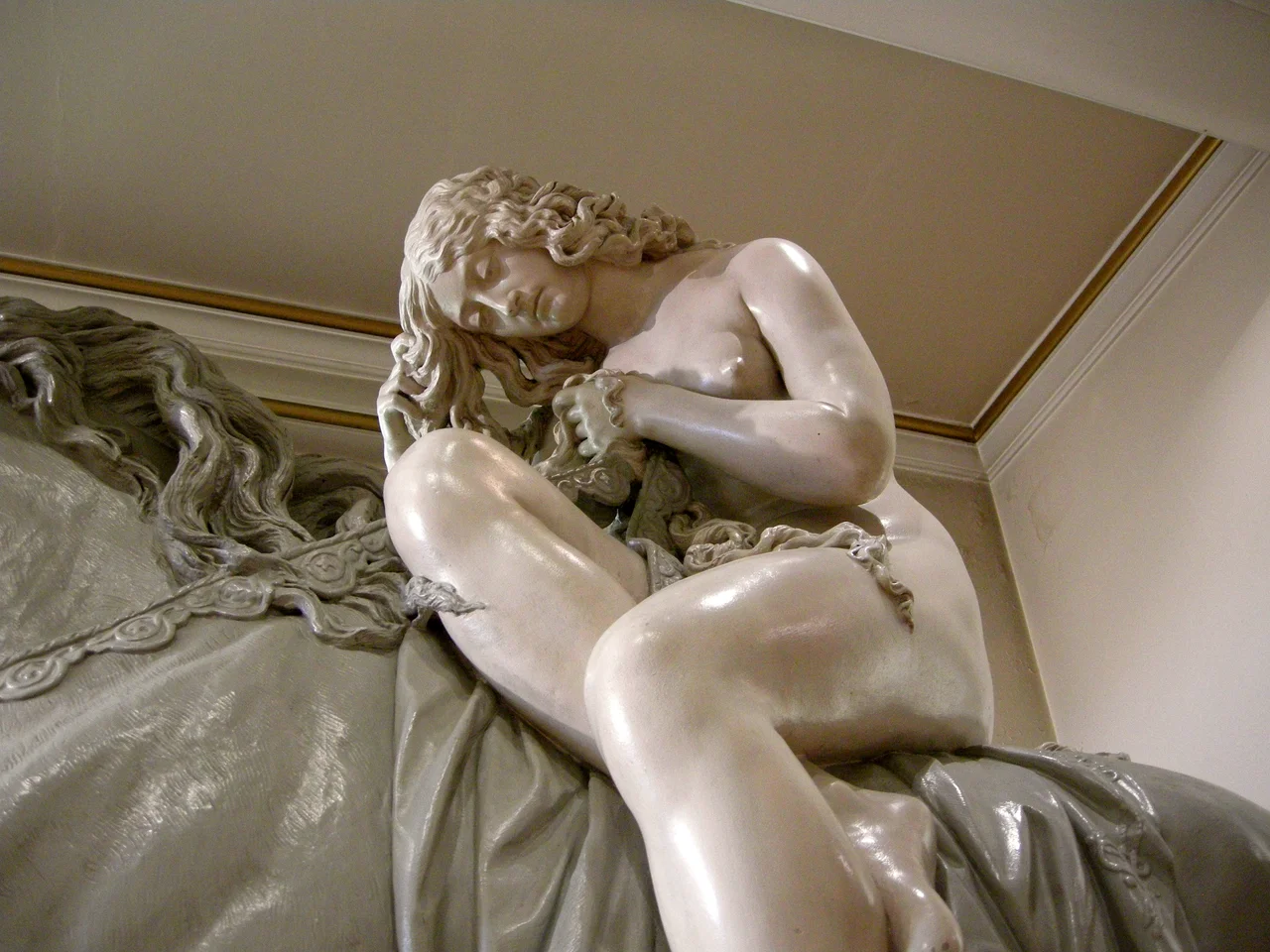
Standing in the sculpture gallery is John Thomas's Lady Godiva. Thomas, who lived from 1813 to 1862, was the sculptor who carved much of the decorative figural work on the Houses of Parliament's exterior. His Godiva is a marble version of the legend: the 11th-century countess riding through Coventry in protest at her husband's taxation of the townspeople. Local visitors have loved it for generations. The Japanese gallery, separately, holds over seven hundred and fifty Edo-period woodblock prints from between 1600 and 1868, plus sword-fittings, netsuke, lacquerwork, and ceramics. It is one of the most studied Japanese collections in Britain - a body of work assembled in an age when Maidstone's traders and travellers came home from East Asia with crates, and decided the town was the right place to house them.
The Hidden Hoard
The natural history holdings run to four hundred and fifty thousand specimens. Among the entomology drawers are roughly two hundred and fifty thousand British insects. The herbarium contains thirty thousand pressed plant specimens, the basis of Eric Philp's Atlas of the Kent Flora. The bird collections include 1,800 mounted British specimens, four hundred foreign birds, and over a thousand cabinet skins, plus three hundred birds' nests and eggs from most species on the British list. Eighteen thousand coins and medals. Eight thousand items of historical costume. Seven hundred English ceramic pieces. The Queen's Own Royal West Kent Regiment Museum, a separate charitable trust, has been a tenant in the building since 1964, displaying over three thousand medals - four of them Victoria Crosses. The museum announces itself quietly: a single Grade II*-listed building on St Faith's Street that, behind its facade, holds more than most visitors expect.
From the Air
Located at 51.276 north, 0.521 east, in central Maidstone on St Faith's Street, north of the River Medway. The building is a 16th-century Elizabethan manor expanded in the 19th century. London Gatwick (EGKK) sits about 25 nautical miles to the west; Manston (EGMH) is 30 nm east. From cruising altitude, the museum is a tight cluster of pitched roofs in the heart of the old town.
Nearby Stories
- Blackwall Tunnel 0.2 km away
- London Gateway 2.6 km away
- Canterbury Castle 4.2 km away
- Battle Abbey 7.4 km away
- Plymouth Brethren 9.9 km away
- The Carrington Event: The Solar Storm That Could Happen Again 12 km away
- Clacton Pier 32 km away
- 2008 Channel Tunnel fire 42 km away