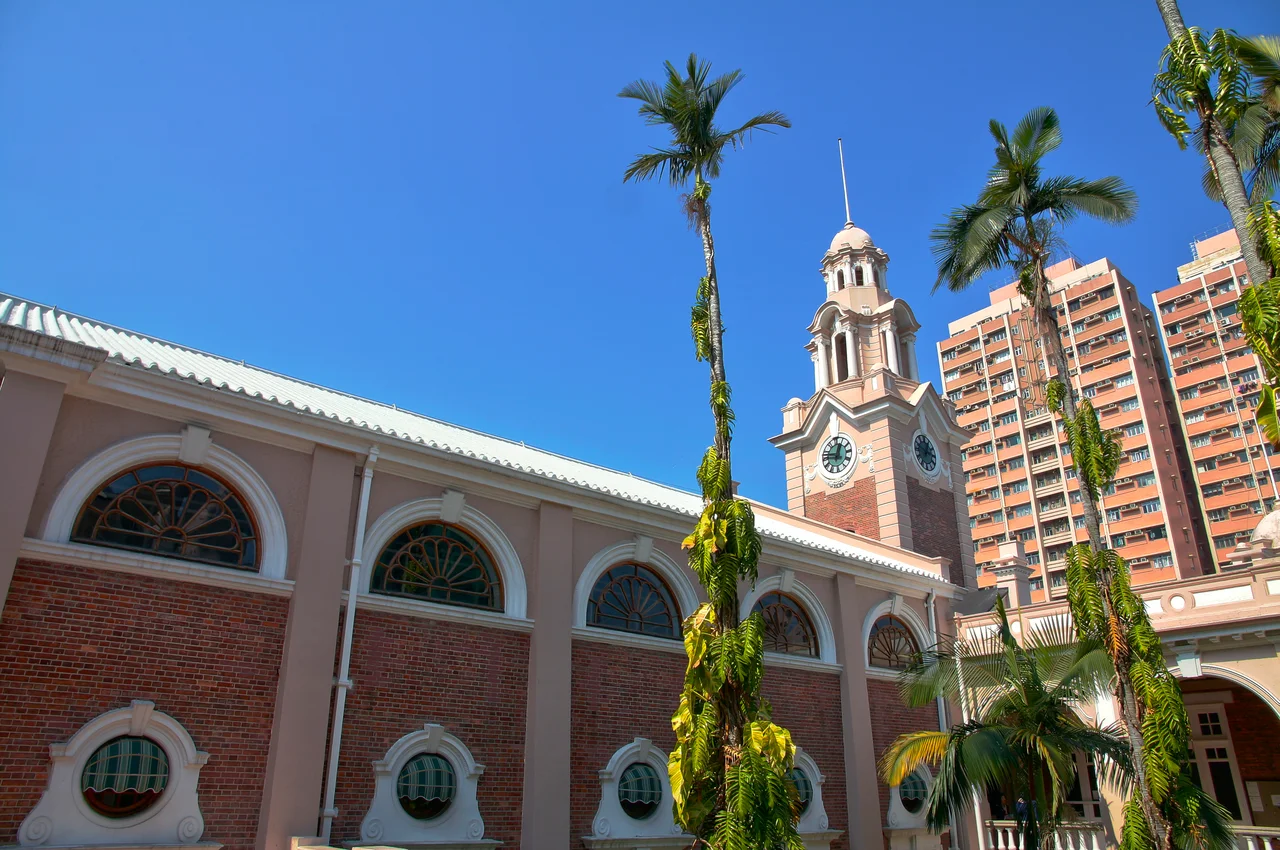

Main Building of the University of Hong Kong
The foundation stone was laid before the building was even finished—a peculiarity of the timeline that the University of Hong Kong's first ceremony did not bother to correct. Construction began in 1910, the inauguration came on 11 March 1912, and the laying of the foundation stone followed five days later on 16 March. Governor Sir Frederick Lugard presided over both events, setting in motion what would become the oldest surviving structure on the campus and one of the most recognizable colonial-era buildings in Hong Kong.
A Parsi Merchant's Gift
The money that built this place came from Sir Hormusjee Naorojee Mody, a Parsi businessman whose family had roots in Bombay and whose fortune had been made in Hong Kong's commercial world. Mody was one of the city's great philanthropists of the era, and his donation to establish the university made a project possible that might otherwise have remained aspirational for years longer. The building he funded—three storeys of Edwardian Baroque rising on the slope of Pokfulam—was designed by Alfred Bryer of the Leigh & Orange architectural firm, the same firm that would leave fingerprints across Hong Kong's colonial built environment. It is worth pausing on what Mody's gift represented: a man whose community was neither British nor Chinese choosing to invest in the education of a place that belonged fully to neither identity.
Edwardian Baroque on a Hong Kong Hillside
Edwardian Baroque is an assertive style—heavy cornices, generous columns, facades that announce themselves before you reach the entrance. On Bonham Road and Pok Fu Lam Road, where the Main Building occupies its campus slope, the architecture reads as a deliberate declaration that this institution belonged to a permanent world. The clock tower is the landmark detail that travelers and students have used for orientation for more than a century. Inside, corridors carry the weight of the institution's history: degree congregations, high-table dinners, the ordinary traffic of academic life accumulating across generations. The exterior has been a declared monument since 1984, meaning Hong Kong's government has formally committed to its preservation—an acknowledgment that the building is more than a facility.
The Building That Was the Whole University
In the early years, the Main Building was not just the oldest structure on campus. It was the entire campus. The University of Hong Kong began here in this single building, which served every function the institution needed: lectures, administration, gatherings. That singular status gave the building an outsized importance in the university's institutional memory. Other structures eventually surrounded it, and the campus grew into the hillside and beyond, but the Main Building remained the address to which everything referred back.
Loke Yew Hall
The building's principal hall was originally called the Grand Hall—a name that conveyed gravitas without specificity. In 1956, the university renamed it Loke Yew Hall, in memory of a Malayan benefactor, Dr Loke Yew, whose support had been important to the university's early development. The renaming was a recognition of the extended network of donors and supporters, often from across Southeast Asia, who had believed in the institution. The name Loke Yew Hall is still in use today, though most people simply refer to the whole structure as the Main Building. Both names point toward the same truth: this building was shaped by people from far beyond Hong Kong's shores.
Monument and Gathering Place
What makes a building a monument is partly the formal declaration and partly the way people continue to use it. The Main Building of HKU functions as both: it holds declared monument status under Hong Kong law, and it remains an active venue for the ceremonies that mark the university's year. Graduation congregations still pass through it. The weight of all those ceremonies—more than a century of them—has settled into the stone and timber in a way that no preservation order could fully manufacture. Standing at the entrance on graduation day, watching students in robes assemble under the Edwardian arcade, the building earns what history has given it.
From the Air
The Main Building of HKU sits at approximately 22.284°N, 114.138°E on the northern slope of Hong Kong Island, in the Pokfulam/Bonham Road area west of Central. From the air at 1,500–3,000 feet heading east along the northern shore of Hong Kong Island from VHHH (Hong Kong International Airport, approximately 10 nautical miles to the west), the campus buildings on the Pokfulam hillside are visible as a cluster of older and modern structures above the expressway. The clock tower of the Main Building is the most identifiable detail at lower altitudes. VHHH is the primary nearby airport; the campus is roughly 2 nautical miles west of Central's high-rise core. Visibility is best in the dry winter months when haze is reduced.
Nearby Stories
- Lok Ma Chau Loop 2.3 km away
- Portas do Cerco 2.3 km away
- Kweilin Incident 17 km away
- Wanshan Archipelago Campaign 34 km away
- Nanxiong Formation 115 km away
- Battle of Nanpeng Island 148 km away
- Heyuan 169 km away
- Cape Maobitou 632 km away